An important set of relations satisfied by Pauli matrices are their commutation relations:
where satisfies , is antisymmetric under permutation of two of its subscripts, and vanishes if two of the subscripts take the same value. More explicitly, this says:
These relations can easily be checked by explicitly computing with the matrices. Putting together equations 3.2 and 3.4 gives a formula for the product of two Pauli matrices:
While physicists prefer to work with the self-adjoint Pauli matrices and their real eigenvalues, the skew-adjoint matrices
can instead be used. These satisfy the slightly simpler commutation relations
or more explicitly
The non-triviality of the commutators reflects the non-commutativity of the group. Group elements near the identity satisfy
for small and real, just as group elements near the identity satisfy
The and their commutation relations can be thought of as an infinitesimal version of the full group and its group multiplication law, valid near the identity. In terms of the geometry of manifolds, recall that is the space . The give a basis of the tangent space to the identity of , just as gives a basis of the tangent space to the identity of .
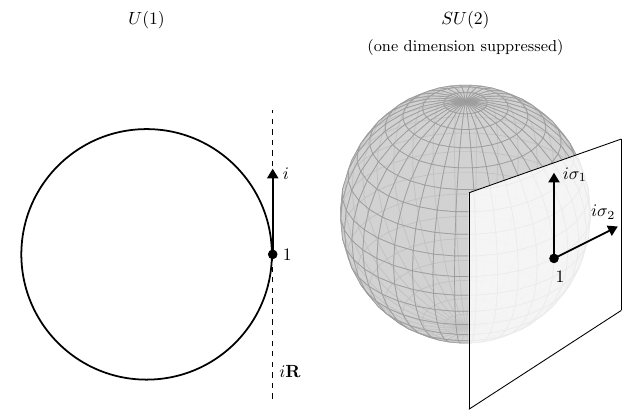 Figure 3.1: Comparing the geometry of as to the geometry of as .
来源与版本
正文:英文 · 原著转录
核对状态:AI 辅助转录核对,未作人工审阅
原书 PDF · 印刷页 30、31
来源版本:2025-10-20
来源 PDF SHA-256:5a1941b2443b54d5db3d055f1e5ba390429b7a728475258017aaac87ee85a837