We have defined a group representation as a homomorphism (a map of groups preserving group multiplication)
We can similarly define a Lie algebra representation as a map of Lie algebras preserving the Lie bracket:
Definition · Lie algebra representation
A (complex) Lie algebra representation of a Lie algebra on an dimensional complex vector space is given by a real-linear map
satisfying
Such a representation is called unitary if its image is in , i.e., if it satisfies
More concretely, given a basis of a Lie algebra of dimension with structure constants , a representation is given by a choice of complex dimensional matrices satisfying the commutation relations
The representation is unitary when the matrices are skew-adjoint.
The notion of a Lie algebra representation is motivated by the fact that the homomorphism property causes the map to be largely determined by its behavior infinitesimally near the identity, and thus by the derivative . One way to define the derivative of such a map is in terms of velocity vectors of paths, and this sort of definition in this case associates to a representation a linear map
where
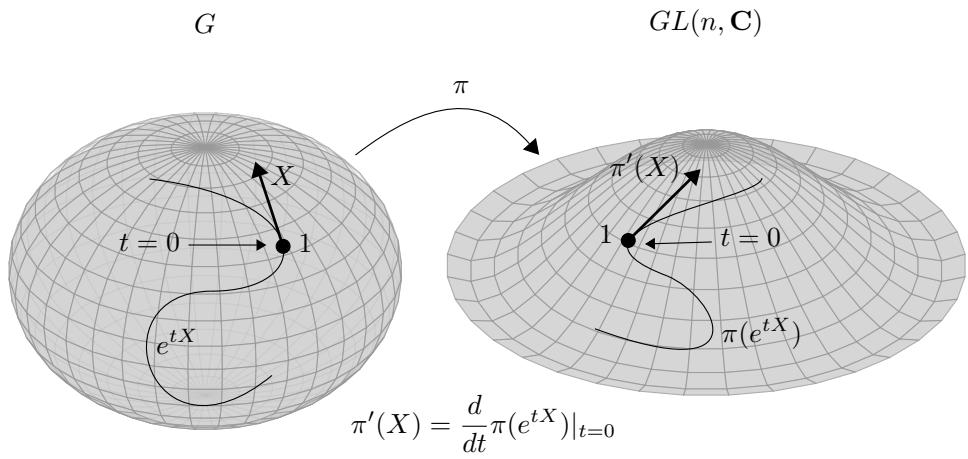 Figure 5.1: Derivative of a representation , illustrated in terms of “velocity” vectors along paths.
For the case of we classified in theorem 2.3 all irreducible representations (homomorphisms ) by looking at the derivative of the map at the identity. For general Lie groups , something similar can be done, showing that a representation of gives a representation of the Lie algebra (by taking the derivative at the identity), and then trying to classify Lie algebra representations.
Theorem
Proof
Proof. 1. We have
So satisfies the differential equation with initial condition . This has the unique solution .
- We have
Diferentiating with respect to at gives
- Recall equation 5.1:
so
This theorem shows that we can study Lie group representations by studying the corresponding Lie algebra representation . This will generally be much easier since the are linear maps. Unlike the non-linear maps , the map is determined by its value on basis elements of . The will satisfy the same bracket relations as the (see equation 5.2). We will proceed in this manner in chapter 8 when we construct and classify all and representations, finding that the corresponding Lie algebra representations are much simpler to analyze. Note though that representations of the Lie algebra do not necessarily correspond to representations of the group (when they do they are called “integrable”). For a simple example, looking at the proof of theorem 2.3, one gets unitary representations of the Lie algebra of for any value of the constant , but these are only representations of the group when is integral.
For any Lie group we have seen that there is a distinguished representation, the adjoint representation . The corresponding Lie algebra representation is also called the adjoint representation, but written as From the fact that
we can differentiate with respect to and use equation 5.1 to get the Lie algebra representation
This leads to the definition:
Definition · Adjoint Lie algebra representation
is the Lie algebra representation given by
where is defined as the linear map from to itself given by
Note that this linear map , which can be written as , can be thought of as the infinitesimal version of the conjugation action
The Lie algebra homomorphism property of says that
where these are linear maps on , with ◦ composition of linear maps, so operating on we have
Using our expression for as a commutator, we find
This is called the Jacobi identity. It could have been more simply derived as an identity about matrix multiplication, but here we see that it is true for a more abstract reason, reflecting the existence of the adjoint representation. It can be written in other forms, rearranging terms using antisymmetry of the commutator, with one example the sum of cyclic permutations
Lie algebras can be defined much more abstractly as follows:
Definition · Abstract Lie algebra
An abstract Lie algebra over a field is a vector space over , with a bilinear operation
satisfying
- Antisymmetry:
- Jacobi identity:
Such Lie algebras do not need to be defined as matrices, and their Lie bracket operation does not need to be defined in terms of a matrix commutator (although the same notation continues to be used). Later on we will encounter important examples of Lie algebras that are defined in this more abstract way.
来源与版本
正文:英文 · 原著转录
核对状态:AI 辅助转录核对,未作人工审阅
原书 PDF · 印刷页 54、55、56、57、58
来源版本:2025-10-20
来源 PDF SHA-256:5a1941b2443b54d5db3d055f1e5ba390429b7a728475258017aaac87ee85a837