Linear functionals
A linear functional on a vector space over a field is a linear map , where the field ofscalars is regarded as a one-dimensional vector space, spanned by the element 1,
The use ofthe phrase linearfunctional in place of‘linear function’ is largely adopted with infinite dimensional spaces in mind. For example, if is the space of continuous functions on the interval and is an integrable function on [0, 1], let be defined by
As the linear map is a function whose argument is another function, the terminology ‘linear functional’ seems more appropriate. In this case it is common to write the action of on the function as in place of
If is any linearfunctional then its kernel has codimension 1. Conversely, any subspace ofcodimension 1 defines a linearfunctional on uniquely up to a scalarfactor, such that
Proof
The first part of the theorem follows from Example 3.22 and Eq. (3.3),
To prove the converse, let be any vector not belonging to – if no such vector exists then and the codimension is 0. The set ofcosets where form a one-dimensional vector space that must be identical with all of . Every vector therefore has a unique decomposition where , since
A linear functional having kernel has , for then the kernel of is all of . Furthermore, given any non-zero scala , these two requirements define a linear functional on as its value on any vector is uniquely determined by
If is any other such linear functional, having , then since -
This proofeven applies, as it stands, to infinite dimensional spaces, although in that case it is usual to impose the added stipulation that linear functionals be continuous (see Section 10.9 and Chapter 13).
If and are linear functionals on , show that
Let , where is any integer or possibly . For conve nience, we will take to be the space ofrow vectors oflength here. Let be the subspace of vectors
This is a subspace of codimension 1, for if we set , then any vector can be written
where and . This decomposition is unique, for if then . Hence and , since . Every coset can therefore be uniquely expressed as , and has codimension 1.
Let be the linear functional such that . Then , so that
The kernel of is evidently , and every other linear functional having kernel is of the form
The dual space of a vector space
As for general linear maps, it is possible to add linear functionals and multiply them by scalars,
With respect to these operations the set oflinear functionals on forms a vector space over called the dual space of , usually denoted . In keeping with earlier conventions, other possible notations for this space are or . Frequently, linear functionals on will be called covectors, and in later chapters we will have reason to refer to them as 1-forms.
Let be a finite dimensional vector space, , and any basis for . A linear functional on is uniquely defined by assigning its values on the basis vectors,
since the value on any vector can be determined using linearity Eq. (3.24),
Define linear functionals by
where is the Kronecker delta defined in Eq. (3.14). Note that these equations uniquely define each linear functional , since their values are assigned on each basis vector in turn.
The -linearfunctionals form a basis of , called the dual basis to . Hence .
Proof
Firstly, suppose there are scalars such that
Applying the linear functional on the left-hand side of this equation to an arbitrary basis vector
shows that the linear functionals are linearly independent. Furthermore these linear functions span since every linear functional on can be written
This follows from
Thus and have the same effect on every vector ; they are therefore identical linear functionals. The proposition that follows from Corollary 3.4.
Show that the expansion Eq. (3.27) is unique; i.e., if then for each
Given a basis , we will frequently refer to the numbers as the components of the linear functional in this basis. Alternatively, we can think ofthem as the components of with respect to the dual basis in . The formula Eq. (3.25) has a somewha deceptive ‘dot product’ feel about it. In Chapter 5 a dot product will be correctly defined as a product between vectors from the same vector space, while Eq. (3.25) is a product between vectors from different spaces and . It is, in fact, better to think of the components of a vector from as forming a column vector, while the components of a linea functional form a row vector. The above product then makes sense as a matrix product between a row matrix and an column matrix. While a vector is often thought of geometrically as a directed line segment, often represented by an arrow, this is not a good way to think of a covector. Perhaps the best way to visualize a linear functional is as a set of parallel planes of vectors determined by . (see Fig. 3.3).
Dual of the dual
We may enquire whether this dualizing process can be continued to generate further vector spaces such as the dual of the dual space , etc. For finite dimensional spaces the process essentially stops at the first dual, for there is a completely natural way in which can be identified with . To understand how itself can be regarded as the dual space of , define a linear map corresponding to any vector by
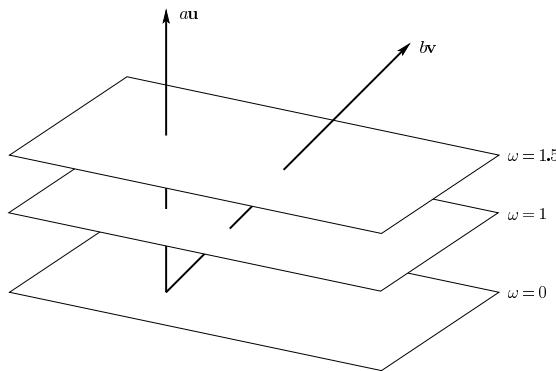 Figure 3.3 Geometrical picture of a linear functional
The map is a linear functional on , since
The map defined by is linear, since
As this holds for arbitrary covectors we have . Furthermore if is a basis of with dual basis , then
and it follows from Theorem 3.9 that is the basis of dual to the basis of . The map is therefore onto since every can be written in the form
Since is a basis, it follows from Theorem 3.5 that the components , and therefore the vector , are uniquely determined by . The map is thus a vector space isomorphism, as it is both onto and one-to-one.
We have shown that . In itself this is to be expected since these spaces have the same dimension, but the significant thing to note is that since the defining Eq. (3.28) makes no mention of any particular choice of basis, the correspondence between and is totally natural. There is therefore no ambiguity in identifying with and rewriting Eq. (3.28) as
This reciprocity between the two spaces and lends itself to the following alternative notations, which will be used interchangeably throughout this book:
However, it should be pointed out that the identification of and will only work for finite dimensional vector spaces. In infinite dimensional spaces, every vector may be regarded as a linear functional on in a natural way, but the converse is not true – there exist linear functionals on that do not correspond to vectors from
Transformation law of covector components
By Theorem 3.9 the spaces and are in one-to-one correspondence since they have the same dimension, but unlike that described above between and this correspondence is not natural. For example, if is a vector in let be the linear functional whose components in the dual basis are exactly the same as the components of the original vector, . While the map is a vector space isomorphism, the same rule applied with respect to a different basis will generally lead to a different correspondence between vectors and covectors. Thus, given an arbitrary vector there is no basis-independent way ofpointing to a covector partner in . Essentially this arises from the fact that the law of transformation of components of a linear functional is different from the transformation law of components for a vector.
We have seen in Section 3.6 that the transformation of a basis can be written by Eqs. Eq. (3.16) and Eq. (3.20),
where and are related through the inverse matrix equations Eq. (3.19). Let and be the dual bases corresponding to the bases and respectively of ,
Set
and substituting this and Eq. (3.30) into the first identity of Eq. (3.31) gives, after replacing the index by ,
Hence and the transformation of the dual basis is
If is a linear functional having components with respect to the first basis, then
where
This is known as the covariant vector transformation law of components. Its inverse is
These equations are to be compared with the contravariant vector transformation law of components of a vector , given by Eqs. Eq. (3.17) and Eq. (3.21),
Verify directly from Eq. (3.34) and Eq. (3.36) that Eq. (3.25) is basis-independent,
Show that if the components of are displayed as a row matrix then the transformation law Eq. (3.34) can be written as a matrix equation
Problems
Find the dual basis to the basis of having column vector representation
Let be the vector space of real polynomials If is any sequence of real numbers, show that the map given by
is a linear functional on
Show that every linear functional on can be obtained in this way from such a sequence and hence that
Define the annihilator of a subset as the set of all linear functionals tha vanish on ,
(a) Show that for any subset is a vector subspace of .
(b) If , show that
(c) If is a vector subspace of , show that . [Hint: For each in define the element by
(d) Show that
(e) If is finite dimensional with and is any subspace of with , show that . [Hint: Use a basis adapted to the subspace by Theorem 3.7 and conside its dual basis in
(f) Adopting the natural identification of and , show that
Let be a vector in the vector space of dimension .
(a) If is a linear functional on such that , show that a basis can be chosen such that
where is the dual basis. [Hint: Apply Theorem 3.7 to the vector and try a further basis transformation of the form
(b) If , show that the basis may be chosen such that
For the three-dimensional basis transformation of Problem 3.13 evaluate the dual to in terms of the dual basis . What are the components of the linear functiona with respect to the new dual basis?
If is a linear operator, define its transpose to be the linear map : such that
Show that this relation uniquely defines the linear operator and that
(a) Show that
(b) If is an invertible operator then show that
(c) If is finite dimensional show that , if we make the natural identification of and .
(d) Show that the matrix of components of the transpose map with respect to the dual basis is the transpose of the matrix of
(e) Using Problem 3.16 show that
(f) Use Eq. (3.10) to show that the rank of equals the rank of .
The row rank ofa matrix is defined as the maximum number oflinearly independen rows, while its column rank is the maximum number of linearly independent columns.
(a) Show that the rank of a linear operator on a finite dimensional vector space is equal to the column rank of its matrix with respect to any basis of .
(b) Use parts (d) and (f) of Problem 3.19 to show that the row rank of a square matrix is equal to its column rank.
Let be a linear operator on a vector space
(a) Show that the rank of is one, , if and only if there exists a non-zero vector and a non-zero linear functional such tha
(b) With respect to any basis of and its dual basis , show that
(c) Show that every linear operator A of rank can be written as a sum of linear operators of rank one.
(d) Show that the last statement is equivalent to the assertion that for every matrix of rank there exist column vectors and such that