2.2.1 Vectors and vector spaces
A vector space (or a linear space) over a field is a set in which two operations, addition and multiplication by an element of (called a scalar), are defined. (In this book we are mainly interested in and .) The elements (called vectors) of satisfy the following axioms:
(i) .
(ii)
(iii) There exists a zero vector such that
(iv) For any , there exists , such that .
(v)
(vi)
(vii)
(viii)
Here and and 1 is the unit element of
Let be a set of vectors. If the equation
has a non-trivial solution, for some , the set of vectors is called linearly dependent, while if (2.6) has only a trivial solution, for any , is said to be linearly independent. If at least one of the vectors is a zero vector , the set is always linearly dependent.
A set of linearly independent vectors is called a basis of , if any element is written uniquely as a linear combination of :
The numbers are called the components of with respect to the basis . If there are elements in the basis, the dimension of is , denoted by . We usually write the -dimensional vector space over as (or simply if and are understood from the context). We assume is finite.
2.2.2 Linear maps, images and kernels
Given two vector spaces and , a map is called a linear map if it satisfies for any and . A linear map is an example of a homomorphism that preserves the vector addition and the scalar multiplication. The image of is and the kernel of is and denoted by and respectively. cannot be empty since is always . If is the field itself, is called a linear function. If is an isomorphism, is said to be isomorphic to and vice versa, denoted by . It then follows that . In fact, all the -dimensional vector spaces are isomorphic to , and they are regarded as identical vector spaces. The isomorphism between the vector spaces is an element of .
If is a linear map, then
Proof
Since is a linear map, it follows that and are vector spaces, see exercise 2.8. Let the basis of be and that of be . For each ( ), take such that and consider the set of vectors .
Now we show that these vectors form a linearly independent basis of . Take an arbitrary vector . Since , it can be expanded as . From the linearity of , it then follows that , that is . This shows that an arbitrary vector is a linear combination of . Thus, is spanned by vectors. Next let us
assume . Then , which implies that . Then it follows from that , and the set is linearly independent in . Finally we find .
[Remark: The vector space spanned by is called the orthogonal complement of and is denoted by .]
(1) Let be a linear map. Show that both and are vector spaces.
(2) Show that a linear map is an isomorphism if and only if .
2.2.3 Dual vector space
The dual vector space has already been introduced in section 1.2 in the context of quantum mechanics. The exposition here is more mathematical and complements the materials presented there.
Let be a linear function on a vector space over a field . Let be a basis and take an arbitrary vector . From the linearity of , we have . Thus, if we know for all , we know the result of the operation of on any vector. It is remarkable that the set of linear functions is made into a vector space, namely a linear combination of two linear functions is also a linear function.
This linear space is called the dual vector space to and is denoted by or simply by . If is finite, is equal to . Let us introduce a basis of . Since is a linear function it is completely specified by giving for all . Let us choose the dual basis,
Any linear function , called a dual vector in this context, is expanded in terms of ,
The action of on is interpreted as an inner product between a column vector and a row vector,
We sometimes use the notation to denote the inner product.
Let and be vector spaces with a linear map and let be a linear function on ( ). It is easy to see that the
composite map is a linear function on . Thus, and give rise to an element defined by
Given , a map has induced a map . Accordingly, we have an induced map defined by , see figure 2.9. The map is called the pullback of by .
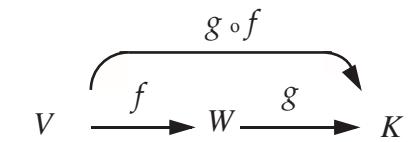
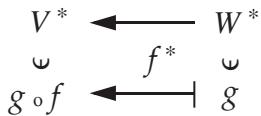
Figure 2.9. The pullback of a function is a function .
Since , there exists an isomorphism between and . However, this isomorphism is not canonical; we have to specify an inner product in to define an isomorphism between and and vice versa, see the next section. The equivalence of a vector space and its dual vector space will appear recurrently in due course.
Suppose is another basis of and the dual basis. In terms of the old basis, is written as where . Show that the dual bases are related by .
2.2.4 Inner product and adjoint
Let be a vector space with a basis and let be a vector space isomorphism , where is an arbitrary element of . The component representation of is
Once this isomorphism is given, we may define the inner product of two vectors by
Let us assume that the field is a real number . For definiteness. Then equation (2.15) has a component expression,
We require that the matrix be positive definite so that the inner product has the meaning of the squared norm of . We also require that the metric be symmetric: so that .
Next, let be a vector space with a basis and a vector space isomorphism . Given a map , we may define the adjoint of , denoted by , by
where and . It is easy to see that . The component expression of equation (2.17) is
where and are the matrix representations of and respectively. If and , the adjoint reduces to the transpose of the matrix .
Let us show that . Since (2.18) holds for any and , we have , that is
Making use of the result of the following exercise, we obtain , where the rank of a map is defined by that of the corresponding matrix (note that and ). It is obvious that is the rank of a matrix representing the map and we conclude .
Let and and let be a matrix corresponding to a linear map from to . Verify that , where and .
Let be a vector space over . The inner product of two vectors and is defined by
where denotes the complex conjugate. From the positivity and symmetry of the inner product, , the vector space isomorphism is required to be a positive-definite Hermitian matrix. Let be a (complex) linear map and be a vector space isomorphism. The adjoint of is defined by . Repeat the analysis to show that
(a) , where denotes the Hermitian conjugate, and
(b)
Theorem 2.2 · Toy index theorem
Let and be finite-dimensional vector spaces over a field and let be a linear map. Then
Proof
Theorem 2.1 tells us that
and, if applied to
We saw earlier that , from which we obtain
Note that in (2.21), each term on the LHS depends on the details of the map . The RHS states, however, that the difference in the two terms is independent of ! This may be regarded as a finite-dimensional analogue of the index theorems, see chapter 12.
2.2.5 Tensors
A dual vector is a linear object that maps a vector to a scalar. This may be generalized to multilinear objects called tensors, which map several vectors and dual vectors to a scalar. A tensor of type is a multilinear map that maps dual vectors and vectors to ,
For example, a tensor of type maps a vector to a real number and is identified with a dual vector. Similarly, a tensor of type is a vector. If maps a dual vector and two vectors to a scalar, , is of type .
The set of all tensors of type is called the tensor space of type and denoted by . The tensor product is an element of defined by
Another operation in a tensor space is the contraction, which is a map from a tensor space of type to type defined by
where and are the dual bases.
Let and be vector spaces and let be a linear map. Show that is a tensor of type (1, 1).
来源与版本
正文:英文 · OCR 机器稿 · 待校对
核对状态:OCR 机器稿 · 待校对
来源版本:second-edition-local
来源 PDF SHA-256:fcd24c3371d092a8c699ccf5cf0765462924b6c48412804231076e8084b1940d
OCR 来源 SHA-256:0b6324f01172a3548cd34382e82fd8bfae574602b6b2cfaa357ba96bc2c35478
OCR 产物 SHA-256:436ced56c0c01f49350960e335a3c505e9f2b64c0d47795ff03ab4590006d908