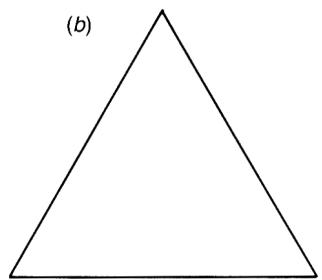
Among the topological invariants the Euler characteristic is a quantity readily computable by the ‘polyhedronization’ of space. The homology groups are refinements, so to speak, of the Euler characteristic. Moreover, we can easily read off the Euler characteristic from the homology groups. Let us look at figure 3.1. In figure , the interior is included but not in figure . How do we characterize this difference? An obvious observation is that the three edges of figure form a boundary of the interior while the edges of figure do not (the interior is not a part of figure ). Clearly the edges in both cases form a closed path (loop), having no boundary. In other words, the existence of a loop that is not a boundary of some area implies the existence of a hole within the loop. This is our guiding principle in classifying spaces here: find a region without boundaries, which is not itself a boundary of some region. This principle is mathematically elaborated into the theory of homology groups.
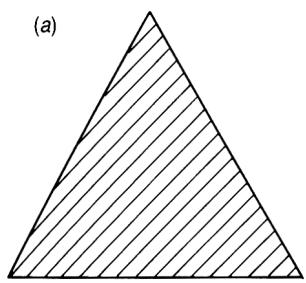
Figure 3.1. (a) is a solid triangle while (b) is the edges of a triangle without an interior.
Our exposition follows Armstrong (1983), Croom (1978) and Nash and Sen (1983). An introduction to group theory is found in Fraleigh (1976).
Problems
来源与版本
正文:英文 · OCR 机器稿 · 待校对
核对状态:OCR 机器稿 · 待校对
来源版本:second-edition-local
来源 PDF SHA-256:fcd24c3371d092a8c699ccf5cf0765462924b6c48412804231076e8084b1940d
OCR 来源 SHA-256:0b6324f01172a3548cd34382e82fd8bfae574602b6b2cfaa357ba96bc2c35478
OCR 产物 SHA-256:10f06c47cd9a108df9b4845baf4273528401a35b5385b8a9f5c3718f07f91262