4.1.1 Basic ideas
Let us look at figure 4.1. One disc has a hole in it, the other does not. What characterizes the difference between these two discs? We note that any loop in figure can be continuously shrunk to a point. In contrast, the loop in figure cannot be shrunk to a point due to the existence of a hole in it. Some loops in figure may be shrunk to a point while others cannot. We say a loop is homotopic to if can be obtained from by a continuous deformation. For example, any loop in is homotopic to a point. It turns out that ‘homotopic to’ is an equivalence relation, the equivalence class of which is called the homotopy class. In figure 4.1, there is only one homotopy class associated with . In , each homotopy class is characterized by , being the number of times the loop encircles the hole; if it winds clockwise, if counterclockwise, if the loop does not wind round the hole. Moreover, is an additive group and the group operation (addition) has a geometrical meaning; corresponds to going round the hole first times and then times. The set of homotopy classes is endowed with a group structure called the fundamental group.
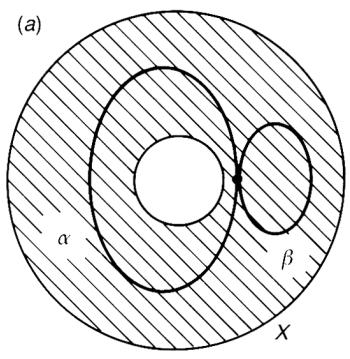
Figure 4.1. A disc with a hole and without a hole . The hole in prevents the loop from shrinking to a point.
4.1.2 Paths and loops
Let be a topological space and let . A continuous map is called a path with an initial point and an end point if and . If , the path is called a loop with base point (or a loop at ).
For , a constant path is defined by . A constant path is also a constant loop since . The set of paths or loops in a topological space may be endowed with an algebraic structure as follows.
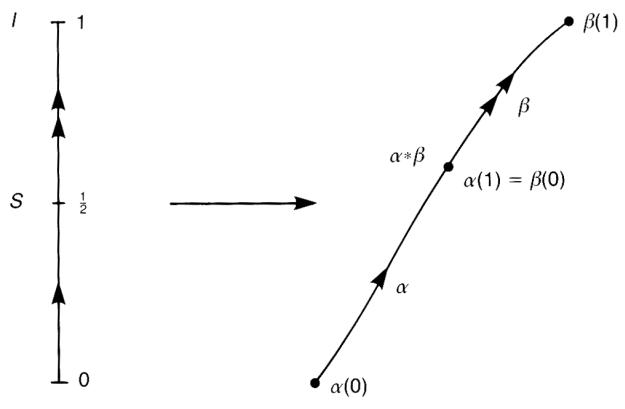
Let be paths such that . The product of and , denoted by , is a path in defined by
see figure 4.2. Since , is a continuous map from to . [Geometrically, corresponds to traversing the image , in the first half, then followed by in the remaining half. Note that the velocity is doubled.]
Figure 4.2. The product of paths and with a common end point.
Let be a path from to . The inverse path of is defined by
[The inverse path corresponds to traversing the image of in the opposite direction from to .]
Since a loop is a special path for which the initial point and end point agree, the product of loops and the inverse of a loop are defined in exactly the same way.
It seems that a constant map is the unit element. However, it is not: is not equal to . We need a concept of homotopy to define a group operation in the space of loops.
4.1.3 Homotopy
The algebraic structure of loops introduced earlier is not so useful as it is. For example, the constant path is not exactly the unit element. We want to classify the paths and loops according to a neat equivalence relation so that the equivalence classes admit a group structure. It turns out that if we identify paths or loops that can be deformed continuously one into another, the equivalence classes form a group. Since we are primarily interested in loops, most definitions and theorems are given for loops. However, it should be kept in mind that many statements are also applied to paths with proper modifications.
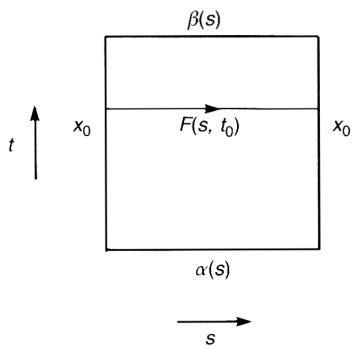
Let be loops at . They are said to be homotopic, written as , if there exists a continuous map such that
The connecting map is called a homotopy between and .
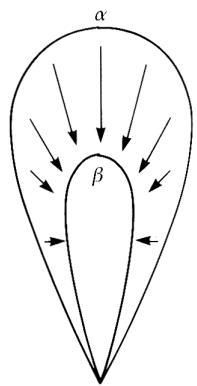
It is helpful to represent a homotopy as figure 4.3(a). The vertical edges of the square are mapped to . The lower edge is while the upper edge is . In the space , the image is continuously deformed as in figure 4.3(b).
(a)
(b)
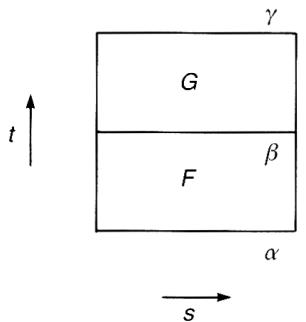
Figure 4.3. (a) The square represents a homotopy interpolating the loops and . (b) The image of is continuously deformed to the image of in real space .
Figure 4.4. A homotopy between and via .
The relation is an equivalence relation.
Proof
Reflectivity: . The homotopy may be given by for any .
Symmetry: Let with the homotopy such that , . Then , where the homotopy is given by .
Transitivity: Let and . Then . If is a homotopy between and and is a homotopy between and , a homotopy between and may be (figure 4.4)
4.1.4 Fundamental groups
The equivalence class of loops is denoted by and is called the homotopy class of . The product between loops naturally defines the product in the set of homotopy classes of loops.
Let be a topological space. The set of homotopy classes of loops at is denoted by and is called the fundamental group (or the first homotopy group) of at . The product of homotopy classes and is defined by
The product of homotopy classes is independent of the representative, that is, if and , then .
Proof
Let be a homotopy between and and be a homotopy between and . Then
is a homotopy between and , hence and is well defined.
The fundamental group is a group. Namely, if are loops at , the following group properties are satisfied:
(1)
(2) and (unit element)
(3) , hence (inverse).
Proof
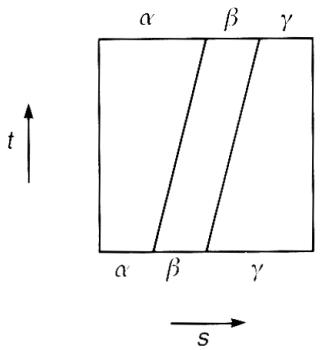
(1) Let be a homotopy between and . It may be given by (figure 4.5(a))
(a)
(b)
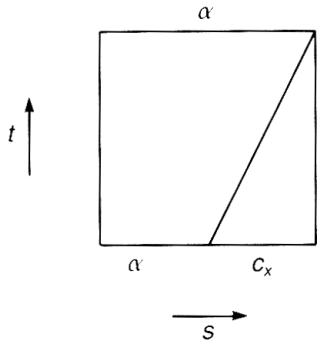
Figure 4.5. (a) A homotopy between and . (b) A homotopy between and .
Thus, we may simply write to denote or
(2) Define a homotopy by (figure 4.5(b))
Clearly this is a homotopy between and . Similarly, a homotopy between and is given by
This shows that .
(3) Define a map by
Clearly and , hence
This shows that .
In summary, is a group whose unit element is the homotopy class of the constant loop . The product is well defined and satisfies the
group axioms. The inverse of is . In the next section we study the general properties of fundamental groups, which simplify the actual computations.
来源与版本
正文:英文 · OCR 机器稿 · 待校对
核对状态:OCR 机器稿 · 待校对
来源版本:second-edition-local
来源 PDF SHA-256:fcd24c3371d092a8c699ccf5cf0765462924b6c48412804231076e8084b1940d
OCR 来源 SHA-256:0b6324f01172a3548cd34382e82fd8bfae574602b6b2cfaa357ba96bc2c35478
OCR 产物 SHA-256:eb3fbe5cd99cf392d62770ba12dcb15764d8e1bb679bd3c6035a41824ec14c3b