There does not exist a routine procedure to compute the fundamental groups, in general. However, in certain cases, they are obtained by relatively simple considerations. Here we look at the fundamental groups of the circle and related spaces.
Let us express as . Define a map by . Under , the point is mapped to , which is taken to be the base point. We imagine that wraps around under , see figure 4.9. If satisfies , they are mapped to the same point in . Then we write . This is an equivalence relation and the equivalence class is identified with a point . It then follows that . Let be a continuous map such that and . It is obvious that for any , where is a fixed integer. If , we have
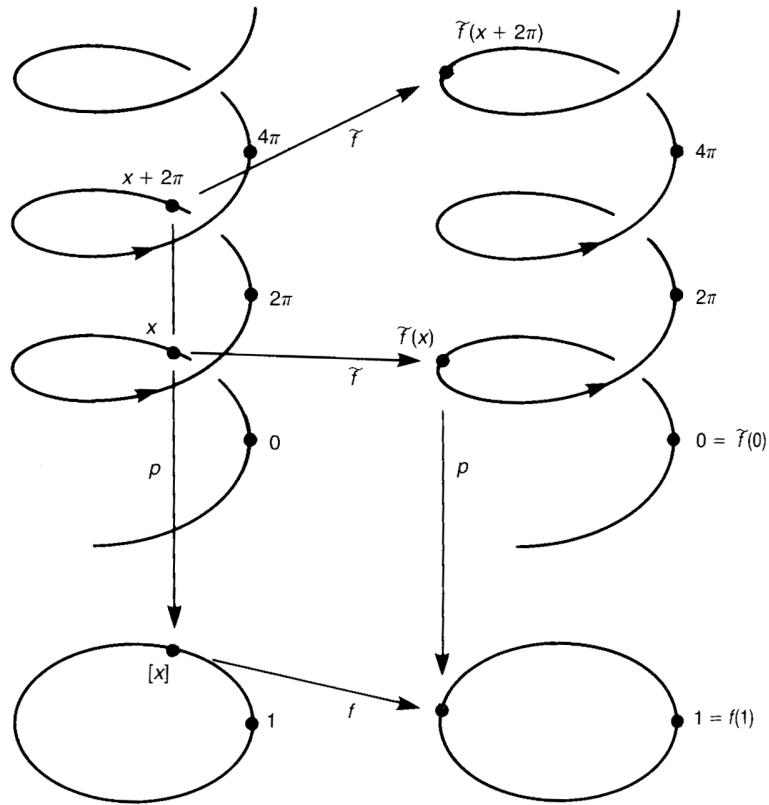
Figure 4.9. The map defined by projects to the same point on , while , such that and for fixed , defines a map . The integer specifies the homotopy class to which belongs.
hence . Accordingly, uniquely defines a continuous map by , see figure 4.9. Note that keeps the base point fixed. Conversely, given a map , which leaves fixed, we may define a map such that and .
In summary, there is a one-to-one correspondence between the set of maps from to with and the set of maps from to such that and . The integer is called the degree of and is denoted by . While encircles once, encircles times.
(1) Let such that . Then if and only if is homotopic to .
(2) For any , there exists a map such that .
Proof
(1) Let and be the corresponding maps. Then is a homotopy between and . It is easy to verify that is a homotopy between and . Conversely, if , there exists a homotopy such that for any . The corresponding homotopy between and satisfies for some . Thus, .
(2) induces a map with
Lemma 4.2 tells us that by assigning an integer to a map such that , there is a bijection between and . Moreover, this is an isomorphism. In fact, for , , defined as a product of loops, satisfies . [Let and . Then . Note that is not a composite of maps but a product of paths.] We have finally proved the following theorem.
The fundamental group of is isomorphic to ,
[Since is arcwise connected, we may drop the base point.]
Although the proof of the theorem is not too obvious, the statement itself is easily understood even by children. Suppose we encircle a cylinder with an elastic band. If it encircles the cylinder times, the configuration cannot be continuously deformed into that with encirclements. If an elastic band encircles a cylinder first times and then times, it encircles the cylinder times in total.
4.3.1 Fundamental group of torus
Let and be arcwise connected topological spaces. Then is isomorphic to .
Proof
Define projections and . If is a loop in at , is a loop in at , and is a loop in at . Conversely, any pair of loops of at and of at determines a unique loop of at . Define a homomorphism by
By construction has an inverse, hence it is the required isomorphism and .
(1) Let be a torus. Then
Similarly, for the -dimensional torus
we have
(2) Let be a cylinder. Since , we have
来源与版本
正文:英文 · OCR 机器稿 · 待校对
核对状态:OCR 机器稿 · 待校对
来源版本:second-edition-local
来源 PDF SHA-256:fcd24c3371d092a8c699ccf5cf0765462924b6c48412804231076e8084b1940d
OCR 来源 SHA-256:0b6324f01172a3548cd34382e82fd8bfae574602b6b2cfaa357ba96bc2c35478
OCR 产物 SHA-256:fbb5f8fa5306199edb11c4d2d6133161956da79edd6675a159efadc51787da69