Recall from chapter 1 the claim of a general principle that, when the state space is a unitary representation of a Lie group, we get an associated self-adjoint operator on . We’ll now illustrate this for the simple case of , where the self-adjoint operator we construct will be called the charge operator and denoted
If the representation of on is irreducible, by theorem 2.2 it must be one dimensional with . By theorem 2.3 it must be of the form for some . In this case the self-adjoint operator is multiplication of elements of by the integer Note that the integrality condition on is needed because of the periodicity condition on corresponding to the fact that we are working with the group , not the group .
For a general representation, by theorems 2.1 and 2.3 we have
for some set of integers ( is the dimension of , the may not be distinct), where is a copy of , with acting by the representation. One can then define
Definition · Charge operator
The charge operator for the representation is the self-adjoint linear operator on that acts by multiplication by on the irreducible sub-representation . Taking basis elements in it acts on as the matrix
Thinking of as a quantum mechanical state space, is our first example of a quantum mechanical observable, a self-adjoint operator on . States in the subspaces will be eigenvectors for and will have a well-defined numerical value for this observable, the integer . A general state will be a linear superposition of state vectors from different and there will not be a well-defined numerical value for the observable on such a state.
The representation can be recovered from the action of on with the action of the group on given by multiplying by and exponentiating, to get
The standard physics terminology is that “ is the generator of the action by unitary transformations on the state space ”.
The general abstract mathematical point of view (which we will discuss in much more detail in chapter 5) is that a representation is a map between manifolds, from the Lie group to the Lie group , that takes the identity of to the identity of . As such it has a differential which is a linear map from the tangent space at the identity of (which here is ) to the tangent space at the identity of (which is the space of by complex matrices). The tangent space at the identity of a Lie group is called a “Lie algebra”. In later chapters we will study many different examples of such Lie algebras and such maps , with the linear map often determining the representation
In the case, the relation between the differential of and the operator is
The following drawing illustrates the situation:
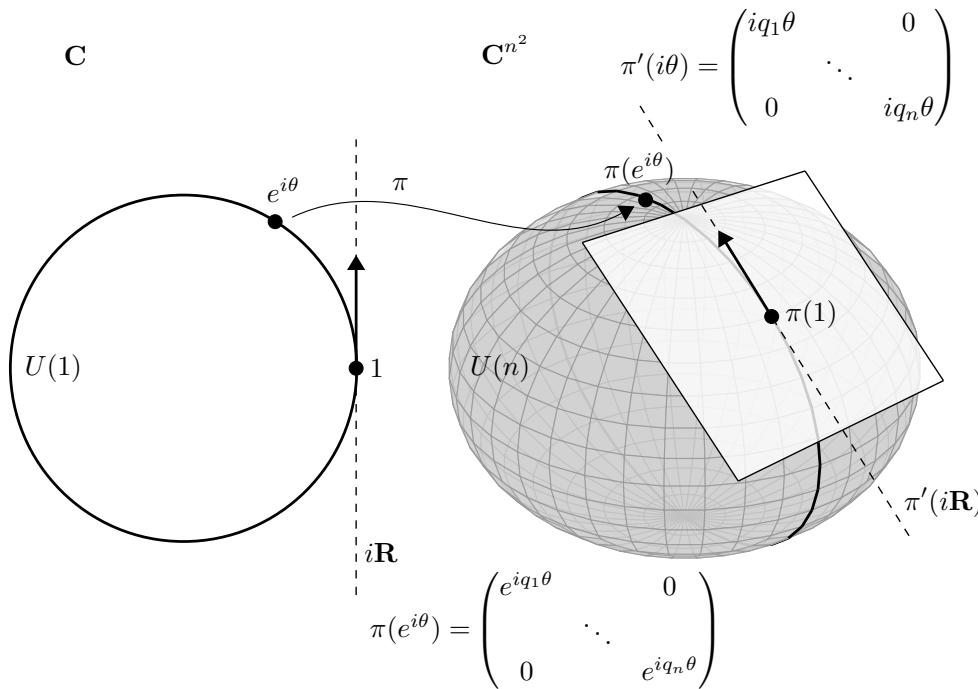 Figure 2.2: Visualizing a representation , along with its differential.
The spherical figure in the right-hand side of the picture is supposed to indicate the space is the by complex matrices, , minus the locus of matrices with zero determinant, which are those that can’t be inverted). It has a distinguished point, the identity. The representation takes the circle to a circle inside . Its derivative is a linear map taking the tangent space to the circle at the identity to a line in the tangent space to at the identity.
In the very simple example , this abstract picture is over-kill and likely confusing. We will see the same picture though occurring in many other much more complicated examples in later chapters. Just like in this case, for finite dimensional representations the linear maps will be matrices, and the representation matrices can be found by exponentiating the
来源与版本
正文:英文 · 原著转录
核对状态:AI 辅助转录核对,未作人工审阅
原书 PDF · 印刷页 19、20、21
来源版本:2025-10-20
来源 PDF SHA-256:5a1941b2443b54d5db3d055f1e5ba390429b7a728475258017aaac87ee85a837