One might think that the simplest Lie group is the one dimensional additive group , a group that we will study together with its representations beginning in chapter 10. It turns out that one gets a much easier to analyze Lie group by adding a periodicity condition (which removes the problem of what happens as you go to ), getting the “circle group” of points on a unit circle. Each such point is characterized by an angle, and the group law is addition of angles.
The circle group can be identified with the group of rotations of the plane , in which case it is called , for reasons discussed in chapter 4. It is quite convenient however to identify with the complex plane and work with the following group (which is isomorphic to ):
Definition · The group U(1)
The elements of the group are points on the unit circle, which can be labeled by a unit complex number , or an angle with and labeling the same group element for . Multiplication of group elements is complex multiplication, which by the properties of the exponential satisfies
so in terms of angles the group law is addition (mod 2).
The name “” is used since complex numbers are 1 by 1 unitary matrices.
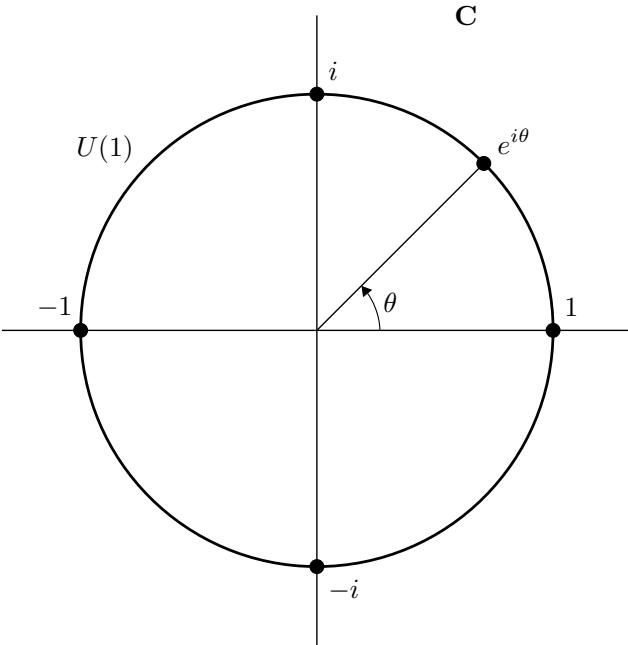 Figure 2.1: viewed as the unit circle in the complex plane .
By theorem 2.2, since is a commutative group, all irreducible representations will be one dimensional. Such an irreducible representation will be given by a differentiable map
is the group of invertible complex numbers, also called . A differentiable map that is a representation of must satisfy homomorphism and periodicity properties which can be used to show:
Theorem
Proof
Proof. We will write the as a function of an angle , so satisfying the periodicity property
Since it is a representation, will satisfy the homomorphism property
We need to show that any differentiable map
satisfying the homomorphism and periodicity properties is of the form . Computing the derivative we find
Denoting the constant by , the only solutions to this differential equation satisfying are
Requiring periodicity we find
which implies for , and for some integer . □
The representations we have found are all unitary, with taking values in . The complex numbers satisfy the condition to be a unitary 1 by 1 matrix, since
These representations are restrictions to the unit circle of irreducible representations of the group , which are given by
Such representations are not unitary, but they have an extremely simple form, so it sometimes is convenient to work with them, later restricting to the unit circle, where the representation is unitary.
来源与版本
正文:英文 · 原著转录
核对状态:AI 辅助转录核对,未作人工审阅
原书 PDF · 印刷页 17、18、19
来源版本:2025-10-20
来源 PDF SHA-256:5a1941b2443b54d5db3d055f1e5ba390429b7a728475258017aaac87ee85a837