45.4 The geometric significance of the connection
The information contained in a connection can be put in a diferent form, using it to define a phase for any curve between two points in :
Definition (Path-dependent phase factor)
Given a connection , one can define for any curve parametrized by , with position at time given by , the path-dependent phase factor
The efect of a gauge transformation is
Note that if is a closed curve, with , then the path-dependent phase factor is gauge invariant.
Digression. For readers familiar with diferential forms, can be thought of as an element of , the space of 1-forms on space-time . The pathdependent phase is then the standard integral of a 1-form along a curve . The curvature of is simply the 2-form , where is the de Rham diferential. The gauge group acts on connections by
and the curvature is gauge invariant since
and satisfies
Stokes theorem for diferential forms implies that is a closed curve, and is the boundary of a surface , then
Note that if , then for any closed curve , and this can be used to show that path-dependent phase factors do not depend on the path. To see this, consider any two paths and from to , and the closed curve that goes from to along , and then back along . Then
so
The path-dependent phase factors allow comparison of the values of the complex field at diferent points in a gauge invariant manner. To compare the value of a field at to that of the field at in a gauge invariant manner, we just need to consider the path-dependent quantity
where is a curve from to . Under a gauge transformation this will change as
which is the same transformation property as that of .
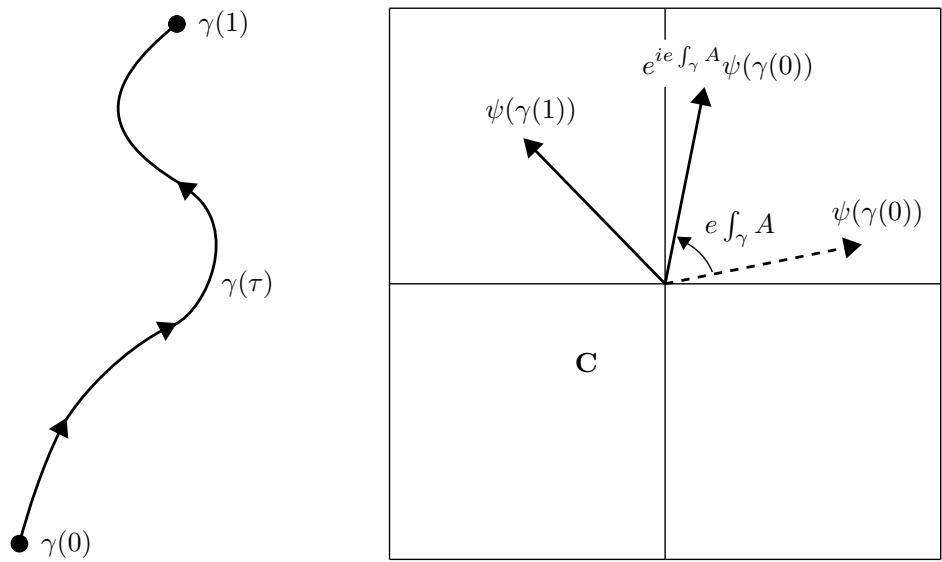
Figure 45.1: Comparing a complex field at two points in a gauge invariant manner.
In the path integral formalism (see section 35.3), the minimal coupling of a single particle to a background electromagnetic field described by a vector potential can be introduced by weighting the integral over paths by the path-dependent phase factor. This changes the formal path integral by
and a path integral with such a weighting of paths then must be sensibly defined. This method only works for the single-particle theory, with minimal coupling for a quantum theory of fields given by the replacement of derivatives by covariant derivatives described earlier.
来源与版本
正文:英文 · OCR 机器稿 · 待校对
核对状态:OCR 机器稿 · 待校对
原书 PDF · 印刷页 484、485、486、487、488、489、490、491、492、493
来源版本:2025-10-20
来源 PDF SHA-256:5a1941b2443b54d5db3d055f1e5ba390429b7a728475258017aaac87ee85a837
OCR 来源 SHA-256:d3d285500af2024670a515c59ee5503cd8bd26667c0e1e839c22ee489820b440
OCR 产物 SHA-256:d3d285500af2024670a515c59ee5503cd8bd26667c0e1e839c22ee489820b440