Given an open covering of a topological space an open covering of is called a refinement of if each for some . The refinement is said to be locally finite if every point belongs to at most a finite number of . The topological space is said to be paracompact if for every open covering there exists a locally finite refinement. As it may be shown that every locally compact Hausdorff secondcountable space is paracompact [12], we will from now on restrict attention to manifolds that are paracompact topological spaces.
Given a locally finite open covering of a manifold , a partition of unity subordinate to the covering consists of a family of differentiable functions such that
(1) on for all ,
(2) for all
It is important that the covering be locally finite, so that the sum in (3) reduces to a finite sum.
Theorem 17.1 · Existence of partitions of unity
For every locally finite covering of a paracompact manifold there exists a partition of unity subordinate to this refinement.
Proof
For each let be an open neighbourhood of such that its closure is compact and contained in some for example, take to be the inverse image of a small coordinate ball in . As the sets form an open covering of they have a locally finite refinement . For each let be the union of all whose closure . Since every for some and , it follows that the sets are an open covering of . For each the closure of is compact and, by the local finiteness of the covering
As seen in Lemma 16.1 for any point it is possible to find a differentiable function such that and on . For each point let be the open neighbourhood . Since is compact, there exists a finite subcover . The function has the following three properties: on , and (iii) outside is a locally finite covering of , the function is well-defined, and positive everywhere on . The functions satisfy all requirements for a partition of unity subordinate to
We can now construct a non-vanishing -form on a manifold from any atlas of charts having positive Jacobian determinants on all overlaps. Let be a locally finite refinement of and partition of unity subordinate to . The charts where and form an atlas on , and
is a differential -form on that nowhere vanishes.
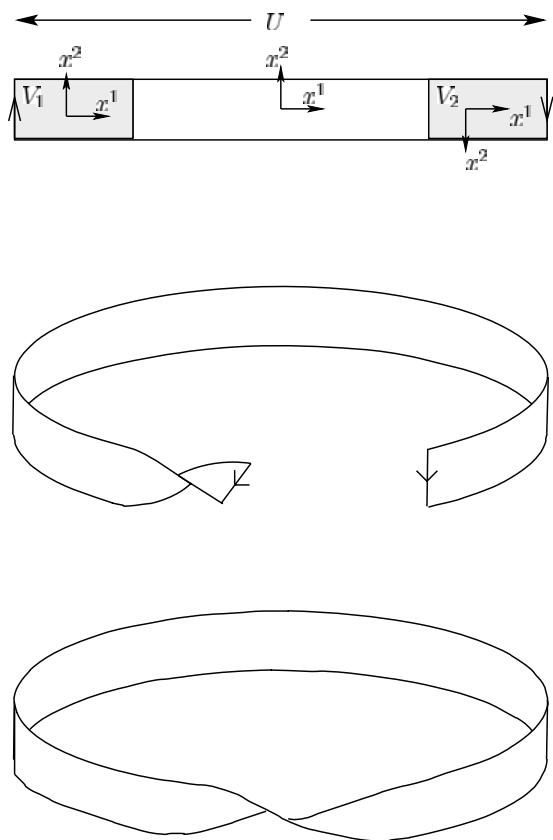
The Möbius band can be thought of as a strip of paper with the two ends joined together after giving the strip a twist, as shown in Fig. 17.1. For exam ple, let where the end edges are identified in opposing directions, . This manifold can be covered by two charts
Figure 17.1 Möbius bandThe Jacobian is 1 on and 1 on , so these two charts do not have the same orientation everywhere. The Möbius band is non-orientable, for if there existed a non-vanishing 2-form , we would have with or everywhere on . Setting we have and on Hence must vanish on the line , which contradicts being non-vanishing everywhere.