In the previous section we considered regions that could be subdivided into ‘cubical’ parts. While this has practical advantages when it comes to integration, and makes the proof of Stokes’ theorem relatively straightforward, the subject of homology is more standardly based on triangular cells. There is no essential difference in this change since any -cube is readily triangulated, as well as the converse. For example, a triangle in two dimensions is easily divided into squares (see Fig. 17.4). Dividing a tetrahedron into four cubical regions is harder to visualize, and is left as an excercise for the reader.
Ordered simplices and chains in Euclidean space
A set of points in Euclidean space is said to be independent if the vectors are linearly independent. The ordered -simplex with these points as vertices consists of their convex hull,
together with a specific ordering of the vertex points. We will often denote an ordered -simplex by a symbol such as or . Two ordered -simplices with the same set of vertices will be taken to be identical if the orderings are related by an even permutation, else they are given the opposite sign. For example,
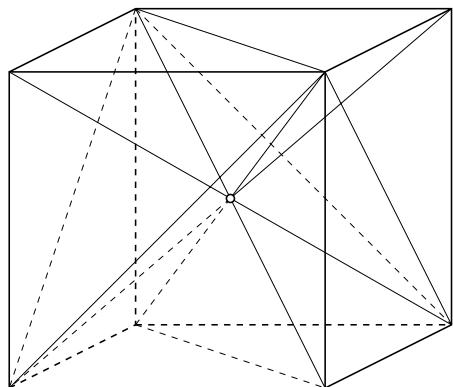
Figure 17.4 Dividing the triangular into ‘cubical’ cells
The standard -simplex on is where is the th basis vector , i.e.
A 0-simplex is a single point together with a plus or minus sign.
A 1-simplex is a closed directed line from to .
A 2-simplex is an oriented triangle, where the vertices are taken in a definite order.
A 3-simplex is a tetrahedron in which the vertices are again given a specific order up to even permutations. These examples are depicted in Fig. 17.5.
A -chain is a formal sum where are real numbers and are -simplices in . The set of all -chains on is obviously a vector space, denoted
The th face of a -simplex is defined as the ordered simplex
and the boundary of a -simplex is defined as the -chain
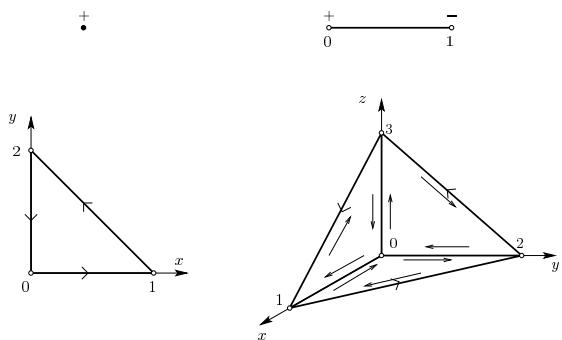
Figure 17.5 Standard low dimensional -simplexes
and extends to all -chains by linearity. For example,
For each the boundary operator generates a linear map by setting
If we set the boundary of any 0-form to be the zero chain, it is trivial to see that two successive applications of the boundary operator on any 1-simplex vanishes,
This identity generalizes to arbitrary -simplices, for
since all terms cancel in pairs. The identity follows from the linearity of the boundary operator on ).
Write out the cancellation of terms in this argument explicitly for a 2-simplex and 3-simplex
A -chain is said to be a cycle if it has no boundary, . It is said to be a boundary if there exists a -chain such that . Clearly every boundary is a -cycle since , but the converse need not be true.
Simplicial homology on manifolds
Let be an -dimensional differentiable manifold. A (singular) -simplex on is a smooth map where is an open subset of containing the standard -simplex . A -chain on is a formal linear combination of -simplices on ,
and let be the real vector space generated by all -simplices on
For each denote by the map that embeds into the plane of ,
and for set
The maps are -simplices in , whose supports are the various faces of the standard -simplex, ,
If is a -simplex in , define its th face to be the -simplex
and its boundary to be the -chain
Extend by linearity to all chains ,
A -boundary is a singular -cycle on that is the boundary of a -chain, -cycle is a singular -chain on whose boundary vanishes, Since it is clear that every -boundary is a -cycle.
If we let be the set of all -boundaries on , and all -cycles, these are both vector subspaces of
We define the th homology space to be the factor space
Commonly this is called the th homology group, only the abelian group property being relevant. Two cycles and are said to be homologous if they belong to the same homology class – that is, if there exists a chain such that . The dimension of the th homology space is known as the th Betti number,
and the quantity
is known as the Euler characteristic of the manifold . A non-trivial result that we shall not attempt to prove is that the Betti numbers are topological invariants – two manifolds that are topologically homeomorphic have the same Betti numbers and Euler characteristic [13].
Since every 0-simplex in a manifold has boundary 0. Hence every 0-chain in is a 0-cycle, and . The zeroth homology space counts the number of 0-chains that are not boundaries of 1-chains. Since a 1-simplex is essentially a smooth curve it has boundary ), where we represent the 0-simplex map simply by its image point . Two 0-simplices and are homologous if is a boundary; that is, if they are the end points of a smooth curve connecting them. This is true if and only ifthey belong to the same connected component of . Thus is spanned by a set ofsimplices , one from each connected component of , and the zeroth Betti number is the number of connected components of the topological space .
De Rham cohomology groups and duality
Let be the real vector space consisting of all differential -forms on . Its elements are also known as -cochains on . The exterior derivative is a linear operator : for each , with the property ). We write its restriction to as .
A differential -form is said to be closed if , and it is said to be exact if there exists an -form such that . Clearly every exact -form is closed since . In the language of cochains these definitions can be expressed as follows: an -cochain is called an -cocycle if it is a closed differential form, while it is an -coboundary if it is exact. We denoted the vector subspace of -cocycles by , and the subspace of -coboundaries by
The th de Rham cohomology space (group) is defined as the factor space , and any two -cocycles and are said to be cohomologous if they belong to the same coset, for some -cochain . The dimensions of the vector spaces are denoted .
Since there are no differential forms of degree 1 we always set 0. Hence . A 0-form is closed and belongs to if and only if . Hence . on each connected component of , and , one contribution from each such component. Hence is the number of connected components of (see Example 17.4).
If , then from the previous example is closed if . Setting we can clearly always write
Hence every closed 1-form is exact and . It is not difficult to verify that this is also the value of the Betti numbers,
Define a bracket by setting
for every -chain and -cochain . For every the map is evidently linear on and for every the map is linear on . By Stokes’ theorem the exterior derivative is the adjoint of the boundary operator with respect to this bracket, in the sense that
The bracket induces a bracket , on by setting
for any pair . It is independent of the choice of representative from the homology and cohomology classes, for if and , where
and , then
For any fixed -cohomology class [], the map given by
is a well-defined linear functional on . De Rham’s theorem asserts that this corre spondence between linear functionals on and cohomology classes is bijective.
Theorem 17.4 · de Rham’s theorem
(de Rham) The bilinear map on defined by is non-degenerate in both arguments. That is, every linear func tional on () has theform a uniquely defined -cohomology class [].
The proof lies beyond the scope of this book, and may be found in [6, 10]. There are a variety of ways ofexpressing de Rham’s theorem. Essentially it says that the th cohomology group is isomorphic with the dual space of the th homology group,
If the Betti numbers are finite then
The integral of a closed -form over an -cycle
is sometimes called a period of . By Stokes’ theorem all periods of vanish if is an exact form, and the period of any closed -form vanishes over a boundary -cycle Let be linearly independent cycles in , such that for . De Rham’s theorem implies that an -form is exact if and only if all the periods . If is exact then we have already remarked that all its periods vanish. The converse follows from the fact that for every , since [] can be expanded to . By non-degeneracy of the product , we must have so that for some -form
Problems
Show that any tetrahedron may be divided into ‘cubical’ regions. Describe a procedure for achieving the same result for a general -simplex.
For any pair of subspaces and of the exterior algebra , set to be the vector subspace spanned by all where . Show that
(a)
(b)
(c)
Show that for any set of real numbers there exists a closed -form whose periods
is the unit circle, show that