Let us recall how the Euler characteristic of a surface is calculated. We first construct a polyhedron homeomorphic to the given surface, then count the numbers of vertices, edges and faces. The Euler characteristic of the polyhedron, and hence of the surface, is then given by equation (2.31). We abstract this procedure so that we may represent each part of a figure by some standard object. We take triangles and their analogues in other dimensions, called simplexes, as the standard objects. By this standardization, it becomes possible to assign to each figure Abelian group structures.
3.2.1 Simplexes
Simplexes are building blocks of a polyhedron. A 0-simplex is a point, or a vertex, and a 1-simplex is a line, or an edge. A 2-simplex is defined to be a triangle with its interior included and a 3-simplex is a solid tetrahedron (figure 3.2). It is common to denote a 0-simplex without the bracket; may be also written as . It is easy to continue this construction to any -simplex . Note that for an -simplex to represent an -dimensional object, the vertices must be geometrically independent, that is, no -dimensional hyperplane contains all the points. Let be points geometrically independent in where . The -simplex is expressed as
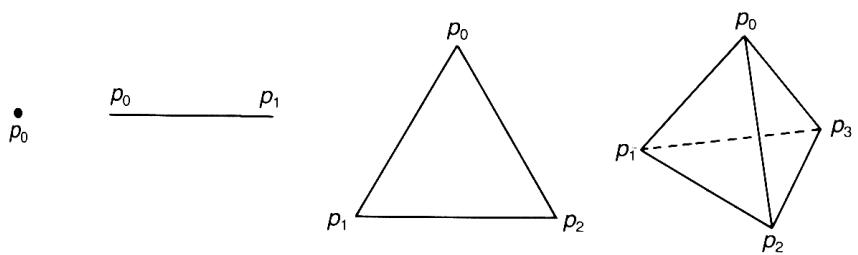
Figure 3.2. 0-, 1-, 2- and 3-simplexes.
is called the barycentric coordinate of . Since is a bounded and closed subset of , it is compact.
Let be an integer such that . If we choose points out of , these points define a -simplex , which is called a -face of . We write if is a face of
. If , we say is a proper face of , denoted as . Figure 3.3 shows a 0-face and a 2-face of a 3-simplex . There are one 3-face, four 2-faces, six 1-faces and four 0-faces. The reader should verify that the number of -faces in an -simplex is . A 0-simplex is defined to have no proper faces.
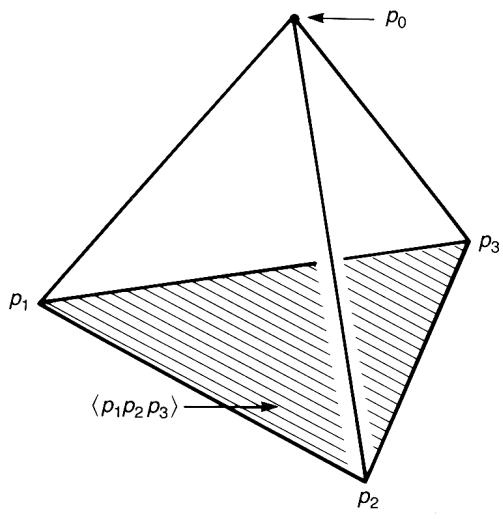
Figure 3.3. A 0-face and a 2-face of a 3-simplex .
3.2.2 Simplicial complexes and polyhedra
Let be a set of finite number of simplexes in . If these simplexes are nicely fitted together, is called a simplicial complex. By ‘nicely’ we mean:
(i) an arbitrary face of a simplex of belongs to , that is, if and then ; and
(ii) if and are two simplexes of , the intersection is either empty or a common face of and , that is, if then either or and .
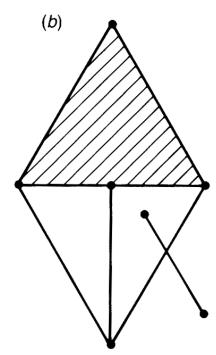
For example, figure 3.4(a) is a simplicial complex but figure 3.4(b) is not. The dimension of a simplicial complex is defined to be the largest dimension of simplexes in .
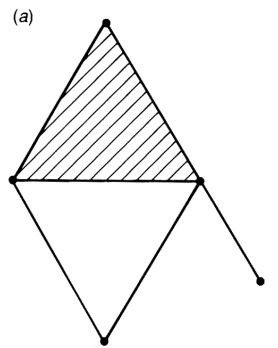
Figure 3.4. (a) is a simplicial complex but (b) is not.
Let be an -simplex and be the set of faces of . is an -dimensional simplicial complex. For example, take
(figure 3.3). Then
A simplicial complex is a set whose elements are simplexes. If each simplex is regarded as a subset of ( ), the union of all the simplexes becomes a subset of . This subset is called the polyhedron of a simplicial complex . The dimension of as a subset of is the same as that of ; .
Let be a topological space. If there exists a simplicial complex and a homeomorphism , is said to be triangulable and the pair is called a triangulation of . Given a topological space , its triangulation is far from unique. We will be concerned with triangulable spaces only.
Figure is a triangulation of a cylinder . The reader might think that somewhat simpler choices exist, figure , for example. This is, however, not a triangulation since, for and , we find , which is neither empty nor a simplex.
来源与版本
正文:英文 · OCR 机器稿 · 待校对
核对状态:OCR 机器稿 · 待校对
来源版本:second-edition-local
来源 PDF SHA-256:fcd24c3371d092a8c699ccf5cf0765462924b6c48412804231076e8084b1940d
OCR 来源 SHA-256:0b6324f01172a3548cd34382e82fd8bfae574602b6b2cfaa357ba96bc2c35478
OCR 产物 SHA-256:0983288173d1a406d252c2dffcf35849482cc172c2dac6bdae8b288cd1ef6333