4.2.1 Arcwise connectedness and fundamental groups
In section 2.3 we defined a topological space to be arcwise connected if, for any , there exists a path such that and .
Let be an arcwise connected topological space and let . Then is isomorphic to .
Proof
Let be a path such that and . If is a loop at , then is a loop at (figure 4.6). Given an element , this correspondence induces a unique element . We denote this map by so that .
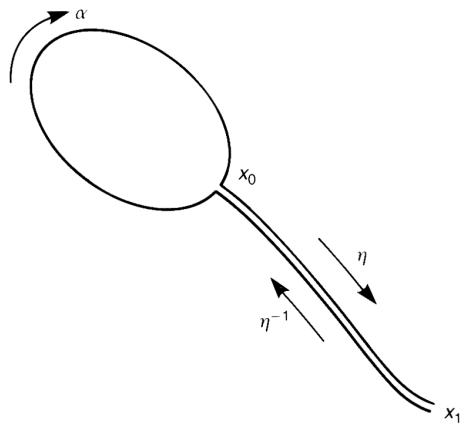
Figure 4.6. From a loop at , a loop at is constructed.
We show that is an isomorphism. First, is a homomorphism, since for , we have
To show that is bijective, we introduce the inverse of . Define a map whose action on is .
Clearly is the inverse of since
Thus, . From the symmetry, we have . We find from exercise 2.3 that is one to one and onto.
Accordingly, if is arcwise connected, we do not need to specify the base point since for any , and we may simply write .
(1) Let and be paths from to , such that . Show that .
(2) Let and be paths such that . Show that .
4.2.2 Homotopic invariance of fundamental groups
The homotopic equivalence of paths and loops is easily generalized to arbitrary maps. Let be continuous maps. If there exists a continuous map such that and , is said to be homotopic to , denoted by . The map is called a homotopy between and .
Let and be topological spaces. and are of the same homotopy type, written as , if there exist continuous maps and such that and . The map is called the homotopy equivalence and , its homotopy inverse. [Remark: If is homeomorphic to , and are of the same homotopy type but the converse is not necessarily true. For example, a point and the real line are of the same homotopy type but is not homeomorphic to .]
‘Of the same homotopy type’ is an equivalence relation in the set of topological spaces.
Proof
Reflectivity: where is a homotopy equivalence. Symmetry: Let with the homotopy equivalence . Then , the homotopy equivalence being the homotopy inverse of . Transitivity: Let and . Suppose , are homotopy equivalences and , , their homotopy inverses. Then
from which it follows
One of the most remarkable properties of the fundamental groups is that two topological spaces of the same homotopy type have the same fundamental group.
Let and be topological spaces of the same homotopy type. If is a homotopy equivalence, is isomorphic to .
The following corollary follows directly from theorem 4.3.
A fundamental group is invariant under homeomorphisms, and hence is a topological invariant.
In this sense, we must admit that fundamental groups classify topological spaces in a less strict manner than homeomorphisms. What we claim at most is that if topological spaces and have different fundamental groups, cannot be homeomorphic to . Note, however, that the homotopy groups including the fundamental groups have many applications to physics as we shall see in due course. We should stress that the main usage of the homotopy groups in physics is not to classify spaces but to classify maps or field configurations.
It is rather difficult to appreciate what is meant by ‘of the same homotopy type’ for an arbitrary pair of and . In practice, however, it often happens that is a subspace of . We then claim that if is obtained by a continuous deformation of .
Let ( ) be a subspace of . If there exists a continuous map such that , is called a retract of and a retraction.
Note that the whole of is mapped onto keeping points in fixed. Figure 4.7 is an example of a retract and retraction.
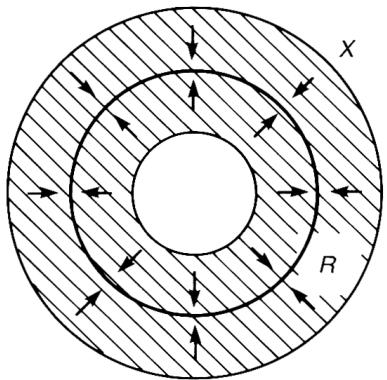
Figure 4.7. The circle is a retract of the annulus . The arrows depict the action of the retraction.
Let be a subspace of . If there exists a continuous map such that
The space is said to be a deformation retract of . Note that is a homotopy between and a retraction , which leaves all the points in fixed during deformation.
A retract is not necessarily a deformation retract. In figure 4.8, the circle is a retract of but not a deformation retract, since the hole in is an obstruction to continuous deformation of to the retraction. Since and are of the same homotopy type, we have
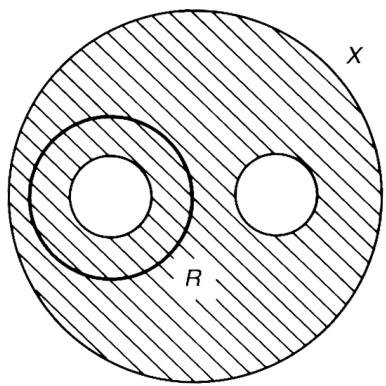
Figure 4.8. The circle is not a deformation retract of .
Let be the unit circle and be the annulus,
see figure 4.7. Define by and by . Then and . Observe that and . There exists a homotopy
which interpolates between and , keeping the points on fixed. Hence, is a deformation retract of . As for the fundamental groups we have where .
If a point is a deformation retract of , is said to be contractible.
Let be a constant map. If is contractible, there exists a homotopy such that and for any and, moreover, for any . The homotopy is called the contraction.
is contractible to the origin 0. In fact, if we define by , we have (i) and for any and (ii) for any . Now it is clear that any convex subset of is contractible.
Let . Show that the unit circle is a deformation retract of . Show also that the unit sphere is a deformation retract of , where .
The fundamental group of a contractible space is trivial, . In particular, the fundamental group of is trivial, .
Proof
A contractible space has the same fundamental group as a point and a point has a trivial fundamental group.
If an arcwise connected space has a trivial fundamental group, is said to be simply connected, see section 2.3.
来源与版本
正文:英文 · OCR 机器稿 · 待校对
核对状态:OCR 机器稿 · 待校对
来源版本:second-edition-local
来源 PDF SHA-256:fcd24c3371d092a8c699ccf5cf0765462924b6c48412804231076e8084b1940d
OCR 来源 SHA-256:0b6324f01172a3548cd34382e82fd8bfae574602b6b2cfaa357ba96bc2c35478
OCR 产物 SHA-256:00e84d8e739437cd1a4a0acabbea04b5ee2cebf82bb5f08feb2dae36e1cdbfc5