2.1.1 Definitions
Let and be sets. A map (or mapping) is a rule by which we assign for each . We write
If is defined by some explicit formula, we may write
There may be more than two elements in that correspond to the same . A subset of whose elements are mapped to under is called the inverse image of , denoted by . The set is called the domain of the map while is called the range of the map. The image of the map is . The image is also denoted by . The reader should note that a map cannot be defined without specifying the domain and the range. Take , for example. If both the domain and the range are , has no inverse
image. If, however, the domain and the range are the complex plane , we find . The domain and the range are as important as itself in specifying a map.
Let be given by . We also write . The domain and the range are and the image is . The inverse image of is . Let us take the same function but this time. The image is the whole complex plane .
If a map satisfies a certain condition it bears a special name.
(a) A map is called injective (or one to one) if implies .
(b) A map is called surjective (or onto) if for each there exists at least one element such that .
(c) A map is called bijective if it is both injective and surjective.
A map defined by ( ) is bijective. defined by is neither injective nor surjective. given by is injective but not surjective.
A map defined by is neither injective nor surjective. Restrict the domain and the range to make bijective.
Let be an element of the general linear group whose matrix representation is given by matrices with non-vanishing determinant. Then , is bijective. If , it is neither injective nor surjective.
A constant map is defined by where is a fixed element in and is an arbitrary element in . Given a map , we may think of its restriction to , which is denoted as . Given two maps and , the composite map of and is a map defined by . A diagram of maps is called commutative if any composite maps between a pair of sets do not depend on how they are composed. For example, in figure 2.1, and etc.
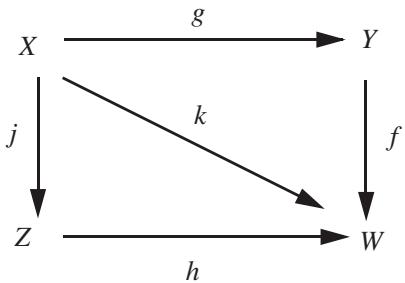
Figure 2.1. A commutative diagram of maps.
Let be defined by and by . What are and ?
If , an inclusion map is defined by for any . An inclusion map is often written as . The identity map is a special case of an inclusion map, for which . If defined by is bijective, there exists an inverse map , such that , which is also bijective. The maps
and satisfy and . Conversely, if and satisfy and , then and are bijections. This can be proved from the following exercise.
Show that if and satisfy , is injective and is surjective. If this is applied to as well, we obtain the previous result.
Let be a bijection defined by . Then the inverse map is . Let be a bijection defined by . The inverse map is .
The -dimensional Euclidean group is made of an -dimensional translation ( ) and an rotation , . A general element of acts on by . The product is defined by , that is, . Show that the maps , and are bijections. Find their inverse maps.
Suppose certain algebraic structures (product or addition, say) are endowed with the sets and . If preserves these algebraic structures, then is called a homomorphism. For example, let be endowed with a product. If is a homomorphism, it preserves the product, . Note that is defined by the product rule in , and by that in . If a homomorphism is bijective, is called an isomorphism and is said to be isomorphic to , denoted .
2.1.2 Equivalence relation and equivalence class
Some of the most important concepts in mathematics are equivalence relations and equivalence classes. Although these subjects are not directly related to maps, it is appropriate to define them at this point before we proceed further. A relation defined in a set is a subset of . If a point is in , we may write . For example, the relation is a subset of . If , then .
An equivalence relation is a relation which satisfies the following requirements:
(i) (reflective).
(ii) If , then (symmetric).
(iii) If and , then (transitive).
If an integer is divided by 2, the remainder is either 0 or 1. If two integers and yield the same remainder, we write . Show that is an equivalence relation in .
Given a set and an equivalence relation , we have a partition of into mutually disjoint subsets called equivalence classes. A class is made of all the elements in such that ,
cannot be empty since . We now prove that if then . First note that . (Since there is at least one element in that satisfies and . From the transitivity, we have .) Next we show that . Take an arbitrary element in ; . Then implies , that is . Thus, we have . Similarly, can be shown and it follows that . Hence, two classes and satisfy either or . In this way a set is decomposed into mutually disjoint equivalence classes. The set of all classes is called the quotient space, denoted by . The element (or any element in ) is called the representative of a class . In exercise 2.5, the equivalence relation divides integers into two classes, even integers and odd integers. We may choose the representative of the even class to be 0, and that of the odd class to be 1. We write this quotient space . is isomorphic to , the cyclic group of order 2, whose algebra is defined by , and . If all integers are divided into equivalence classes according to the remainder of division by , the quotient space is isomorphic to , the cyclic group of order .
Let be a space in our usual sense. (To be more precise, we need the notion of topological space, which will be defined in section 2.3. For the time being we depend on our intuitive notion of ‘space’.) Then quotient spaces may be realized as geometrical figures. For example, let and be two points in .

(a)
(b)
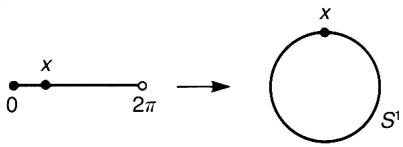
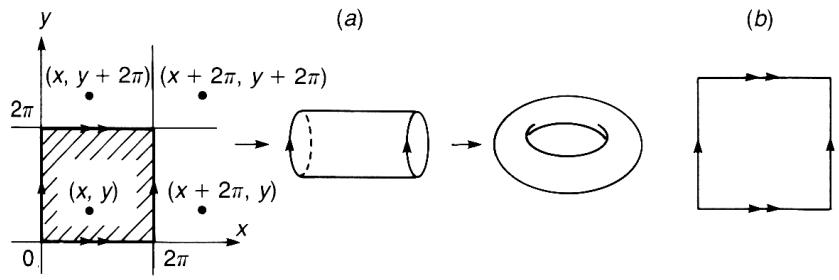
Figure 2.2. In (a) all the points , are in the same equivalence class . We may take as a representative of . (b) The quotient space is the circle .
Introduce a relation by: if there exists such that . It is easily shown that is an equivalence relation. The class is the set . A number serves as a representative of an equivalence class , see figure . Note that and are different points in but, according to the equivalence relation, these points are looked upon as the same element in . We arrive at the conclusion that the quotient space is the circle ; see figure . Note that a point is close to a point for infinitesimal . Certainly this is the case for , where an angle is close to an angle , but not the case for . The concept of closeness of points is one of the main ingredients of topology.
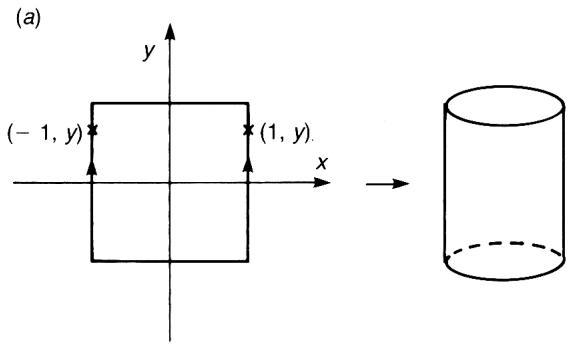
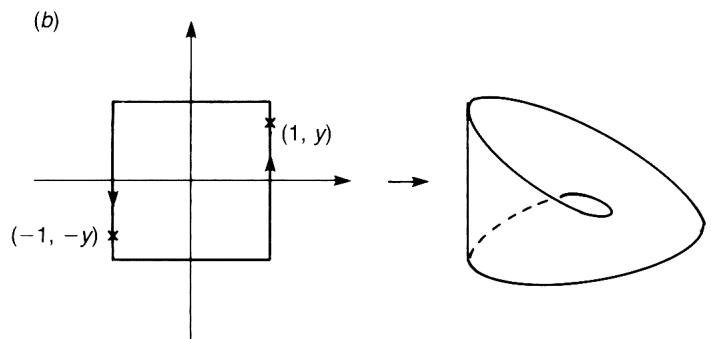
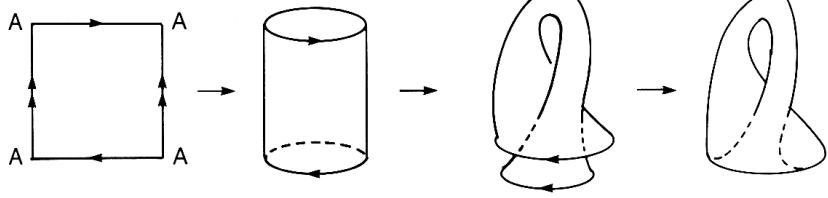
(a) Let be a square disc . If we identify the points on a pair of facing edges, , for example, we obtain the cylinder, see figure 2.3(a). If we identify the points , we find the Möbius strip, see figure 2.3(b). [Remarks: If readers are not familiar with the Möbius strip, they may take a strip of paper and glue up its ends after a -twist. Because of the twist, one side of the strip has been joined to the other side, making the surface single sided. The Möbius strip is an example of a non-orientable surface, while the cylinder has definite sides and is said to be orientable. Orientability will be discussed in terms of differential forms in section 5.5.]
Figure 2.3. (a) The edges are identified in the direction of the arrows to form a cylinder. (b) If the edges are identified in the opposite direction, we have a Möbius strip.
(b) Let and be two points in and introduce an equivalence relation by: if and , . Then is an equivalence relation. The quotient space is the torus (the surface of a doughnut), see figure 2.4(a). Alternatively, is
Figure 2.4. If all the points are identified as in (a), the quotient space is taken to be the shaded area whose edges are identified as in (b). This resulting quotient space is the torus .
represented by a rectangle whose edges are identified as in figure 2.4(b).
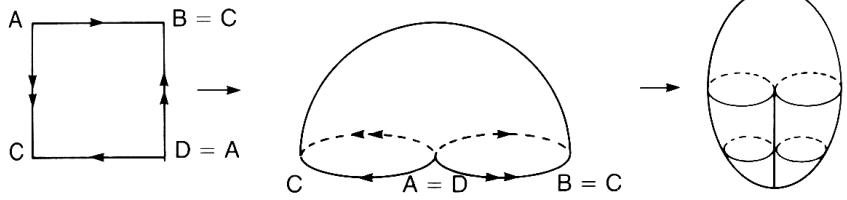
(c) What if we identify the edges of a rectangle in other ways? Figure 2.5 gives possible identifications. The spaces obtained by these identifications are
(a)
(b)
Figure 2.5. The Klein bottle and the projective plane .
called the Klein bottle, figure 2.5(a), and the projective plane, figure 2.5(b), neither of which can be realized (or embedded) in the Euclidean space without intersecting with itself. They are known to be non-orientable.
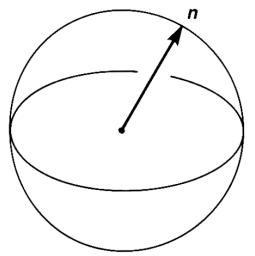
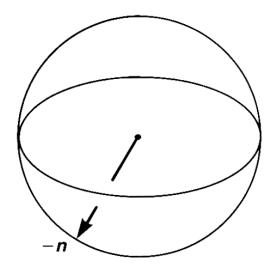
The projective plane, which we denote , is visualized as follows. Let us consider a unit vector and identify with , see figure 2.6. This identification takes place when we describe a rod with no head or tail, for example. We are tempted to assign a point on to specify the ‘vector’ . This works except for one point. Two antipodal points and represent the same state. Then we may take a northern hemisphere as the coset space since only a half of is required. However, the coset space is not just an ordinary hemisphere since the antipodal points on the equator are identified. By continuous deformation of this hemisphere into a square, we obtain the square in figure 2.5(b).
Figure 2.6. If has no head or tail, one cannot distinguish from and they must be identified. One obtains the projective plane by this identification ; . It suffices to take a hemisphere to describe the coset space. Note, however, that the antipodal points on the equator are identified.
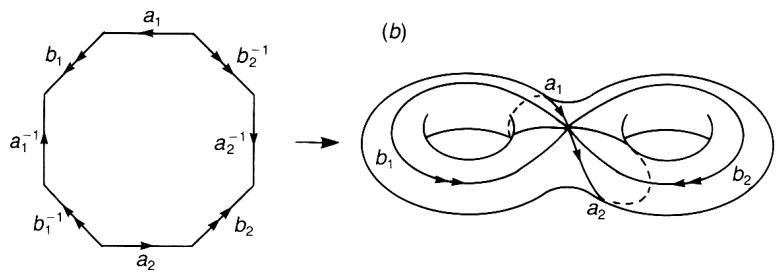
(d) Let us identify pairs of edges of the octagon shown in figure 2.7(a). The quotient space is the torus with two handles, denoted by , see figure 2.7(b). , the torus with handles, can be obtained by a similar identification, see problem 2.1. The integer is called the genus of the torus.
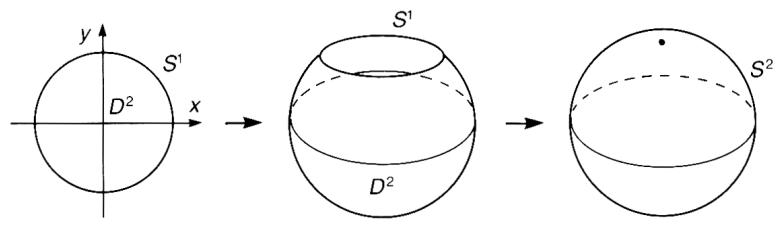
(e) Let be a closed disc. Identify the points on the boundary ; if . Then we obtain the sphere as the quotient space , also written as , see figure 2.8. If we take an -dimensional disc and identify the points on the surface , we obtain the -sphere , namely .
(a)
Figure 2.7. If the edges of are identified a torus with two holes (genus two) is obtained.
Figure 2.8. A disc whose boundary is identified is the sphere .
Let be the upper-half complex plane . Define a
group
Introduce a relation , for , by if there exists a matrix
such that
Show that this is an equivalence relation. (The quotient space is shown in figure 8.3.)
Let be a group and a subgroup of . Let and introduce an equivalence relation by if there exists such that . We denote the equivalence class by . The class is called a (left) coset. satisfies either or . The quotient space is denoted by . In general is not a group unless is a normal subgroup of , that is, for any and . If is a normal subgroup of , is called the quotient group, whose group operation is given by , where is the product in . Take and . Then there exists such that and hence . The unit element of is the equivalence class and the inverse element of is .
Let be a group. Two elements are said to be conjugate to each other, denoted by , if there exists such that . Show that is an equivalence relation. The equivalence class is called the conjugacy class.
来源与版本
正文:英文 · OCR 机器稿 · 待校对
核对状态:OCR 机器稿 · 待校对
来源版本:second-edition-local
来源 PDF SHA-256:fcd24c3371d092a8c699ccf5cf0765462924b6c48412804231076e8084b1940d
OCR 来源 SHA-256:0b6324f01172a3548cd34382e82fd8bfae574602b6b2cfaa357ba96bc2c35478
OCR 产物 SHA-256:57a64667da4d3fccda699a9230c2383dc1c9304631645626e3b28e3aa18dc71d