Recently topological methods have played increasingly important roles in condensed matter physics. For example, homotopy theory has been employed to classify possible forms of extended objects, such as solitons, vortices, monopoles and so on, in condensed systems. These classifications will be studied in sections 4.8-4.10. Here, we briefly look at the order parameters of condensed systems that undergo phase transitions.
4.8.1 Order parameter
Let be a Hamiltonian describing a condensed matter system. We assume is invariant under a certain symmetry operation. The ground state of the system need not preserve the symmetry of . If this is the case, we say the system undergoes spontaneous symmetry breakdown.
To illustrate this phenomenon, we consider the Heisenberg Hamiltonian
which describes ferromagnetic Heisenberg spins . The parameter is a positive constant, the summation is over the pair of the nearest-neighbour sites and is the uniform external magnetic field. The partition function is , where is the inverse temperature. The free energy is defined by . The average magnetization per spin is
where . Let us consider the limit . Although is invariant under the SO(3) rotations of all in this limit, it is well known that does not vanish for large enough and the system does not observe the SO(3) symmetry. It is said that the system exhibits spontaneous magnetization and the maximum temperature, such that is called the critical temperature.
The vector is the order parameter describing the phase transition between the ordered state and the disordered state . The system is still symmetric under SO(2) rotations around the magnetization axis .
What is the mechanism underlying the phase transition? The free energy is , being the entropy. At low temperature, the term in may be negligible and the minimum of is attained by minimizing , which is realized if all align in the same direction. At high temperature, however, the entropy term dominates and the minimum of is attained by maximizing , which is realized if the directions of are totally random.
If the system is at a uniform temperature, the magnitude is independent of the position and is specified by its direction only. In the ground state, itself is expected to be independent of position. It is convenient to introduce the polar coordinate to specify the direction of . There is a one-to-one correspondence between and a point on the sphere . Suppose varies as a function of position: . At each point of the space, a point of is assigned and we have a map from the space to . Besides the ground state (and excited states that are described by small oscillations (spin waves) around the ground state) the system may carry various excited states that cannot be obtained from the ground state by small perturbations. What kinds of excitation are possible depends on the dimension of the space and the order parameter. For example, if the space is two dimensional, the Heisenberg ferromagnet may admit an excitation called the Belavin-Polyakov monopole shown in figure 4.20 (Belavin and Polyakov 1975). Observe that approaches a constant vector in this case) so the energy does not diverge. This condition guarantees the stability of this excitation; it is impossible to deform this configuration into the uniform one with far from the origin kept fixed. These kinds of excitation whose stability depends on topological arguments are called topological excitations. Note that the field defines a map and, hence, are classified by the homotopy group .
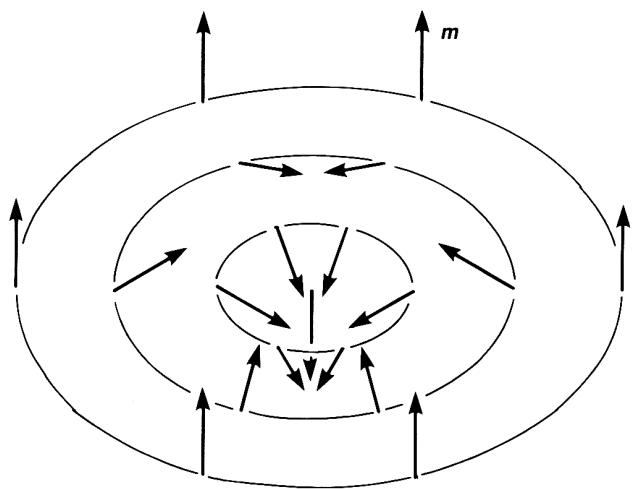
Figure 4.20. A sketch of the Belavin-Polyakov monopole. The vector approaches as .
4.8.2 Superfluid and superconductors
In Bogoliubov’s theory, the order parameter of superfluid is the expectation value
where is the field operator. In the operator formalism,
from which we find the number of particles is not conserved if . This is related to the spontaneous breakdown of the global gauge symmetry. The
Hamiltonian of is
Clearly is invariant under the global gauge transformation
The order parameter, however, transforms as
and hence does not observe the symmetry of the Hamiltonian. The phenomenological free energy describing is made up of two contributions. The main contribution is the condensation energy
where changes sign at the critical temperature . Figure 4.21 sketches for and . If , the minimum of is attained at while if at . If depends on , we have an additional contribution called the gradient energy
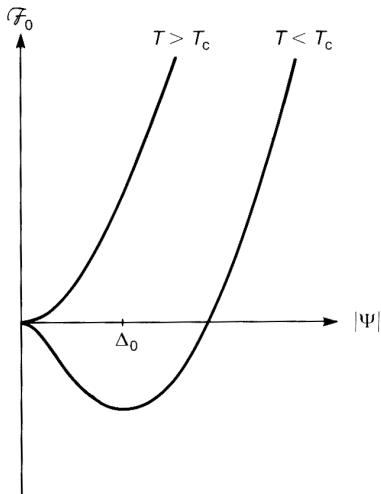
Figure 4.21. The free energy has a minimum at for and at for .
being a positive constant. If the spatial variation of is mild enough, we may assume is constant (the London limit).
In the BCS theory of superconductors, the order parameter is given by (Tsuneto 1982)
being the (non-relativistic) electron field operator of spin . It should be noted, however, that (4.64) is not an irreducible representation of the spin algebra. To see this, we examine the behaviour of under a spin rotation. Consider an infinitesimal spin rotation around an axis by an angle , whose matrix representation is
being the Pauli matrices. Since transforms as we have
where we note that . Suppose . Then does not change under this rotation, hence it represents the spin-singlet pairing. We write
If, however, we take
we have
This shows that is a vector in spin space, hence (4.65b) represents the spin-triplet pairing.
The order parameter of a conventional superconductor is of the form (4.65a) and we restrict the analysis to this case for the moment. In (4.65a), assumes the same form as of superfluid and the free energy is again given by (4.63). This similarity is attributed to the Cooper pair. In the superfluid state, a macroscopic number of atoms occupy the ground state (Bose-Einstein condensation) which then behaves like a huge molecule due to the quantum coherence. In this state creating elementary excitations requires a finite amount of energy and the flow cannot decay unless this critical energy is supplied. Since an electron is a fermion there is, at first sight, no Bose-Einstein condensation. The key observation is the Cooper pair. By the exchange of phonons, a pair of electrons feels an attractive force that barely overcomes the Coulomb repulsion. This tiny attractive force makes it possible for electrons to form a pair (in momentum space) that obeys Bose statistics. The pairs then condense to form the superfluid state of the Cooper pairs of electric charge .
An electromagnetic field couples to the system through the minimal coupling
(The term is used since the Cooper pair carries charge .) Superconductors are roughly divided into two types according to their behaviour in applied magnetic fields. The type-I superconductor forms an intermediate state in which normal and superconducting regions coexist in strong magnetic fields. The type-II superconductor forms a vortex lattice (Abrikosov lattice) to confine the magnetic fields within the cores of the vortices with other regions remaining in the superconducting state. A similar vortex lattice has been observed in rotating superfluid in a cylinder.
4.8.3 General consideration
In the next two sections, we study applications of homotopy groups to the classification of defects in ordered media. The analysis of this section is based on Toulouse and Kleman (1976), Mermin (1979) and Mineev (1980).
As we saw in the previous subsections, when a condensed matter system undergoes a phase transition, the symmetry of the system is reduced and this reduction is described by the order parameter. For definiteness, let us consider the three-dimensional medium of a superconductor. The order parameter takes the form . Let us consider a homogeneous system under uniform external conditions (temperature, pressure etc). The amplitude is uniquely fixed by minimizing the condensation free energy. Note that there are still a large number of degrees of freedom left. may take any value in the circle
determined by the phase . In this way, a uniform system takes its value in a certain region called the order parameter space. For a superconductor, . For the Heisenberg spin system, . The nematic liquid crystal has while for the superfluid , see sections 4.9- 4.10.
If the system is in an inhomogeneous state, the gradient free energy cannot be negligible and may not be in . If the characteristic size of the variation of the order parameter is much larger than the coherence length, however, we may still assume that the order parameter takes its value in , where the value is a function of position this time. If this is the case, there may be points, lines or surfaces in the medium on which the order parameter is not uniquely defined. They are called the defects. We have point defects (monopoles), line defects (vortices) and surface defects (domain walls) according to their dimensionalities. These defects are classified by the homotopy groups.
To be more mathematical, let be a space which is filled with the medium under consideration. The order parameter is a classical field , which is also regarded as a map . Suppose there is a defect in the medium. For concreteness, we consider a line defect in the three-dimensional medium of a superconductor. Imagine a circle which encircles the line defect. If each part of is far from the line defect, much further than the coherence length , we may assume the order parameter along takes its value in the order parameter space , see figure 4.22. This is how the fundamental group comes into the problem; we talk of loops in a topological space . The map is classified by the homotopy classes. Take a point and require that be mapped to . By noting that , we may assign an integer to the line defect. This integer is called the winding number since it counts how many times the image of winds the space . If two line defects have the
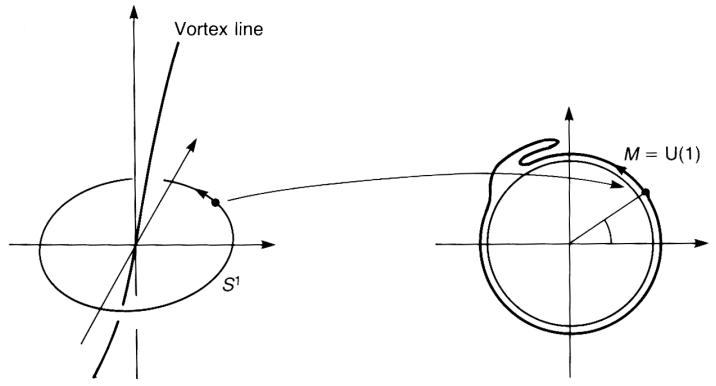
Figure 4.22. A circle surrounding a line defect (vortex) is mapped to . This map is classified by the fundamental group .
same winding number, one can be continuously deformed to the other. If two line defects and merge together, the new line defect belongs to the homotopy class of the product of the homotopy classes to which and belonged before coalescence. Since the group operation in is an addition, the new winding number is a sum of the old winding numbers. A uniform distribution of the order parameter corresponds to the constant map , which belongs to the unit element . If two line defects of opposite winding numbers merge together, the new line defect can be continuously deformed into the defect-free configuration.
What about the other homotopy groups? We first consider the dimensionality of the defect and the sphere which surrounds it. For example, consider a point defect in a three-dimensional medium. It can be surrounded by and the defect is classified by . If has many components, is non-trivial. Let us consider a three-dimensional Ising model for which . Then there is a domain wall on which the order parameter is not defined. For example, if for and for , there is a domain wall in the -plane at . In general, an -dimensional defect in a -dimensional medium is classified by the homotopy group where
In the case of the Ising model, , ; hence .
来源与版本
正文:英文 · OCR 机器稿 · 待校对
核对状态:OCR 机器稿 · 待校对
来源版本:second-edition-local
来源 PDF SHA-256:fcd24c3371d092a8c699ccf5cf0765462924b6c48412804231076e8084b1940d
OCR 来源 SHA-256:0b6324f01172a3548cd34382e82fd8bfae574602b6b2cfaa357ba96bc2c35478
OCR 产物 SHA-256:172f2a4b45b38ff65693febbb99b23dd2cbeb2c2dface9b7fb75e071505139af