4.9.1 Order parameter of nematic liquid crystals
Certain organic crystals exhibit quite interesting optical properties when they are in their fluid phases. They are called liquid crystals and they are characterized by their optical anisotropy. Here we are interested in so-called nematic liquid crystals. An example of this is octyloxy-cyanobiphenyl whose molecular structure is
The molecule of a nematic liquid crystal is very much like a rod and the order parameter, called the director, is given by the average direction of the rod. Even though the molecule itself has a head and a tail, the director has an inversion symmetry; it does not make sense to distinguish the directors and . We are tempted to assign a point on to specify the director. This works except for one point. Two antipodal points and represent the same state; see figure 4.23. Accordingly, the order parameter of the nematic liquid crystal is the projective plane . The director field in general
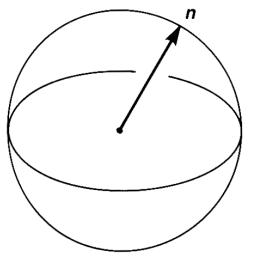
Figure 4.23. Since the director has no head or tail, one cannot distinguish from . Therefore, these two pictures correspond to the same order-parameter configuration.
depends on the position . Then we may define a map . This map is called the texture. The actual order-parameter configuration in is also called the texture.
4.9.2 Line defects in nematic liquid crystals
From example 4.10 we have . There exist two kinds of line defect in nematic liquid crystals; one can be continuously deformed into a uniform configuration while the other cannot. The latter represents a stable vortex, whose texture is sketched in figure 4.24. The reader should observe how the loop is mapped to by this texture.
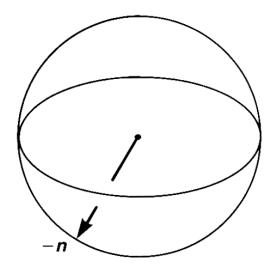
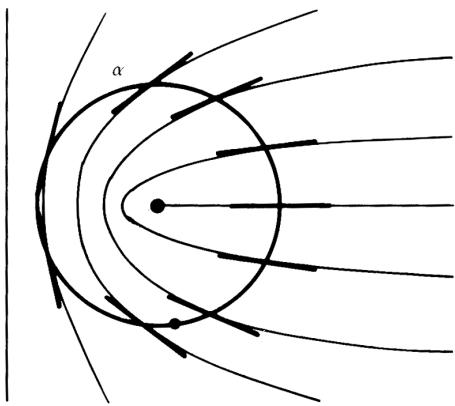
Figure 4.24. A vortex in a nematic liquid crystal, which corresponds to the non-trivial element of .
Show that the line ‘defect’ in figure 4.25 is fictitious, namely the singularity at the centre may be eliminated by a continuous deformation of directors with directors at the boundary fixed. This corresponds to the operation .
Figure 4.25. A line defect which may be continuously deformed into a uniform configuration.
4.9.3 Point defects in nematic liquid crystals
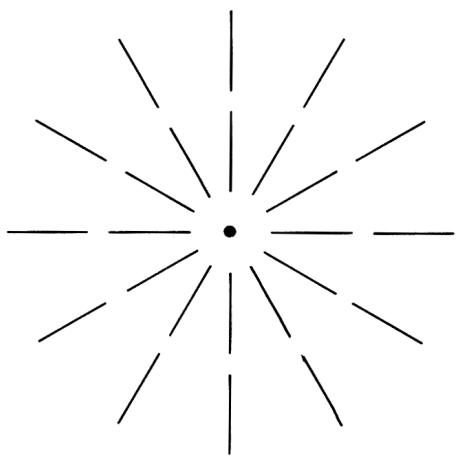
From example 4.14, we have . Accordingly, there are stable point defects in the nematic liquid crystal. Figure 4.26 shows the texture of the point defects that belong to the class .
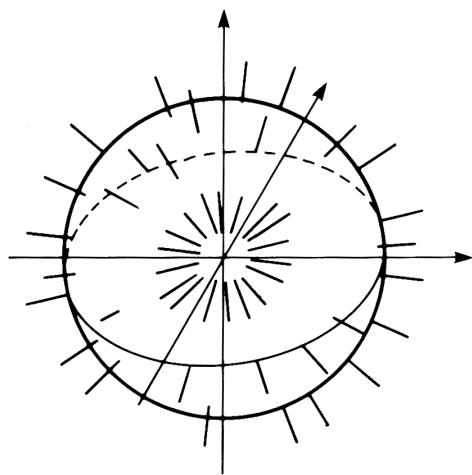
Figure 4.26. The texture of a point defect in a nematic liquid crystal.
It is interesting to point out that a line defect and a point defect may be combined into a ring defect, which is specified by both and , see Mineev (1980). If the ring defect is observed from far away, it looks like
a point defect, while its local structure along the ring is specified by . Figure 4.27 is an example of such a ring defect. The loop classifies while the sphere (2-loop) classifies .
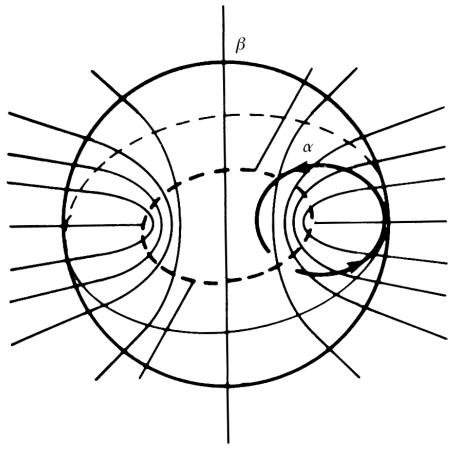
Figure 4.27. The texture of a ring defect in a nematic liquid crystal. The loop classifies while the sphere (2-loop) classifies .
4.9.4 Higher dimensional texture
The third homotopy group leads to an interesting singularity-free texture in a three-dimensional medium of nematic liquid crystal. Suppose the director field approaches an asymptotic configuration, say as . Then the medium is effectively compactified into the three-dimensional sphere and the topological structure of the texture is classified by . What is the texture corresponding to a non-trivial element of the homotopy group?
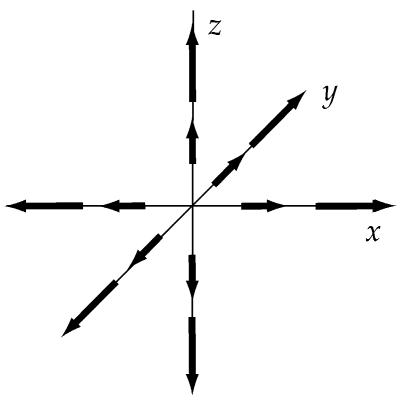
An arbitrary rotation in is specified by a unit vector , around which the rotation is carried out, and the rotation angle . It is possible to assign a ‘vector’ to this rotation. It is not exactly a vector since and are the same rotation and hence should be identified. Therefore, belongs to the real projective space . Suppose we take as a standard director. Then an arbitrary director configuration is specified by rotating around some axis by an angle : , where is the corresponding rotation matrix in SO(3). Suppose a texture field is given by applying the rotation
to , where is the unit vector in the direction of the position vector and
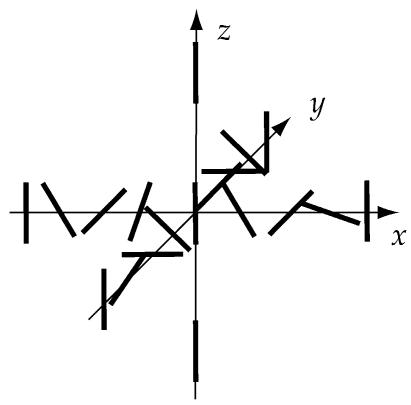
Figure 4.28 shows the director field of this texture. Note that although there is no singularity in the texture, it is impossible to ‘wind off’ this to a uniform configuration.
(a)
Figure 4.28. The texture of the non-trivial element of . (a) shows the rotation ‘vector’ . The length approaches as . (b) shows the corresponding director field.
(b)
来源与版本
正文:英文 · OCR 机器稿 · 待校对
核对状态:OCR 机器稿 · 待校对
来源版本:second-edition-local
来源 PDF SHA-256:fcd24c3371d092a8c699ccf5cf0765462924b6c48412804231076e8084b1940d
OCR 来源 SHA-256:0b6324f01172a3548cd34382e82fd8bfae574602b6b2cfaa357ba96bc2c35478
OCR 产物 SHA-256:f4f846ff09c81b19db79dc32112d7b451133bdade35995bbc26f6aea2d656b9f