5.5.1 Orientation
An integration of a differential form over a manifold is defined only when is ‘orientable’. So we first define an orientation of a manifold. Let be a connected -dimensional differentiable manifold. At a point , the tangent space is spanned by the basis , where is the local coordinate on the chart to which belongs. Let be another chart such that with the local coordinates . If , is spanned by either or . The basis changes as
If on , and are said to define the same orientation on and if , they define the opposite orientation.
Let be a connected manifold covered by . The manifold is orientable if, for any overlapping charts and , there exist local coordinates for and for such that .
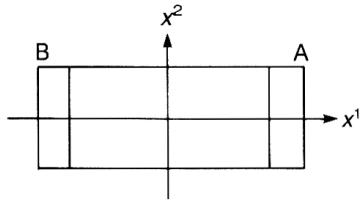
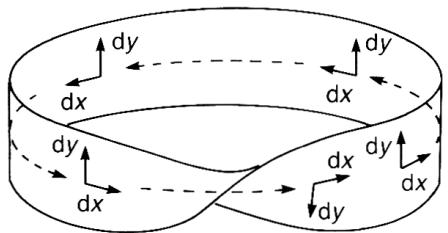
If is non-orientable, cannot be positive in all intersections of charts. For example, the Möbius strip in figure 5.14(a) is non-orientable since we have to choose to be negative in the intersection B.
(a)
(b)
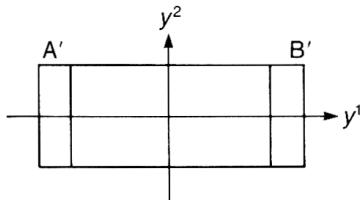
Figure 5.14. (a) The Möbius strip is obtained by twisting the part of the second strip by before pasting A with and B with . The coordinate change on B is , and the Jacobian is . (b) Basis frames on the Möbius strip.
If an -dimensional manifold is orientable, there exists an -form which vanishes nowhere. This -form is called a volume element, which plays the role of a measure when we integrate a function over . Two volume elements and are said to be equivalent if there exists a strictly positive function such that . A negative-definite function gives an inequivalent orientation to . Thus, any orientable manifold admits two inequivalent orientations, one of which is called right handed, the other left handed. Take an -form
with a positive-definite on a chart whose coordinate is . If is orientable, we may extend throughout such that the component is positive definite on any chart . If is orientable, this is a volume element. Note that this positivity of is independent of the choice of coordinates. In fact, let and let and be the coordinates of and , respectively. Then (5.98) becomes
The determinant in (5.99) is the Jacobian of the coordinate transformation and must be positive by assumed orientability. If is non-orientable, with a positive-definite component cannot be defined on . Let us look at figure 5.14 again. If we circumnavigate the strip along the direction shown in the figure, changes the signature when we come back to the starting point. Hence, cannot be defined uniquely on .
5.5.2 Integration of forms
Now we are ready to define an integration of a function over an orientable manifold . Take a volume element . In a coordinate neighbourhood with the coordinate , we define the integration of an -form by
The RHS is an ordinary multiple integration of a function of variables. Once the integral of over is defined, the integral of over the whole of is given with the help of the ‘partition of unity’ defined now.
Take an open covering of such that each point of is covered with a finite number of . [If this is always possible, is called paracompact, which we assume to be the case.] If a family of differentiable functions satisfies
(i)
(ii) if and
(iii) for any pointthe family is called a partition of unity subordinate to the covering .
From condition (iii), it follows that
where vanishes outside by (ii). Hence, given a point , assumed paracompactness ensures that there are only finite terms in the summation over in (5.101). For each , we may define the integral over according to (5.100). Finally the integral of on is given by
Although a different atlas gives different coordinates and a different partition of unity, the integral defined by (5.102) remains the same.
Let us take the atlas of defined in example 5.2. Let , , and . The reader should verify that is a partition of unity subordinate to . Let us integrate a function , for example. [Of course we know
but let us use the partition of unity.] We have
So far, we have left arbitrary provided it is strictly positive. The reader might be tempted to choose to be unity. However, as we found in (5.99), is multiplied by the Jacobian under the change of coordinates and there is no canonical way to single out the component ; unity in one coordinate might not be unity in the other. The situation changes if the manifold is endowed with a metric, as we will see in chapter 7.
来源与版本
正文:英文 · OCR 机器稿 · 待校对
核对状态:OCR 机器稿 · 待校对
来源版本:second-edition-local
来源 PDF SHA-256:fcd24c3371d092a8c699ccf5cf0765462924b6c48412804231076e8084b1940d
OCR 来源 SHA-256:0b6324f01172a3548cd34382e82fd8bfae574602b6b2cfaa357ba96bc2c35478
OCR 产物 SHA-256:eaf4272ea8bfc2311bff66a600ea7668c625e5c35a4e6b7b9b53d5f4a5519545