Quantum field theory (QFT) is occasionally called particle physics since it deals with the dynamics of particles. As far as high-energy processes whose typical energy is much smaller than the Planck energy ( ) are concerned there is no objection to this viewpoint. However, once we try to quantize gravity in this framework, there exists an impenetrable barrier. We do not know how to renormalize the ultraviolet divergences that are ubiquitous in the QFT of gravity. In the early 1980s, physicists tried to construct a consistent theory of gravity by introducing supersymmetry. In spite of a partial improvement, the resulting supergravity could not tame the ultraviolet behaviour completely.
In the late 1960s and early 1970s, the dual resonance model was extensively studied as a candidate for a model of hadrons. In this, particles are replaced by one-dimensional objects called strings. Unfortunately, it turned out that the theory contained tachyons (imaginary mass particles) and spin-2 particles and, moreover, it is consistent only in 26-dimensional spacetime! Due to these difficulties, the theory was abandoned and taken over by quantum chromodynamics (QCD). However, a small number of people noticed that the theory must contain the graviton and they thought it could be a candidate for the quantum theory of gravity.
Nowadays, supersymmetry has been built into string theory to form the superstring theory, which is free of tachyons and consistent in ten-dimensional spacetime. There are several candidates for consistent superstring theories. It is sometimes suggested that complete mathematical consistency will single out a unique theory of everything (TOE).
In this book, we study the elementary aspects of bosonic string theory in the final chapter. We also study some mathematical tools relevant for superstrings. The classical review is that of Scherk (1975). We give more references in chapter 14.
7.11.1 The string action
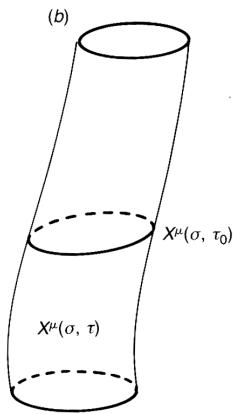
The trajectory of a particle in a -dimensional Minkowski spacetime is given by the set of functions , , where parametrizes the trajectory. A string is a one-dimensional object and its configuration is parametrized by two numbers , being spacelike and timelike. Its position in -dimensional Minkowski spacetime is given by , see figure 7.9. The parameter can be normalized as . A string may be open or closed. We now seek an action that governs the dynamics of strings.
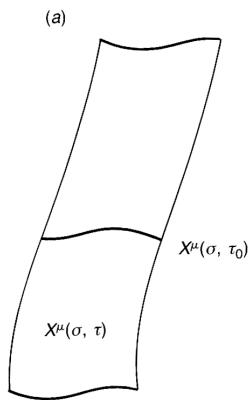
Figure 7.9. The trajectories of an open string and a closed string . Slices of the trajectories at fixed parameter are also shown.
We first note that the action of a relativistic particle is the length of the world line,
where . For some purposes, it is convenient to take another expression,
where the auxiliary variable is regarded as a metric.
Write down the Euler-Lagrange equations derived from (7.231). Eliminate from (7.231) making use of the equation of motion to reproduce (7.230).
What is the advantage of (7.231) over (7.230)? We first note that (7.231) makes sense even when , while (7.230) vanishes in this case. Second, (7.231) is quadratic in while the -dependence of (7.230) is rather complicated.
Nambu (1970) proposed an action describing the strings, which is proportional to the area of the world sheet, the surface spanned by the trajectory of a string. Clearly this is a generalization of the length of the world line of a particle. He proposed the Nambu action,
where and . The parameter is the initial (final) value of the parameter while is a parameter corresponding to the inverse string tension (the Regge slope).
The action is required to have no dimension. We take and to be dimensionless. Show that the dimension of is .
Although the action provides a nice geometrical picture, it is not quadratic in and it turned out that the quantization of the theory was rather difficult. Let us seek an equivalent action which is easier to quantize. We proceed analogously to the case of point particles. A quadratic action for strings is called the Polyakov action (Polyakov 1981) and is given by
where and . If the string is open, the trajectory is a sheet while if it is closed, it is a tube, see figure 7.9. It is shown here that the action (7.233) agrees with (7.232) upon eliminating . It should be noted though that this is true only for the Lagrangian. There is no guarantee that this remains true at the quantum level. It has been shown that the quantum theory based on the respective Lagrangians agrees only for . The action (7.233) is invariant under
(i) local reparametrization of the world sheet
(ii) Weyl rescaling
(iii) global Poincaré invariance
These symmetries will be worked out later.
Taking advantage of symmetries (i) and (iii), it is always possible to choose in the form . Write down the equation of motion for to show that it obeys the equation
7.11.2 Symmetries of the Polyakov strings
The bosonic string theory is defined on a two-dimensional Lorentz manifold . The embedding is defined by where are the local coordinates of . We assume the physical spacetime is Minkowskian for simplicity. The Polyakov action
is left invariant under the coordinate reparametrization since the volume element is invariant and is a scalar.
Now we are ready to derive the equation of motion. Our variational parameters are the embedding and the geometry . Under the variation , we have the Euler-Lagrange equation
Under the variation , the integrand of changes as
where proposition 7.2 has been used. Since this should vanish for any variation , we should have
This is solved for to yield
showing that the induced metric (the RHS) agrees with . Substituting (7.238) into (7.236) to eliminate , we recover the Nambu action,
By construction, the action is invariant under local reparametrization of , . In addition to this, the action has extra invariances. Under the global Poincaré transformation in -dimensional spacetime,
the action transforms as
From , we find that is invariant under global Poincaré transformations. The action is also invariant under the Weyl rescaling, keeping fixed. In fact, transforms as
and hence is left invariant. Note that the Weyl rescaling invariance exists only when is two dimensional, making strings prominent among other extended objects such as membranes.
Since , we can always parametrize the world sheet by the isothermal coordinate (example 7.9) so that
Then the Weyl rescaling invariance allows us to choose the standard metric on the world sheet. The metric has three independent components while the reparametrization has two degrees of freedom and the Weyl scaling invariance has one. Thus, so long as we are dealing with strings, we can choose the standard metric .
We end our analysis of Polyakov strings here. Polyakov strings will be quantized in the most elegant manner in chapter 14.
Let and be Riemannian manifolds. Take a chart of in which the metric takes the form
Take a chart of on which takes the form
A map defined by is called a harmonic map if it satisfies
Show that this equation is obtained by the variation of the action
with respect to . Applications of harmonic maps to physics are found in Misner (1978) and Sánchez (1988). Mathematical aspects have been reviewed in Eells and Lemaire (1968).
7.1 Let be a general connection for which the torsion tensor does not vanish. Show that the first Bianchi identity becomes
where is the symmetrizer defined in theorem 7.2. Show also that the second Bianchi identity is given by
where symmetrizes and only.
7.2 Let be a conformally flat three-dimensional manifold. Show that the Weyl-Schouten tensor defined by
vanishes. It is known that is the necessary and sufficient condition for conformal flatness if .
7.3 Consider a metric
where and . Introduce a new variable
and show that the metric reduces to the Minkowski metric. Does this mean that describes Minkowski spacetime? Compute the Riemann curvature tensor and show that there is a stringlike singularity at . This singularity is conical (the spacetime is flat except along the line). This metric models the spacetime of a cosmic string.
来源与版本
正文:英文 · OCR 机器稿 · 待校对
核对状态:OCR 机器稿 · 待校对
来源版本:second-edition-local
来源 PDF SHA-256:fcd24c3371d092a8c699ccf5cf0765462924b6c48412804231076e8084b1940d
OCR 来源 SHA-256:0b6324f01172a3548cd34382e82fd8bfae574602b6b2cfaa357ba96bc2c35478
OCR 产物 SHA-256:1a8e2da24e89a54f48fe346404ee6eaa2fc96570c15e2ebf32549f7b8c1dfe75