Let be a manifold and let be a discrete group which acts on . Then the quotient space is called an orbifold. As we will see later there are fixed points in , which do not transform under the action of . These points are singular and the orbifold is not a manifold in general. Thus, even though we start with a simple manifold , the orbifold may have quite a complicated topology.
8.8.1 One-dimensional examples
To obtain a concrete idea, let us consider a simple example. Take which is to be identified with the complex plane . Let us take and identify the points , and . The orbifold consists of a third of the
complex plane and after the identification of the edges we end up with a cone, see figure 8.6. It is interesting to see what the holonomy group of this orbifold is. We use the flat connection induced by the Euclidean metric of . Then, after the parallel transport of a vector along the loop (this is indeed a loop!), we obtain a vector which is different from after the identification. Observe that the angle between and is . It is easy to verify that the holonomy group is . Since the holonomy is trivial for the loop which does not encircle the origin, we find that the curvature is singular at the origin (recall that the curvature measures the non-triviality of the holonomy, see section 7.3). In general the fixed points (the origin in the present case) are singular points of the curvature. Note, however, that is a manifold since it has an open covering homeomorphic to .
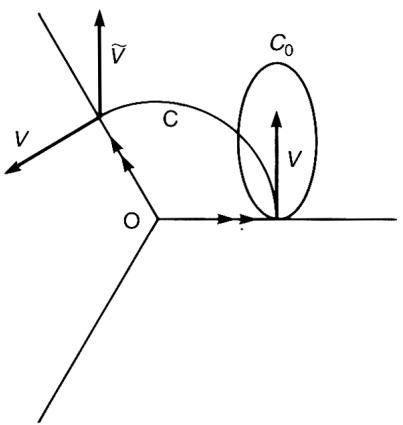
Figure 8.6. The orbifold is a third of the complex plane. The edges of the orbifold are identified as shown in the figure. becomes a vector after parallel transportation along . The angle between and is .
A less trivial example is obtained by taking the torus as the manifold. We identify the points and in the complex plane; see figure 8.7(a). If we identify the edges of the parallelogram OPQR, we have the torus . Let act on as . We find that there are three inequivalent fixed points where and 2. This orbifold consists of two triangles surrounding a hollow; see figure 8.7(b). If the flat connection induced by the flat metric of the torus is employed to define the parallel transport of vectors, we find that the holonomy around each fixed point is .
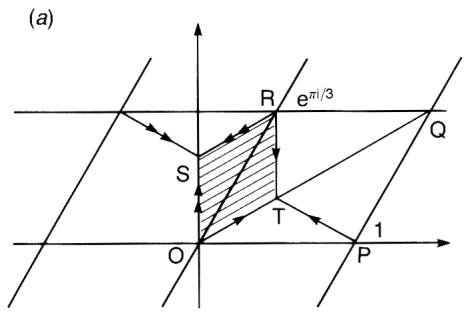
Figure 8.7. Under the action of , points of the torus are identified. The shaded area is the orbifold . If the edges of the orbifold are identified, we end up with the object in figure 8.7(b), which is homeomorphic to the sphere .
8.8.2 Three-dimensional examples
Orbifolds with three complex dimensions have been proposed as candidates for superstring compactification. The detailed treatment of this subject is outside the scope of this book and the reader should consult Dixson et al (1985, 1986) and Green et al (1987).
Let be a three-dimensional complex torus, where is a lattice in . For definiteness, let be the coordinates of and identify and . Under this identification, is identified with a product of three tori, . admits, as before, the action of defined
by . If each takes one of the values 0, , , the action of leaves the point invariant. Thus, there are fixed points in the orbifold. In the present case, the fixed point is a conical singularity (figure 8.8) and the orbifold cannot be a manifold. [Remarks: The appearance of the conical singularity can be understood more easily from a simpler example. Let and let act on as . Then the orbifold has a conical singularity at the origin. In fact, let be an embedding of in . Note that and satisfy a relation . If and are thought of as real variables, this is simply the equation of a cone.]
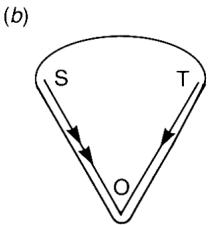
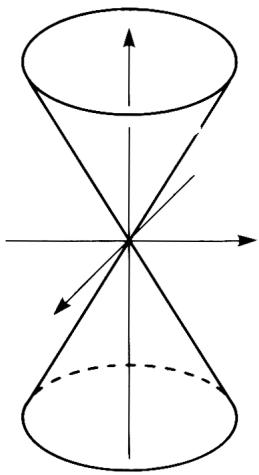
Figure 8.8. The conical singularity. The origin does not look like or .
来源与版本
正文:英文 · OCR 机器稿 · 待校对
核对状态:OCR 机器稿 · 待校对
来源版本:second-edition-local
来源 PDF SHA-256:fcd24c3371d092a8c699ccf5cf0765462924b6c48412804231076e8084b1940d
OCR 来源 SHA-256:0b6324f01172a3548cd34382e82fd8bfae574602b6b2cfaa357ba96bc2c35478
OCR 产物 SHA-256:ec0d2b1766da26d6be87f71016fb6d8f41843f9b1bb263a53f159e6022f6c54d