The tangent bundle in the previous section is an example of a more general framework called a fibre bundle. Definitions are now in order.
9.2.1 Definitions
A (differentiable) fibre bundle consists of the following elements:
(i) A differentiable manifold called the total space.
(ii) A differentiable manifold called the base space.
(iii) A differentiable manifold called the fibre (or typical fibre).
(iv) A surjection called the projection. The inverse image is called the fibre at .
(v) A Lie group called the structure group, which acts on on the left.
(vi) A set of open covering of with a diffeomorphism such that . The map is called the local trivialization since maps onto the direct product .
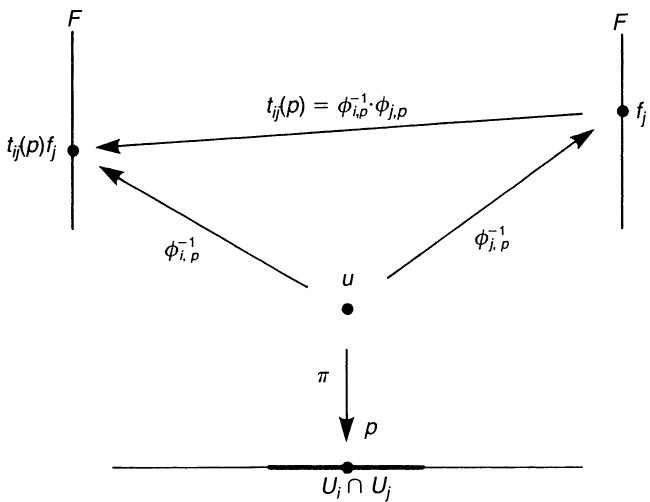
(vii) If we write , the map is a diffeomorphism. On , we require that be an element of . Then and are related by a smooth map as (figure 9.2)
Figure 9.2. On the overlap , two elements are assigned to , . They are related by as .
The maps are called the transition functions.
[Remarks: We often use a shorthand notation or simply to denote a fibre bundle .]
Strictly speaking, the definition of a fibre bundle should be independent of the special covering of . In the mathematical literature, this definition is employed to define a coordinate bundle . Two coordinate bundles and are said to be equivalent if is again a coordinate bundle. A fibre bundle is defined as an equivalence class of coordinate bundles. In practical applications in physics, however, we always employ a certain
definite covering and make no distinction between a coordinate bundle and a fibre bundle.]
We need to clarify several points. Let us take a chart of the base space . is a direct product diffeomorphic to , being the diffeomorphism. If , we have two maps and on . Let us take a point such that . We then assign two elements of , one by and the other by ,
see figure 9.2. There exists a map which relates and as . This is also written as (9.4).
We require that the transition functions satisfy the following consistency conditions:
Unless these conditions are satisfied, local pieces of a fibre bundle cannot be glued together consistently. If all the transition functions can be taken to be identity maps, the fibre bundle is called a trivial bundle. A trivial bundle is a direct product .
Given a fibre bundle , the possible set of transition functions is obviously far from unique. Let be a covering of and and be two sets of local trivializations giving rise to the same fibre bundle. The transition functions of respective local trivializations are
Define a map at each point by
We require that be a homeomorphism which belongs to . This requirement must certainly be fulfilled if and describe the same fibre bundle. It is easily seen from (9.7) and (9.8) that
In the practical situations which we shall encounter later, are the gauge transformations required for pasting local charts together, while corresponds to the gauge degrees of freedom within a chart . If the bundle is trivial, we may put all the transition functions to be identity maps. Then the most general form of the transition functions is
Let be a fibre bundle. A section (or a cross section) is a smooth map which satisfies . Clearly, is an element of . The set of sections on is denoted by . If , we may talk of a local section which is defined only on . denotes the set of local sections on . For example, is identified with the set of vector fields . It should be noted that not all fibre bundles admit global sections.
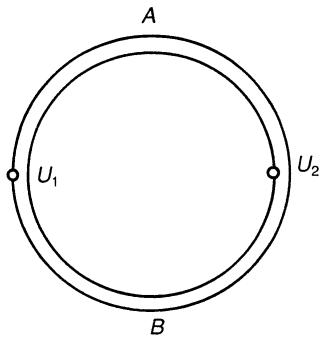
Let be a fibre bundle with a typical fibre . Let and be an open covering of and let and be the intersection , see figure 9.3. The local trivializations and are given by
Figure 9.3. The base space and two charts and over which the fibre bundle is trivial.
for and . The transition function , , is the identity map . We have two choices on ;
(I) (II)
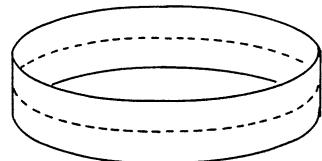
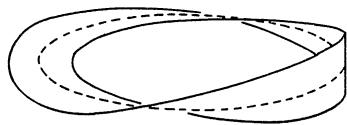
For case (I), we find that is the identity map and two pieces of the local bundles are glued together to form a cylinder (figure 9.4(a)). For case (II), we have , and obtain the Möbius strip (figure 9.4(b)). Thus, a cylinder has the trivial structure group where is the identity map of onto while the Möbius strip has where . Since , we find . A cylinder is a trivial bundle , while the Möbius strip is not. [Remark: The group is not a Lie group. This is the only occasion we use a discrete group for the structure group.]
(a)
(b)
Figure 9.4. Two fibre bundles over : (a) is the cylinder which is a trivial bundle ; (b) is the Möbius strip.
9.2.2 Reconstruction of fibre bundles
What is the minimal information required to construct a fibre bundle? We now show that for given , , , and , we can reconstruct the fibre bundle . This amounts to finding a unique , and from given data. Let us define
Introduce an equivalence relation between and by if and only if and . A fibre
bundle is then defined as
Denote an element of by . The projection is given by
The local trivialization is given by
The reader should verify that and thus defined satisfy all the axioms of fibre bundles. Thus, the given data reconstruct a fibre bundle uniquely.
This procedure may be employed to construct a new fibre bundle from an old one. Let be a fibre bundle. Associated with this bundle is a new bundle whose base space is , transition function , structure group and fibre on which acts. Examples of associated bundles will be given later.
9.2.3 Bundle maps
Let and be fibre bundles. A smooth map is called a bundle map if it maps each fibre of onto of . Then naturally induces a smooth map such that (figure 9.5). Observe that the diagram
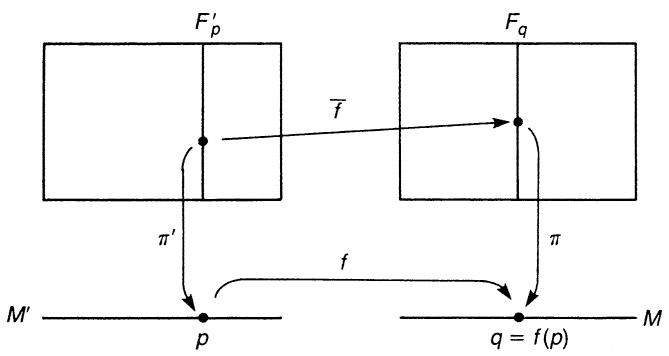
Figure 9.5. A bundle map induces a map .
commutes. [Caution: A smooth map is not necessarily a bundle map. It may map of to and on different fibres of so that .]
9.2.4 Equivalent bundles
Two bundles and are equivalent if there exists a bundle map such that is the identity map and is a diffeomorphism:
This definition of equivalent bundles is in harmony with that given in the remarks following definition 9.1.
9.2.5 Pullback bundles
Let be a fibre bundle with typical fibre . If a map is given, the pair defines a new fibre bundle over with the same fibre (figure 9.6). Let be a subspace of , which consists of points such that . is called the pullback of by . The fibre of is just a copy of the fibre of . If we define by and by , the pullback may be endowed with the structure of a fibre bundle and we obtain the following bundle map,
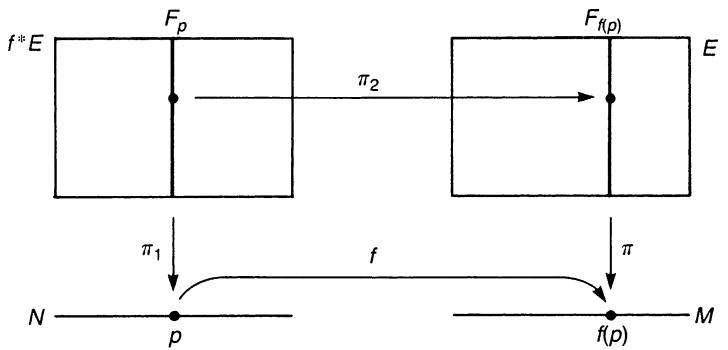
Figure 9.6. Given a fibre bundle , a map defines a pullback bundle over .
The commutativity of the diagram follows since for . In particular, if and , then two fibre bundles and are equivalent.
Let be a covering of and be local trivializations. defines a covering of such that is locally trivial. Take such that for some . If we find where is the local trivialization of . The transition function at maps to . The corresponding transition function of at also maps to ; see figure 9.7. This shows that
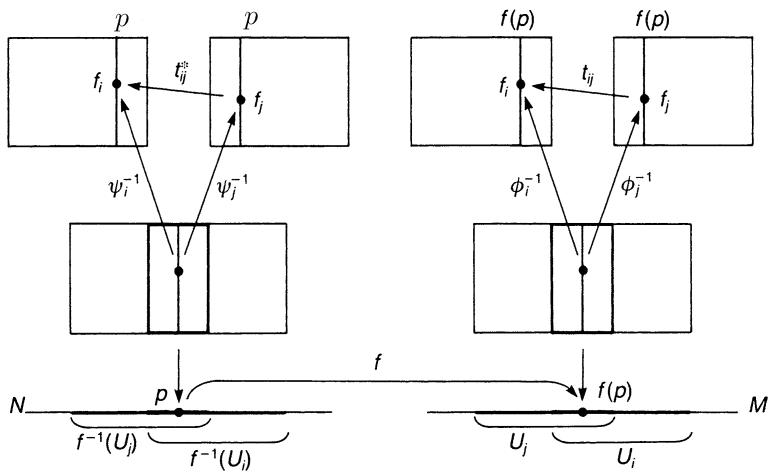
Figure 9.7. The transition function of the pullback bundle is a pullback of the transition function of .
Let and be differentiable manifolds with . Let be a smooth map. The map induces a map such that the following diagram commutes:
Let be a vector of and be the corresponding vector of . If is a pullback bundle , maps to diffeomorphically. This is possible if and only if has the maximal rank at
each point of . Let be the coordinates of in a chart of , where are the coordinates of in a chart of . The maximal rank condition is given by for any .
9.2.6 Homotopy axiom
Let and be maps from to . They are said to be homotopic if there exists a smooth map such that and for any , see section 4.2.
Let be a fibre bundle with fibre and let and be homotopic maps from to . Then and are equivalent bundles over .
The proof is found in Steenrod (1951). Let be a manifold which is contractible to a point. Then there exists a homotopy such that
where is a fixed point. Let be a fibre bundle over and consider pullback bundles and , where . The fibre bundle is a pullback of a fibre bundle and hence is a trivial bundle: . However, since is the identity map. According to theorem 9.1, is equivalent to , hence is a trivial bundle. For example, the tangent bundle is trivial. We have obtained the following corollary.
Let be a fibre bundle. is trivial if is contractible to a point.
来源与版本
正文:英文 · OCR 机器稿 · 待校对
核对状态:OCR 机器稿 · 待校对
来源版本:second-edition-local
来源 PDF SHA-256:fcd24c3371d092a8c699ccf5cf0765462924b6c48412804231076e8084b1940d
OCR 来源 SHA-256:0b6324f01172a3548cd34382e82fd8bfae574602b6b2cfaa357ba96bc2c35478
OCR 产物 SHA-256:e9cf1de192524c4c43490cdae4620757a7dc85b2c097852839c7190e964b2d67