So far we have been concerned with index theorems defined on a compact manifold without a boundary. In practical situations in physics, we often need to find an index of an operator defined over a base space with a boundary. The extensions of the AS index theorem to these cases are discussed here. Our argument is restricted to the spin bundle over since this is the only situation we shall be concerned with in chapter 13.
12.8.1 -invariant and spectral flow
Let be a Hermitian Dirac operator defined on an odd-dimensional manifold , . Since is Hermitian, the eigenvalues are real. We define the -invariant of by the spectral asymmetry of ,
This is not well defined and requires a proper regularization. For example, we may define by where
It can be shown that, under proper boundary conditions, has no pole at .
Use the Mellin transformation
to verify that
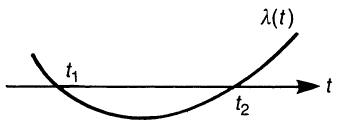
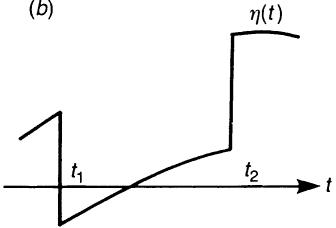
Suppose a Dirac field is interacting with an external gauge potential , . The Dirac operator has a -dependent eigenvalue problem. If an eigenvalue of crosses zero, the -invariant jumps by . This jump
denotes the spectral flow from modes to modes; if jumps by , there is a flow of a state from to ( to ), see figure 12.1. In addition to the discontinuous change associated with the spectral flow, i also has a continuous variation . We have
(a)
(b)
Figure 12.1. Whenever an eigenvalue crosses zero , the -invariant jumps by . The sign depends on the way in which crosses zero.
12.8.2 The Atiyah-Patodi-Singer (APS) index theorem
Let us consider a -dimensional Dirac operator
where
[Remark: The positions of and are reversed since
for our choice of -matrices; cf (12.79).]
Theorem 12.3 · Atiyah-Patodi-Singer theorem
Let be an odd-dimensional manifold and a Dirac operator on interacting with an external gauge field . Then,
The general argument shows that the continuous part of the -invariant satisfies
Then the RHS of (12.123) is simply the spectral flow
Thus, we find another expression for the APS index theorem,
The proof of the APS index theorem in its most general form is found in Atiyah et al (1975a, b, 1976). The physicists’ proof is found in Alvarez-Gaume et al (1985). We use the APS index theorem to study the odd-dimensional parity anomaly in section 13.6.
To see why the spectral flow appears in the index theorem, we consider an example taken from Atiyah (1985). Let and be its coordinate. Consider a Hermitian operator
The term is thought of as a U(1) gauge potential. The eigenvector and the eigenvalue of are
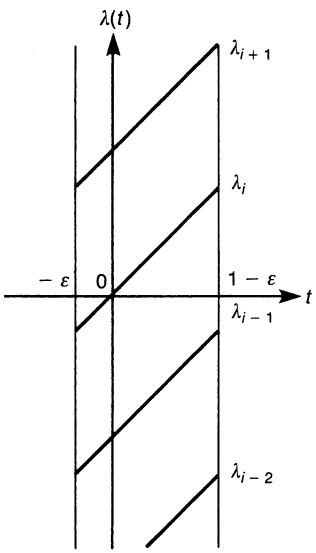
Since , the family of operators is periodic in with the period 1, see figure 12.2. This periodicity manifests itself in the gauge equivalence of and :
Figure 12.2. Time evolution of the eigenvalues of . Spec has period 1. The th eigenvalue crosses zero at and, hence, there is a unit spectral flow.
There is precisely unit spectral flow from to at while changes from to , being a small positive number. From , we construct a two-dimensional Dirac operator
where
These operators act on functions which satisfy the boundary conditions
Let . We have a Fourier expansion
It follows from that
which is easily solved to yield
The boundary conditions (12.128) require that
from which we find that is independent of . Thus, is one dimensional and is spanned by the theta function,
Suppose . If we put , satisfies
The solution of this equation is
and, hence, cannot be normalized. This shows that
which agrees with (spectral flow).
来源与版本
正文:英文 · OCR 机器稿 · 待校对
核对状态:OCR 机器稿 · 待校对
来源版本:second-edition-local
来源 PDF SHA-256:fcd24c3371d092a8c699ccf5cf0765462924b6c48412804231076e8084b1940d
OCR 来源 SHA-256:0b6324f01172a3548cd34382e82fd8bfae574602b6b2cfaa357ba96bc2c35478
OCR 产物 SHA-256:453d1a90795d3e2c18e9bf0cc550643c47b73fb755752d878ef9edbc0e2440b7