22.2 Creation and annihilation operators
Concept links · terms present in this machine draft; source roles are unverified: eigenvalue
It turns out that there is a quite easy method which allows one to explicitly find eigenfunctions and eigenvalues of the harmonic oscillator Hamiltonian (although it’s harder to show it gives all of them). This also leads to a new representation of the Heisenberg group (of course unitarily equivalent to the Schr¨odinger one by the Stone-von Neumann theorem). Instead of working with the self-adjoint operators and P that satisfy the commutation relation
we define
which satisfy the commutation relation
Since
the Hamiltonian operator is
The problem of finding eigenvectors and eigenvalues for is seen to be equivalent to the same problem for the operator
Such an operator satisfies the commutation relations
and
If |c⟩ is a normalized eigenvector of with eigenvalue one has
so eigenvalues of must be non-negative. Using the commutation relations of gives
and
This shows that will have eigenvalue for , and a normalized eigenfunction for N will be
Similarly, since
we have
If we start of with a state |0⟩ that is a non-zero eigenvector for with eigenvalue we see that the eigenvalues of will be the non-negative integers, and for this reason is called the “number operator”.
We can find such a state by looking for solutions to
|0⟩ will have energy eigenvalue , and this will be the lowest energy eigenstate. Acting by n-times on |0⟩ gives states with energy eigenvalue . The equation for |0⟩ is
One can check that this equation has a single normalized solution
which is the lowest-energy eigenfunction.
The rest of the energy eigenfunctions can be found by computing
To show that these are the eigenfunctions of equation 22.2, one starts with the definition of Hermite polynomials as a generating function
and interprets the as the Taylor coeficients of the left-hand side at deriving the identity
Taking q to this can be used to show that is given by 22.2. In the physical interpretation of this quantum system, the state , with energy is thought of as a state describing n “quanta”. The state |0⟩ is the “vacuum state” with zero quanta, but still carrying a “zero-point” energy of . The operators and a have somewhat similar properties to the raising and lowering operators we used for but their commutator is diferent (the identity operator), leading to simpler behavior. In this case they are called “creation” and “annihilation” operators respectively, due to the way they change the number of quanta. The relation of such quanta to physical particles like the photon is that quantization of the electromagnetic field (see chapter 46) involves quantization of an infinite collection of oscillators, with the quantum of an oscillator corresponding physically to a photon with a specific momentum and polarization. This leads to a well known problem of how to handle the infinite vacuum energy corresponding to adding up ℏ for each oscillator.
The first few eigenfunctions are plotted below. The lowest energy eigenstate is a Gaussian centered at with a Fourier transform that is also a Gaussian centered at . Classically the lowest energy solution is an oscillator at rest at its equilibrium point , but for a quantum oscillator one cannot have such a state with a well-defined position and momentum. Note that the plot gives the wavefunctions, which in this case are real and can be negative. The square of this function is what has an interpretation as the probability density for measuring a given position.
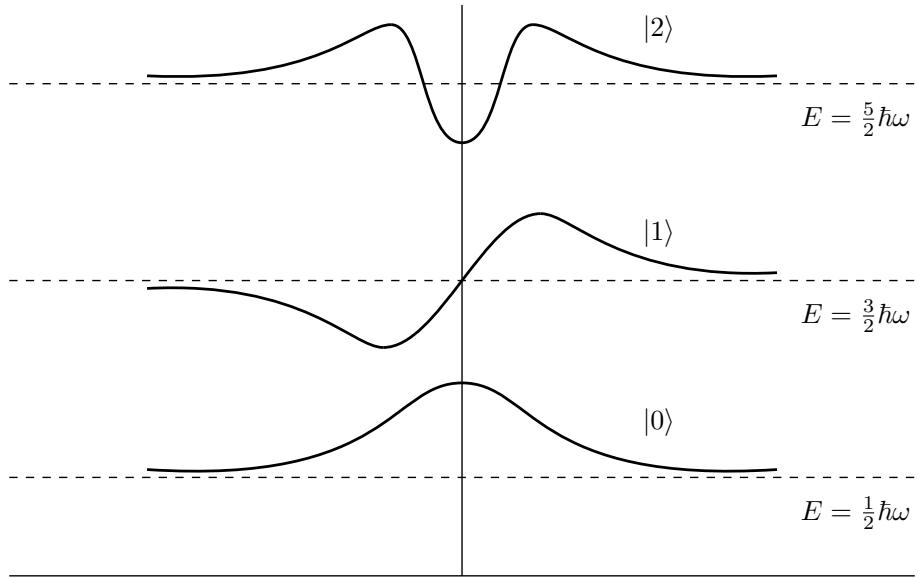
Figure 22.1: Harmonic oscillator energy eigenfunctions.
While we have preserved constants in our calculations in this section, in what follows we will often for simplicity set , which can be done by an appropriate choice of units. Equations with the constants can be recovered by rescaling. In particular, our definition of annihilation and creation operators will be given by
来源与版本
正文:英文 · OCR 机器稿 · 待校对
核对状态:OCR 机器稿 · 待校对
原书 PDF · 印刷页 244、245、246、247、248、249、250、251、252、253
来源版本:2025-10-20
来源 PDF SHA-256:5a1941b2443b54d5db3d055f1e5ba390429b7a728475258017aaac87ee85a837
OCR 来源 SHA-256:461cd8acacffadb41f056f9b4158f2b227594f8538628d1a31493d321b2ecd97
OCR 产物 SHA-256:461cd8acacffadb41f056f9b4158f2b227594f8538628d1a31493d321b2ecd97