Free vector spaces
If is an arbitrary set, the concept of a free vector space on over a field can be thought of intuitively as the set of all ‘formal finite sums’
The word ‘formal’ means that if is an algebraic structure that already has a concept of addition or scalar multiplication defined on it, then the scalar product and summation in the formal sum bears no relation to these.
More rigorously, the free vector space on a set is defined as the set of all functions that vanish at all but a finite number of elements of . Clearly is a vector space with the usual definitions,
It is spanned by the characteristic functions (see Example 1.7)
since any function having non-zero values at just a finite number of places can be written uniquely as
Evidently the elements of are in one-to-one correspondence with the ‘formal finite sums’ alluded to above.
The vector space defined in Example 3.10 is isomorphic with the free vector space on any countably infinite set , since the map defined by
is linear, one-to-one and onto.
The tensor product
Let and be two vector spaces over a field . Imagine forming a product between elements of these two vector spaces, called their ‘tensor product’, subject to the rules
The main difficulty with this simple idea is that we have no idea of what space belongs to. The concept of a free vector space can be used to give a proper definition for this product.
Let be the free vector space over . This vector space is, in a sense, much too ‘large’ since pairs such as and , or and are totally unrelated in . To reduce the vector space to sensible proportions, we define to be the vector subspace of generated by all elements of the form
where, for notational simplicity, we make no distinction between a pair and its characteristic function . The subspace contains essentially all vector combinations that are to be identified with the zero element. The tensor product of and is defined to be the factor space
The tensor product of a pair of vectors and is defined as the equivalence class or coset in to which belongs,
This product is bilinear,
To show the first identity,
and the second identity is similar.
If and are both finite dimensional let be a basis for , and a basis of . Every tensor product can, through bilinearity, be written
We will use the term tensor to describe the general element of . Since every tensor is a finite sum of elements of the form it can, on substituting Eq. (7.1), be expressed in the form
Hence the tensor product space is spanned by the tensors
Furthermore. these tensors form a basis of since they are linearly independent. To prove this statement, let be any ordered pair of linear functionals Such a pair defines a linear functional on by setting
and extending to all of by linearity,
This linear functional vanishes on the subspace and therefore ‘passes to’ the tensor product space by setting
Let be the dual bases in and respectively; we then have
Hence the tensors are l.i. and form a basis of . The dimension of is given by
Setting , the elements of are called contravariant tensors of degree 2 on . If is a basis of every contravariant tensor of degree 2 has a unique expansion
and the real numbers are called the components of the tensor with respect to this basis. Similarly each element of is called a covariant tensor of degree 2 on and has a unique expansion with respect to the dual basis
Dual representation of tensor product
Given a pair of vector spaces and over a field , a map is said to be bilinear if
for all , and . Bilinear maps can be added and multiplied by scalars in a manner similar to that for linear functionals given in Section 3.7, and form a vector space that will be denoted
Every pair of vectors where defines a bilinear map . by setting
We can extend this correspondence to all of in the obvious way by setting
and since the action of any generators of the subspace , such as , clearly vanishes on , the correspondence passes in a unique way to the tensor product space . That is, every tensor defines a bilinear map , by setting
This linear mapping from into the space of bilinear maps on is also one-to-one in the case of finite dimensional vector spaces. For, suppose for all . Let be bases of and respectively, and be the dual bases. Writing , we have
for all linear functionals . If we set then
resulting in . Hence , and for finite dimensional vector spaces and we have shown that the linear correspondence between and is one-to-one,
This isomorphism does not hold for infinite dimensional spaces.
A tedious but straightforward argument results in the associative law for tensor products of three vectors
Hence the tensor product of three or more vector spaces is defined in a unique way,
For finite dimensional spaces it may be shown to be isomorphic with the space of maps that are linear in each argument separately.
Free associative algebras
Let be the infinite direct sum of vector spaces
where and
The typical member of this infinite direct sum can be written as a finite formal sum of tensors from the tensor spaces
To define a product rule on set
and extend to all of by linearity. The distributive law (6.1) is automatically satisfied, making with this product structure into an associative algebra. The algebra has in essence no ‘extra rules’ imposed on it other than simple juxtaposition of elements from and multiplication by scalars. It is therefore called the free associative algebra over . All associative algebras can be constructed as a factor algebra of the free associative algebra over a vector space. The following example illustrates this point.
If is the one-dimensional free vector space over the reals on the singleton set then the free associative algebra over is in one-to-one correspondence with the algebra of real polynomials , Example 6.3, by setting
This correspondence is an algebra isomorphism since the product defined on by the above procedure will be identical with multiplication of polynomials. For example,
Set to be the ideal of generated by , consisting of all polynomials of the form . By identifying with the polynomial class and real numbers with the class of constant polynomials , the algebra of complex numbers is isomorphic with the factor algebra , for
Grassmann algebra as a factor algebra of free algebras
The definition of Grassmann algebra given in Section 6.4 is unsatisfactory in two key aspects. Firstly, in the definition of exterior product it is by no means obvious that the rules (EP1)–(EP3) produce a well-defined and unique product on . Secondly, the matter of linear independence of the basis vectors had to be postulated separately in Section 6.4. The following discussion provides a more rigorous foundation for Grassmann algebras, and should clarify these issues.
Let be the free associative algebra over a real vector space , and let be the ideal generated by all elements of of the form where and . The general element of is
where and , , . The ideal essentially identifies those elements of that will vanish when the tensor product is replaced by the wedge product .
Show that the ideal is generated by all elements of the form where and . [Hint: Set .]
Define the Grassmann algebra to be the factor algebra
and denote the induced associative product by ,
where . As in Section 6.4, the elements [] of the factor algebra are called multivectors. There is no ambiguity in dropping the square brackets,
and writing for . The algebra is the direct sum of subspaces corresponding to tensors of degree ,
where
whose elements are called -vectors. If is an -vector and an -vector then is an -vector.
Since, by definition, is a member of , we have
for all . Hence for all
Prove that if , and are any multivectors then for all ,
and
From the corresponding rules of tensor product show that exterior product is associative and distributive.
From the associative law
in agreement with (EP2) of Section 6.4. This provides a basis-independent definition for exterior product on any finite dimensional vector space , having the desired properties (EP1)–(EP3). Since every -vector is the sum of simple -vectors, the space of -vectors is spanned by
where
as shown in Section 6.4. It is left as an exercise to show that the set does indeed form a basis of the space of -vectors (see Problem 7.6). Hence, as anticipated in Section 6.4, the dimension of the space of -vectors is
and the dimension of the Grassmann algebra is .
Problems
Show that the direct sum of two vector spaces can be defined from the free vector space as where is a subspace generated by all linear combinations of the form
Prove the so-called universal property of free vector spaces. Let be the map that assigns to any element its characteristic function . If is any vector space and any map from to , then there exists a unique linear map such that , as depicted by the commutative diagram
Commutative diagram for the universal property of a free vector space (Problem 7.2).Show that this process is reversible and may be used to define the free vector space on as being the unique vector space for which the above commutative diagram holds.
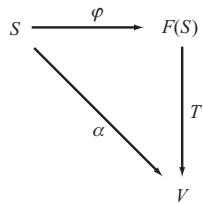
Let be the free associative algebra over a vector space .
(a) Show that there exists a linear map such that if is any associative algebra over the same field and a linear map, then there exists a unique algebra homomorphism such that
(b) Depict this property by a commutative diagram.
(c) Show the converse: any algebra for which there is a map such that the commutative diagram holds for an arbitrary linear map is isomorphic with the free associative algebra over .
Give a definition of quaternions as a factor algebra of the free algebra on a three dimensional vector space.
The Clifford algebra associated with an inner product space with scalar product can be defined in the following way. Let be the free associative algebra on and the two-sided ideal generated by all elements of the form
The Clifford algebra in question is now defined as the factor space . Verify that this algebra isomorphic with the Clifford algebra as defined in Section 6.3, and could serve as a basis-independent definition for the Clifford algebra associated with a real inner product space.
Show that is a basis of . In outline: define the maps by
Extend by linearity to the tensor space and show there is a natural passage to the factor space, . If a linear combination from were to vanish,
apply the map to this equation, to show that all coefficients must vanish separately.
Indicate how the argument may be extended to show that if then is a basis of