Induced topologies and topological products
Given a topological space and a map from an arbitrary set into , we can ask for the weakest topology on for which this map is continuous – it is useless to ask for the finest such topology since, as shown in Example 10.10, the discrete topology on always achieves this end. This is known as the topology induced on by the map . Let be the family of all inverse images of open sets of ,
Since is required to be continuous, all members of this collection must be open in the induced topology. Furthermore, is a topology on since (i) property (Top1) is trivial, as and (ii) the axioms (Top2) and (Top3) follow from the
set-theoretical identities
Hence is a topology on and is included in any other topology such that the map is continuous. It must be the topology induced on by the map since it is the coarsest possible such topology.
Let be any topological space and any subset of . In the topology induced on by the natural inclusion map defined by for all , a subset of is open iff it is the intersection of with an open set of that is, where is open in . This is precisely the relative topology on defined in Section 10.2. The relative topology is thus the coarsest topology on for which the inclusion map is continuous.
More generally, for a collection of maps where are topological spaces, the weakest topology on such that all these maps are continuous is said to be the topology induced by these maps. To create this topology it is necessary to consider the set of all inverse images of open sets . This collection of sets is not itself a topology in general, the topology generated by these sets will be the coarsest topology on such that each function is continuous.
Given two topological spaces and ), let and be the natural projection maps defined by
The product topology on the set is defined as the topology induced by these two maps. The space together with the product topology is called the topological product of and . It is the coarsest topology such that the projection maps are continuous. The inverse image under of an open set in is a ‘vertical strip , while the inverse image of an open set in under is a ‘horizontal strip . The intersection of any pair of these strips is a set of the form where and are open sets from and respectively (see Fig. 10.4). Since the topology generated by the vertical and horizontal strips consists of all possible unions of such intersections, it follows that in the product topology a subset is open if for every point there exist open sets and such that
Given an arbitrary collection of sets , their cartesian product is defined as the set of maps such that for each . For a finite number of sets, taking , this concept is identical with the set of tuples from . The product topology on is the topology induced by the projection maps defined by . This topology is coarser than the topology generated by all sets of the form where is an open subset of
Let be the unit circle in defined by , with the relative topology. The product space is homeomorphic to the torus or ‘donut’, with topology induced from its embedding as a subset of . This can be seen by embedding in the plane of , and attaching a vertical unit circle facing outwards from each point on . As the vertical circles ‘sweep around’ the horizontal cirle the resulting circle is clearly a torus.
The following is an occasionally useful theorem.
Theorem 10.3 · Continuity of slice inclusions into a product space
If and are topological spaces then for each point the injection map defined by is continuous. Similarly the map defined by is continuous.
Proof
Let and be open subsets of and respectively. Then
Since every open subset of in the product topology is a union of sets oftype it follows that the inverse image under of every open set in is an open subset of . Hence the map is continuous. Similarly for the map .
Topology by identification
We may also reverse the above situation. Let be a topological space, and a map from onto an arbitrary set . In this case the topology on induced by is defined to be the finest topology such that is continuous. This topology consists of all subsets such that is open in that is,
Show that is a topology on
Show that is the strongest topology such that is continuous.
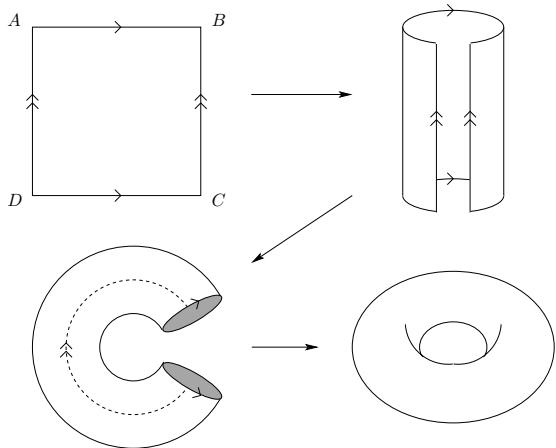 Figure 10.5 Construction of a torus by identification of opposite sides of a square
A common instance ofthis type ofinduced topology occurs when there is an equivalence relation defined on a topological space . Let be the equivalence class containing the point . In the factor space define the topology obtained by identification from to be the topology induced by the natural map associating each point with the equivalence class to which it belongs, . In this topology a subset is open iff its inverse image is an open subset of . That is, a subset of equivalence classes is open in the identification topology on iff the union of the sets that belong to is an open subset of .
Verify directly from the last statement that the axioms (Top1)–(Top3) are satisfied by this topology on
As in Example 1.4, we say two points and in the plane are equivalent if their coordinates differ by integral amounts,
The topology on the space obtained by identification can be pictured as the unit square with opposite sides identified (see Fig. 10.5). To understand that this is a representation of the torus , consider a square rubber sheet. Identifying sides and is equivalent to joining these two sides together to form a cylinder. The identification of and is now equivalent to identifying the circular edges at the top and bottom of the cylinder. In three-dimensions this involves bending the cylinder until top and bottom join up to form the inner tube of a tyre – remember, distances or metric properties need not be preserved for a topological transformation. The -torus can similarly be defined as the topological space obtained by identification from the corresponding equivalence relation on , whereby points are equivalent if their coordinates differ by integers.
Let be the set of non-zero 3-triples of real numbers given the relative topology in . Define an equivalence relation on whereby iff there exists a real number such that and . The factor space is known as the real projective plane.
Each equivalence class is a straight line through the origin that meets the unit 2-sphere in two diametrically opposite points. Define an equivalence relation on by identifying diametrically opposite points, ) where . The topology on obtained by identification from is thus identical with that of the 2-sphere with diametrically opposite points identified.
Generalizing, we define real projective -space to be where if and only ifthere exists such that . This space can be thought of as the set of all straight lines through the origin in . The topology of is homeomorphic with that of the -sphere with opposite points identified.
Problems
If is a continuous map between topological spaces, we define its graph to be the set . Show that if is given the relative topology induced by the topological product then it is homeomorphic to the topological space
Let and be topological spaces and a continuous map. For each fixed show that the map defined by is continuous.