A locally Euclidean space or topological manifold of dimension is a Hausdorff topological space in which every point has a neighbourhood homeomorphic to an open subset of . If is any point of then a (coordinate) chart at is a pair where is an open subset of , called the domain ofthe chart and is a homeomorphism between and its image . The image is an open subset of , given the relative topology in . It is also common to call a coordinate neighbourhood of and a coordinate map. The functions , where are the standard projection maps, are known as the coordinate functions determined by this chart, and the real numbers are called the coordinates of in this chart (see Fig. 15.1). Sometimes, when we wish to emphasize the symbols to be used fo the coordinate functions, we denote the chart by , or simply . Occasionally the term coordinate system at is used for a chart whose domain covers . The use of superscripts rather than subscripts for coordinate functions is not universal, but its advantages will become apparent as the tensor formalism on manifolds is developed.
For any pair ofcoordinate charts ) and such that , define the transition functions
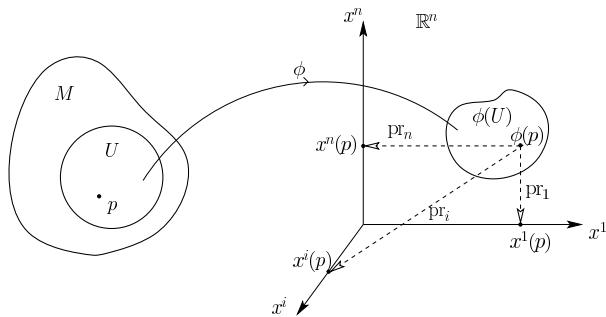
Figure 15.1 Chart at a point
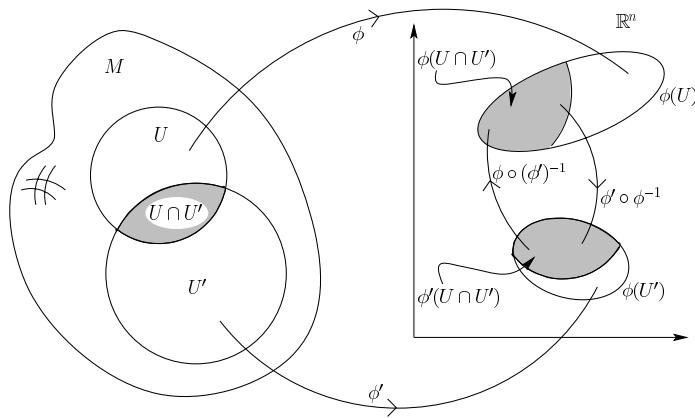
Figure 15.2 Transition functions on compatible chart
which are depicted in Fig. 15.2. The transition functions are often written
which is an abbreviated form of the awkward, but technically correct,
The two charts are said to be -compatible where is a non-negative integer or if al the functions in Eq. (15.1) are . For convenience we will generally assume that the charts are
An atlas on is a family of charts such that the coordinate neighbourhoods cover , and any pair of charts from the family are -compatible. If and are two atlases on then so is their union
Prove this statement. [Hint: A differentiable function of a differentiable function is always differentiable.]
Any atlas may thus be extended to a maximal atlas by adding to it all charts that are -compatible with the charts of . This maximal atlas is called a differentiable structure on . A pair , where , is an -dimensional topological manifold and is a differentiable structure on , is called a differentiable manifold; it is usually just denoted .
The Jacobian matrix is non-singular since its inverse is
Similarly . Hence the Jacobian determinant is non-vanishing, We are making a return here and in the rest of this book to the summation convention of earlier chapters.
Euclidean space is trivially a manifold, since the single chart covers it and generates a unique atlas consisting ofall charts that are compatible with it. For example, in it is permissible to use polar coordinates defined by
which are compatible with on the open set . The inverse transformation is
The image set in the is a semi-infinite open strip
Any open region of is a differentiable manifold formed by giving it the relative topology and the differentiable structure generated by the single chart . Every chart on is the restriction ofa coordinate neighbourhood and coordinate map on to the open region and can be written where is a chart on . Such a manifold is called an open submanifold of
Describe the open region of and the image set in the on which spherical pola coordinates are defined,
The unit circle , defined by the equation , is a onedimensional manifold. The coordinate can be used on either the upper semicircle or the lower semicircle , but not on all of . Alternatively, setting in polar coordinates as defined in Example 15.1, a possible chart is where and is defined by . The image set is the open interva . These charts are clearly compatible with each other. is the only one dimensional manifold that is not homeomorphic to the real line
The 2-sphere defined as the subset of points of satisfying
is a two-dimensional differentiable manifold. Some possible charts on are:
(i) Rectangular coordinates , defined on the upper and lower hemisphere, and , separately. These two charts are non-intersecting and do not cover the sphere since points on the central plane are omitted.
(ii) Stereographic projection from the north pole, Eqs. (10.1) and (10.2), defines a chart where is given by
These coordinates are not defined on the sphere’s north pole ), but a similar projection from the south pole will cover ,
Both of these charts are evidently compatible with the rectangular coordinate charts (i) and therefore with each other in their region of overlap.
(iii) Spherical polar coordinates defined by seting in Eq. (15.2). Simple algebra shows that these are related to the stereographic coordinates (ii) by
and therefore form a compatible chart on their region of definition.
In a similar way the -sphere ,
is a differentiable manifold of dimension . A set of charts providing an atlas is the set of rectangular coordinates on all hemispheres, and ), where
and and are both defined by
Prove that and are compatible, by showing they are related by
The set of real matrices can be put in one-to-one correspondence with points of , through the map defined by
This provides with a Hausdorff topology inherited from in the obvious way. The differentiable structure generated by the chart converts into a differentiable manifold of dimension
The group of real non-singular matrices consists of real matrices having non-zero determinant. The determinant map : is continuous since it is made up purely ofpolynomial operations, so that is an open subset of . Thus is a differentiable manifold of dimension , as it is in one-to-one correspondence with an open submanifold of
From any two differentiable manifolds and of dimensions and respectively, it is possible to form their product , which is the topological space defined in Section 10.4. Let and be any families of mutually compatible charts on and
respectively, which generate the differentiable structures on these manifolds. The charts , where defined by
manifestly cover , and are clearly compatible in their overlaps. The maximal atlas generated by these charts is a differentiable structure on making it into a differen tiable manifold of dimension
The topological 2-torus (see Example 10.13) can be given a differentiable structure as a product manifold in the obvious way from the manifold structure on . Similarly, one can define the -torus to be the product of circles,
Problems
Show that the group of unimodular matrices is a differentiable manifold.
On the -sphere find coordinates corresponding to (i) stereographic projection, (ii) spherical polars.
Show that the real projective -space defined in Example 10.15 as the set of straight lines through the origin in is a differentiable manifold of dimension , by finding an atlas of compatible charts that cover it.
Define the complex projective -space in a similar way to Example 10.15 as lines in ofthe form where . Show that is a differentiable (real) manifold of dimension 2.