Measurable spaces
Given a set , a sigma-algebra on consists of a collection ofsubsets, known as measurable sets, satisfying
(Meas1) The empty set is a measurable set,
(Meas2) If is measurable then so is its complement:
(Meas3) is closed under countable unions:
The pair is known as a measurable space. Although there are similarities between these axioms and (Top1)–(Top3) for a topological space, (Meas2) is distinctly different in that the complement ofan open set is a closed set and is rarely open. It follows from (Meas1) and (Meas2) that the whole space is measurable. The intersection of any pair of measurable sets is measurable, for
Also, is closed with respect to taking differences,
Show that any countable intersection of measurable sets is measurable
Given any set , the collection is obviously a sigma-algebra. This is the smallest sigma-algebra possible. By contrast, the largest sigma-algebra is the set of all subsets . All interesting examples fall somewhere between these two extremes.
It is trivial to see that the intersection of any two sigma-algebras is another sigma-algebra – check that properties (Meas1)–(Meas3) are satisfied by the sets common to the two sigma-algebras. This statement extends to the intersection of an arbitrary family of sigma-algebras, . Hence, given any collection of subsets , there is a unique ‘smallest’ sigma-algebra . This is the intersection of all sigma-algebras that contain It is called the sigma-algebra generated by . For a topological space , the sigma-algebra generated by the open sets are called Borel sets on . They include all open and all closed sets and, in general, many more that are neither open nor closed.
In the standard topology on the real line every open set is a countable union of open intervals. Hence the Borel sets are generated by the set of all open intervals . Infinite left-open intervals such as . are Borel sets by (Meas3), and similarly all intervals are Borel. The complements of these sets are the infinite right or left-closed intervals and . Hence all closed intervals are Borel sets.
Prove that the sigma-algebra of Borel sets on is generated by (a) the infinite left-open intervals , (b) the closed intervals .
Prove that all singletons are Borel sets on
If and are two measurable spaces then we define the product measurable space , by setting the sigma-algebra on to be the sigma-algebra generated by all sets of the form where and
Measurable functions
Given two measurable spaces and , a map is said to be a measurable function if the inverse image of every measurable set is measurable:
This definition mirrors that for a continuous function in topological spaces.
Theorem 11.1 · Borel measurability of continuous functions
If and are topological spaces and and are the sigma-algebras of Borel sets, then every continuous function is Borel measurable.
Proof
Let and be the families of open sets in and respectively. We adopt the notation for any family of sets . Since is continuous, . The sigma-algebras of Borel sets on the two spaces are and . To prove is Borel measurable we must show that Let
This is a sigma-algebra on , for and
Hence for . Since is the sigma-algebra generated by we must have that . Hence as required. -
If and are measurable functions between measure spaces, show tha the composition is a measurable function
If is a measurable real-valued function on a measurable space , where is assumed given the Borel structure of Example 11.2, it follows that the set
is measurable in . Since the family of Borel sets on the real line is generated by the intervals (see the exercise following Example 11.2), this can actually be used as a criterion for measurability: is a measurable function iff for any the set is measurable.
Prove the sufficiency of this condition [refer to the proof of Theorem 11.1].
If is a measurable space then the characteristic function of a set is measurable if and only if , since for any
Show that for any , the set is a measurable set of
If is a measurable function then so is its modulus , since the continuous function on is necessarily Borel measurable, and is the composition function . Similarly the function for is measurable, and is measurable if for all . If is another measurable function then the function is measurable since it can be written as the composition where and are the maps
The function is measurable since the inverse image of any product of intervals is
which is a measurable set in since and are assumed measurable functions, while the map is evidently continuous on
Show that for measurable functions , the function is measurable.
An important class of functions are the simple functions: measurable functions that take on only a finite set ofextended real values . Since is a measurable subset of for each , we can write a simple function as a linear combination of measurable characteristic functions
Some authors use the term step function instead of simple function, but the common convention is to preserve this term for simple functions in which each set is a union of disjoint intervals (Fig. 11.1).
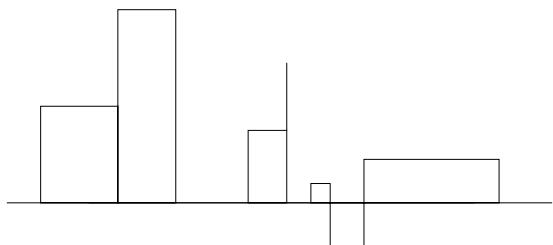 Figure 11.1 Simple (step) function
Let and be any pair of measurable functions from into the extended reals . The function defined by
is measurable, since
is measurable. Similarly, is a measurable function. In particular, if is a measurable function, its positive and negative parts
are measurable functions.
Show that
A simple extension of the above argument shows that sup is a measurable function for any countable set of measurable functions . with values in the extended real numbers . We define the lim sup as
The lim sup always exists since the functions are everywhere monotone decreasing,
and therefore have a limit if they are bounded below or approach if unbounded below. Similarly we can define
It follows that if is a sequence of measurable functions then and are also measurable. By standard arguments in analysis is a convergent sequence if and only if . Hence the limit of any convergent sequence of measurable functions ) is measurable. Note that the convergence need only be ‘pointwise convergence’, not uniform convergence as is required in many theorems in Riemann integration.
Theorem 11.2 · Approximation of measurable functions by simple functions
Any measurable function is the limit of a sequence of simple functions. The sequence can be chosen to be monotone increasing at all positive values of and monotone decreasing at negative values.
Proof
Suppose is positive and bounded above, . For each integer . let be the simple function
where is the measurable set
These simple functions are increasing, . and . Hence for all as
If is any positive function, possibly unbounded, the functions are positive and bounded above. Hence for each there exists a simple function such that . The sequence of simple functions clearly converges everywhere to . To obtain a monotone increasing sequence of simple functions that converge to , set
If is not positive, construct simple function sequences approaching the positive and negative parts and use -
Problems
If and are measurable spaces, show that the projection maps and defined by and are measurable functions.
Find a step function () that approximates uniformly to within on [0, 1], in the sense that everywhere in [0, 1].
Let and be measurable functions and a measurable set. Show that
is a measurable function on
If are Borel measurable real functions show that is a measurable function with respect to the product measure on