Let be a simple function on a measure space
where are measurable subsets of . We define its integral to be
This integral only gives a finite answer if the measure of all sets is finite, and in some cases it may not have a sensible value at all. For example defined by
has integral which is not well-defined.
If is a simple function, then for any constant we have
If is another simple function then is a simple function
and has integral
It is best to omit any term from the double sum where , else we may face the awkward problem of assigning a value to the product .
Prove Eq. (11.8).
For any pair of functions we write to mean for all . If and are simple functions such that then
This follows immediately from the fact that is a simple function that is non-negative everywhere, and therefore has an integral
Taking the measure on to be Lebesgue measure, the integral of a non-negative measurable function is defined as
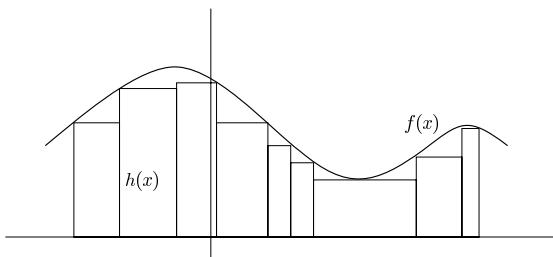 Figure 11.3 Integral of a non-negative measurable function
where the supremum is taken over all non-negative simple functions such that (Fig. 11.3) . If is a measurable set then is a measurable function on that vanishes outside . We define the integral of over to be
Show that for any pair of non-negative measurable functions and
The following theorem is often known as the monotone convergence theorem:
Theorem 11.7 · Monotone convergence theorem (Beppo Levi)
(Beppo Levi) If is an increasing sequence ofnon-negative measurable real-valuedfunctions on , , such that for all then
Proof
From the comments before Theorem 11.2 we know that is a measurable function, as it is the limit of a sequence of measurable functions. If has a finite integral then, by definition, for any there exists a simple function such that and . For any real number let
clearly a measurable set for each positive integer . Furthermore, since is an increasing sequence of functions we have
since every point lies in some for big enough. Hence
If then
Hence, by Theorem 11.3,
so that
Since can be chosen arbitrarily close to 1 and arbitrarily close to , we have
which proves the required result.
How does this proof change if
Using the result from Theorem 11.2, that every positive measurable function is a limit of increasing simple functions, it follows from Theorem 11.7 that simple functions can be replaced by arbitrary measurable functions in Eqs. Eq. (11.8) and Eq. (11.9).
Theorem 11.8 · Vanishing integral of a nonnegative measurable function
The integral of a non-negative measurable function vanishes if and only if almost everywhere.
Proof
If ., let be a simple function such that Every set must have measure zero, else on a set of positive measure. Hence
Conversely, suppose . Let . These are an increasing sequence of measurable sets, , and
Hence
which is only possible if . By Theorem 11.3 it follows that
Hence almost everywhere.
Integration may be extended to real-valued functions that take on positive or negative values. We say a measurable function is integrable with respect to the measure if both its positive and negative parts, and , are integrable. The integral of is then defined as
If is integrable then so is its modulus , and
Hence a measurable function is integrable if and only if is integrable.
A function is said to be Lebesgue integrable if it is measurable and integrable with respect to the Lebesgue measure on . As for Riemann integration it is common to use the notations
and for integration over an interval
Riemann integrable functions on an interval are Lebesgue integrable on that interval. A function is Riemann integrable if for any there exist step functions and simple functions that are constant on intervals – such that and
By taking for the sequence of functions defined by , it is straightforward to show that the are simple functions the supremum of whose integrals is the Riemann integral of Hence is Lebesgue integrable, and its Lebesgue integral is equal to its Riemann integral. The difference between the two concepts of integration is that for Lebesgue integration the simple functions used to approximate a function need not be step functions, but can be constant on arbitrary measurable sets. For example, the function on [0, 1] defined by
is certainly Lebesgue integrable, and since . its Lebesgue integral is 1. It cannot, however, be approximated in the required way by step functions, and is not Riemann integrable.
Prove the last statement.
Theorem 11.9 · Linearity of the Lebesgue integral
If and are Lebesgue integrable real functions, then for any , the function is Lebesgue integrable and for any measurable set
The proof is straightforward and is left as an exercise (see problems at end of chapter).
Lebesgue’s dominated convergence theorem
One of the most important results of Lebesgue integration is that, under certain general circumstances, the limit of a sequence of integrable functions is integrable. First we need a lemma, relating to the concept oflim sup of a sequence of functions, defined in the paragraph prior to Theorem 11.2.
Lemma 11.10 · Fatou’s lemma
(Fatou) If is any sequence ofnon-negative measurable functions de fined on the measure space , then
Proof
The functions form an increasing sequence of non-negative measurable functions such that for all . Hence the lim inf of the sequence is the limit of the sequence
By the monotone convergence theorem 11.7,
while the inequality implies that
Hence
Theorem 11.11 · Lebesgue dominated convergence theorem
(Lebesgue) Let be any sequence of real-valuedmeasurable functions defined on the measure space that converges almost everywhere to a function . If there exists a positive integrable function such that for all then
Proof
The function is measurable since it is the limit a.e. of a sequence of measurable functions, and as all functions and are integrable with respect to the measure . Apply Fatou’s lemma 11.10 to the sequence of positive measurable functions
Since and lim inf , we have
Since this is only possible if
Hence
so that , as required.
The convergence in this theorem is said to be dominated convergence, being the dominating function. An attractive feature of Lebesgue integration is that an integral over an unbounded set is defined exactly as for a bounded set. The same is true of unbounded integrands. This contrasts sharply with Riemann integration where such integrals are not defined directly, but must be defined as ‘improper integrals’ that are limits of bounded functions over a succession of bounded intervals. The concept of an improper integral is not needed at all in Lebesgue theory. However, Lebesgue’s dominated convergence theorem can be used to evaluate such integrals as limits of finite integrands over finite regions.
The importance of a dominating function is shown by the following example. The sequence of functions consists of a ‘unit hump’ drifting steadily to the right and clearly has the limit everywhere. However it has no dominating function and the integrals do not converge
We mention, without proof, the following theorem relating Lebesgue integration on higher dimensional Euclidean spaces to multiple integration.
Theorem 11.12 · Fubini’s theorem
(Fubini) If is a Lebesgue measurable function, then for each the function is measurable. Similarly for each the function is measurable on . It is common to write
Then
The result generalizes to a product of an arbitrary pair of measure spaces. For a proof see, for example, [1, 2].
Problems
Show that if and are Lebesgue integrable on and ., then
Prove Theorem 11.9.
If is a Lebesgue integrable function on then show that the function defined by