Given a measurable space , a measure on is a function such that
(Meas4) for all measurable sets , and
(Meas5) If is any mutually disjoint sequence (finite or countably infinite) of measurable sets such that , then
A function satisfying property (Meas5) is often referred to as being countably additive. If the series on the right-hand side is not convergent, it is given the value . A measure space is a triple consisting of a measurable space ) together with a measure
Show that if are measurable sets, then
An occasionally useful measure on a sigma-algebra defined on a set is the Dirac measure. Let be any fixed point of and set
(Meas4) holds trivially for , and (Meas5) follows from the obvious fact that the union of a disjoint family of sets can contain if and only if for precisely one member . This measure has applications in distribution theory, Chapter 12.
The branch ofmathematics known as probability theory is best expressed in terms of measure theory. A probability space is a measure space , where . Sets are known as events and is sometimes referred to as the universe. This ‘universe’ is usually thought of as the set of all possible outcomes of a specific experiment. Note that events are not outcomes of the experiment, but sets of possible outcomes. The measure function is known as the probability measure on and is the probability of the event . All events have probability in the range . The element has probability 0, , and is called the impossible event. The entire space has probability 1; it can be thought of as the certainty event.
The event is referred to as either or , while is and . Since is additive on disjoint sets and , the probabilities are related by
The two events are said to be independent if . This is by no means always the case.
We think of the probability of event after knowing that has occurred as the conditional probability , defined by
Events and are independent if and only if in other words, the probability of in no way depends on the occurrence of .
For a finite or countably infinite set of disjoint events . partitioning (some times called a hypothesis), , we have for any event
Since the sets in this countable union are mutually disjoint, the probability of is
This leads to Bayes’ formula for the conditional probability of the hypothesis given the outcome event ,
Theorem 11.3 · Continuity of measure from below
Let . be a sequence ofmeasurable sets, which is increasing in the sense that for all . Then
Proof
is measurable by condition (Meas3). Set
The sets are all measurable and disjoint, if . Since we have by (Meas5)
Lebesgue measure
Every open set on the real line is a countable union ofdisjoint open intervals. This follows from the fact that every rational point lies in a maximal open interval where . These intervals must be disjoint, else they would not be maximal, and there are countably many of them since the rational numbers are countably infinite. On the real line set for all open intervals . This extends uniquely by countable additivity (Meas5) to all open sets of . By finite additivity must take the value on all intervals, open, closed or half-open. For example, for any
and since the right-hand side is the union of two disjoint Borel sets we have
Hence the measure of the left-closed interval is
Using
we see that every singleton has zero measure, , and
Show that if is a countable set, then
Show that the set of finite unions of left-closed intervals is closed with respect to the operation of taking differences of sets.
For any set we define its outer measure
While outer measure can be defined for arbitrary sets of real numbers it is not really a measure at all, for it does not satisfy the countably additive property (Meas5). The best we can do is a property known as countable subadditivity: if is any mutually disjoint sequence of sets then
Proof
Let . For each . there exists an open set such that
Since . covers
As this is true for arbitrary , the inequality Eq. (11.2) follows immediately.
Show that outer measure satisfies
For an open interval show that
Show that
Following Carathéodory, a set is said to be Lebesgue measurable if for any open interval
At first sight this may not seem a very intuitive notion.
What it is saying is that when we try to cover the mutually disjoint sets and with open intervals, the overlap of the two sets of intervals can be made ‘arbitrarily small’ (see Fig. 11.2). From now on we will often refer to Lebesgue measurable sets simply as measurable.
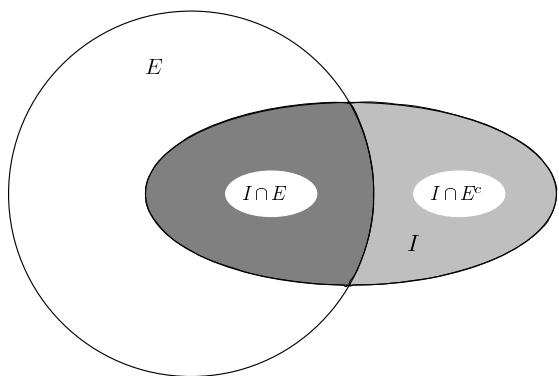 Figure 11.2 Lebesgue measurable set
Theorem 11.4 · Splitting outer measure by a measurable set
If is measurable then for any set , measurable or not,
Proof
Given , let be an open set such that and
Since is a union of two disjoint sets, Eq. (11.2) gives
Setting where are a finite or countable collection of disjoint open intervals, we have by Eq. (11.3)
Using the inequality Eq. (11.5)
for arbitrary . This proves the desired result
Corollary 11.5 · Splitting outer measure over disjoint measurable sets
If is any family ofdisjoint measurable sets then
Proof
If and are disjoint measurable sets, setting in Eq. (11.4) gives
The result follows by induction on .
Theorem 11.6 · Lebesgue measurable sets and Lebesgue measure
The set of all Lebesgue measurable sets is a sigma-algebra, and is a measure on
Proof
The empty set is Lebesgue measurable, since for any open interval ,
If is a measurable set then so is , on substituting in Eq. (11.4) and using . Hence conditions (Meas1) and (Meas2) are satisfied. We prove (Meas3) in severa stages.
Firstly, if and are measurable sets then is measurable. For, and using Eq. (11.2) gives
The sets in the two arguments on the right-hand side can be decomposed as
and
Again using Eq. (11.2) gives
On setting and respectively in Theorem 11.4 we have
since is measurable. Combining this with the inequality Eq. (11.6) we conclude that for al intervals
which shows that is measurable. Incidentally it also follows that the intersection and the difference is measurable. Simple induction shows that any finite union of measurable sets is measurable.
Let . be any sequence of disjoint measurable sets. Set
By subadditivity Eq. (11.2),
and since we have, using Corollary 11.5,
Since this holds for all integers and the right-hand side is a monotone increasing series,
If the series does not converge, the right-hand side is assigned the value .
Since the are disjoint sets, so are the sets . Furthermore by Corollary 11.5
Hence the series is convergent and for any there exists an integer such that
Now since
and by subadditivity Eq. (11.2),
Since is arbitrary
which proves that is measurable.
If . are a sequence of measurable sets, not necessarily disjoint, then se
These sets are all measurable and disjoint, and
The union of any countable collection of measurable sets is therefore measurable, proving that is a sigma-algebra. The outer measure is a measure on since it satisfies and is countably additive by Eq. (11.7). -
Theorem 11.6 shows that is a measure space. The notation for Lebesgue measure agrees with the earlier convention on open intervals. All open sets are measurable as they are disjoint unions of open intervals. Since the Borel sets form the sigma-algebra generated by all open sets, they are included in . Hence every Borel set is Lebesgue measurable. It is not true however that every Lebesgue measurable set is a Borel set.
A property that holds everywhere except on a set of measure zero is said to hold almost everywhere, often abbreviated to a.e. . For example, two functions and are said to be equal a.e. if the set of points where is a set of measure zero. It is sufficient for the set to have outer measure zero, , in order for it to have measure zero (see Problem 11.8).
Lebesgue measure is defined on cartesian product spaces in a similar manner. We give the construction for . We have already seen that the sigma-algebra ofmeasurable sets on the product space is defined as that generated by products of measurable sets where and are Lebesgue measurable on . The outer measure of any set is defined as
where and are any finite or countable family of open intervals of such that the union covers . The outer measure of any product of open intervals is clearly the product of their measures, ). We say a set is Lebesgue measurable if, for any pair of open intervals
As for the real line, outer measure is then a measure on . Lebesgue measure on highe dimensional products is completely analogous. We sometimes denote this measure by
The Cantor set, Example 1.11, is a closed set since it is formed by taking the complement of a sequence of open intervals. It is therefore a Borel set and is Lebesgue measurable. The Cantor set is an uncountable set of measure 0 since the length remaining after the th step in its construction is
Its complement is an open subset of[0, 1] with measure 1 – that is, having ‘no gaps’ between its component open intervals.
Not every set is Lebesgue measurable, but the sets that fail are non constructive in character and invariably make use of the axiom ofchoice. A classic example is the following. For any pair of real numbers , , set if and only if is a rational number. This is an equivalence relation on and it partitions this set into disjoint equivalence classes where is the set ofrational numbers. Assuming the axiom of choice, there exists a set consisting of exactly one representative from each equivalence class . Suppose it has Lebesgue measure . For each rationa number let . Every real number belongs to some since it differs by a rational number from some member of . Hence, since for each such , we must have
The sets are mutually disjoint and all have measure equal to ). Ifthe rational numbers are displayed as a sequence . then
This yields a contradiction either for ; in the first case the sum is in the second it is .
Problems
Show that every countable subset of is measurable and has Lebesgue measure zero.
Show that the union of a sequence of sets of measure zero is a set ofLebesgue measure zero.
If show that for any set , ). Hence show that and are Lebesgue measurable if and only if is measurable.
A measure is said to be complete ifevery subset of a set of measure zero is measurable. Show that if is a set of outer measure zero, , then is Lebesgue measurable and has measure zero. Hence show that Lebesgue measure is complete.
Show that a subset of is measurable if for all there exists an open se such that
If is bounded and there exists an interval such that
then this holds for all intervals, possibly even those overlapping .
The inner measure of a set is defined as the least upper bound of the measures of all measurable subsets of . Show that
For any open set , show that
and that is measurable with finite measure if and only if