Stokes’ theorem requires the concept of a submanifold with boundary. This is not an easy notion in general, but for most practical purposes it is sufficient to restrict ourselves to regions made up of ‘coordinate cubical regions’. Let be the standard unit -cube,
The unit 0-cube is taken to be the singleton . A -cell in a manifold is a smooth map where is an open neighbourhood of in (see Fig. 17.2), and its support is defined as the image of the standard -cube, . A cubical -chain in consists of a formal sum
The set of all cubical -chains is denoted ; it forms an abelian group under addition of -chains defined in the obvious way. It is also a vector space if we define scalar multiplication as where
For each and , 1 define the maps by
These maps can be thought of as the (, 0)-face and (, 1)-face respectively of . If the interior of the standard -cube is oriented in the natural way, by assigning the -form to be positively oriented over , then for each face map or 1 the orientation on is assigned according to the following rule: set the -form to be positively oriented is increasing outwards at the face, else it is negatively oriented. According to this rule the -form has orientation on the (, 0)-face, while on the (, 1)-face it has orientation . This is sometimes called the outward normal rule – the orientation on the boundary surface must be chosen such that at every point there exist local positively oriented coordinates such that the first coordinate points outwards from the surface.
On the two-dimensional square, verify that the outward normal rule implies that the di rection of increasing or coordinate on each side proceeds in an anticlockwise fashion around the square.
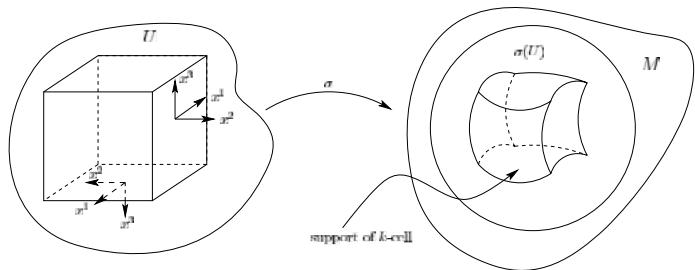
Figure 17.2 -Cell on a manifold
This gives the rationale for the boundary map , defined by:
(i) for a -cell , set
(ii) for a cubical -chain set
An important identity is . For example if is a 2-cell, its boundary is given by
The boundary of the face , where is the map . Hence
For a -cell,
where
It follows from this equation that all terms cancel in pairs, so that . The identity extends by linearity to all -chains.
Write out for a 3-cube, and verify the cancellation property.
For a -form on and a -chain we define the integral
Theorem 17.2 · Stokes’ theorem
(Stokes’ theorem) For any -chain , and differential -form on ,
Proof
By linearity, it is only necessary to prove the theorem for a -cell . The left-hand side of Eq. (17.2) can be written, using Theorem 16.2,
while the right-hand side is
Since is a differential -form on it can be written as
where the are differentiable functions on an open neighbourhood of Hence
Substituting in the left-hand integral of Eq. (17.2) we have
as required.
In Example 15.9 we defined the integral of a differential 1-form over a curve with end points to be
A 1-cell is a curve with parameter range and can be made to cover an arbitrary range by a change of parameter . The integral of over the support of the 1-cell is
which agrees with the definition of the integral given in Example 15.9.
The boundary of the 1-cell is
where the two terms on the right-hand side are the 0-cells and , respectively. Setting where is a differentiable function on , Stokes theorem gives
If and the 1-cell is defined by , Stokes’ theorem reduces to the fundamental theorem of calculus,
Regular domains
In the above discussion, the only requirement made concerning the cell maps was that they be differentiable on a neighbourhood of the unit -cube . For example, they could be completely degenerate and map the entire set into a single point of . For this reason, the chains are sometimes called singular. A fundamental -chain on an -dimensional manifold has the form
where each is a diffeomorphism and the interiors of the supports of different cells are non-intersecting:
A regular domain is a closed set of the form
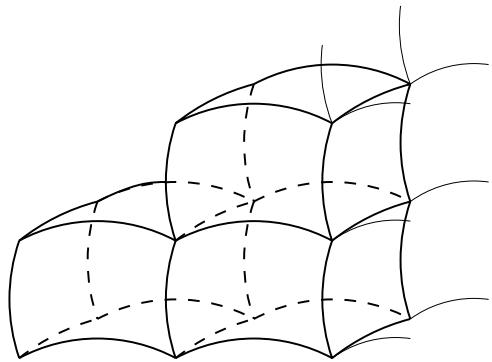
where are the -cells of a fundamental chain (see Fig. 17.3). We may think of a regular domain as subdivided into cubical cells or a region with boundary – the ‘boundary consisting of boundary points of the chain that are not on the common faces of any pair of cells.
Theorem 17.3 · Independence of integration from cubulation
If is a regular domain ‘cubulated’ in two different ways byfundamental chains and then for every differential -form .
Figure 17.3 A regular domain on a manifold
Proof
Let and
The maps are all diffeomorphisms and
Hence
If is a differential ( 1)-form,
Since the outward normals on common faces of adjoining cells are oppositely directed, the faces will be oppositely oriented and the integrals will cancel, leaving only an integra on the ‘free’ parts of the boundary of . This results in Stokes’ theorem for a regular domain
A regular -domain is defined as the image of a regular domain of a -dimensional manifold under a regular embedding , and for any -form
and -form we set
The general form of Stokes’ theorem asserts that for any -form and regular domain
In low dimensions, Stokes’ theorem reduces to a variety offamiliar forms. For example, let be a regular 2-domain in bounded by a circuit having induced orientation according to the ‘right hand rule’. By this we mean that if the outward normal is taken locally in the direction of the first coordinate , and the tangent to in the direction , then is positively oriented. If , then
and Stokes’ theorem is equivalent to Green’s theorem
If is a bounded region in whose boundary is a surface , the induced orientation is such that if (, ) are a correctly ordered pair of tangent vectors to and the outward normal to , then (, , ) is a positively oriented basis of vectors in . Let be a 2-form, then
where . Stokes’ theorem reads
If the bounding surface is locally parametrized by two parameters, , then we can write
and it is common to write Stokes’ theorem in the standard Gauss theorem form
where is the vector area normal to , having components
Let be an oriented 2-surface in , with boundary an appropriately oriented circui , and a differential 1-form . Then
and
This can be expressed in the familiar form of Stokes’ theorem
Show that is ‘normal’ to the surface in the sense tha
Problems
Let . If is the stretch of -axis from , and the unit right semicircle connecting these points, evaluate
Verify Stokes’ theorem for the unit circle and the unit right semicircular region encompassed by and .
If compute where is (i) the uni cube, (ii) the unit ball in . In each case verify Stokes’ theorem,
Let be the surface of a cylinder of elliptical cross-section and height 2 given by
(a) Compute where 2 .
(b) Show , and find a 1-form such that
(c) Verify Stokes’ theorem
A torus in may be represented parametrically by
where . If is replaced by a variable that ranges from 0 to show that
By integrating this 3-form over the region enclosed by the torus, show that the volume of the solid torus is . Can you see this by a simple geometrical argument?
Evaluate the volume by performing the integral of the 2-form over the surface of the torus and using Stokes’ theorem.
Show that in dimensions, if is a regular -domain with boundary , and we set to be an ( 1)-form with components
Stokes’ theorem can be reduced to the -dimensional Gauss theorem
where is a ‘vector volume element’ normal to .