The tangent map and pullback of a map
Let be a differentiable map between manifolds and , where . This induces a map , called the tangent map of whereby the tangent vector is defined by
for any function . This map is often called the differential of the map , bu this may cause confusion with our earlier use of this term.
Let and be charts at and ), respectively. The map has coordinate representation , written
To compute the components of , we perform the following steps:
Hence
If and are differentiable maps between manifolds, show that
The map also induces a map between cotangent spaces, but in this case it acts in the reverse direction, called the pullback induced by
The pullback of a 1-form is defined by requiring
for arbitrary tangent vectors
Show that this definition uniquely defines the pullback
Show that the pullback of a functional composition of maps is given by
The notion of tangent map or pullback of a map can be extended to totally contravarian or totally covariant tensors, such as -vectors or -forms, but is only available for mixed tensors if the map is a diffeomorphism (see Problem 15.13). The tangent map does not in general apply to vector fields, for if it is not one-to-one the tangent vector may not be uniquely defined at the image point (see Example 15.8 below). However, no such ambiguity in the value of the pullback can ever arise at the inverse image point even if is a covector field, since its action on every tangent vector is well-defined by Eq. (15.18). The pullback can therefore be applied to arbitrary differentiable 1-forms; the map need not be either injective or surjective. This is one of the features that makes covector fields more attractive geometrical objects to deal with than vector fields. The following example should make this clear.
Let be the differentiable map
This map is neither surjective, since the whole lower half plane is not mapped onto, nor injective, since, for example, the points and ) are both mapped to the point . Consider a vector field
and the action of the tangent map at any point is
While this map is well-defined on the tangent space at any point , it does not in general map the vector field to a vector field on . For example, no tangent vecto can be assigned at as we would need
There is no reason to expect these two tangent vectors at to be identical.
However, is a differentiable 1-form on it induces a differentiable 1-form on , on substituting , etc.
which is uniquely determined at any point by the components and of the differentiable 1-form at
If is a curve on and , the tangent vector to the curve at is the image under the tangent map induced by of the ordinary derivative on the real line,
for if is any function differentiable at then
By a curve with endpoints we shall mean the restriction of a parametrized curve to a closed subinterval of where . The integral of a 1-form on the curve with end points is defined as
In a coordinate representation and ,
Let be the curve related to by a change of parametrization where is a monotone function on the real line. Then
for, by the standard change of variable formula for a definite integral,
Hence the integral of a 1-form is independent of the parametrization on the curve
The integral of along is zero if its pullback to the real line vanishes, , for
If is the differential of a scalar field it is called an exact 1-form. The integral of an exact 1-form is independent of the curve connecting two points and , for
which only depends on the value of at the end points. In particular, the integral of an exact 1-form vanishes on any closed circuit, since
For general 1-forms, the integral is usually curve-dependent. For example, let on the manifold with coordinates . Consider the following two curves connecting to 1
The pullback of to the first curve vanishes, , while the pullback to is given by
Hence
Submanifolds
Let be a differentiable mapping where . The map is said to be an immersion if the tangent map is injective at every point is everywhere a non-degenerate linear map. From the inverse function theorem, it is straightforward to show that there exist charts at any point and its image such that the map is represented as
A detailed proof may be found in [11].
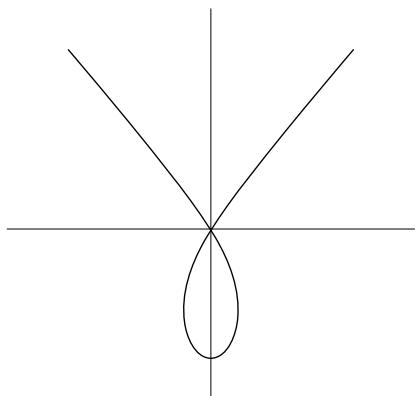
In general the image of an immersion is not a genuine ‘sub manifold’, since there is nothing to prevent self-intersections. For example the mapping defined by
is an immersion since its Jacobian matrix is everywhere non-degenerate,
The subset does not, however, inherit the manifold structure of since there is a self-intersection at , as shown in Fig. 15.4.
Figure 15.4 Immersion that is not a submanifoldIn order to have a natural manifold structure on the subset we require that the map is itself injective as well as its tangent map . The map is then called an embedding, and the pair an embedded submanifold of .
Let be any open subset ofa manifold . As in Example 15.2, it inherits a manifold structure from , whereby a chart is said to be admissible if it has the form for some chart on . With this differentiable structure, is said to be an open submanifold of . It evidently has the same dimension as . The pair is an embedded submanifold of .
Let be the 2-torus (see Example 15.6). The space can also be viewed as the factor space , where mod 1 if there exis integers and such that and . Denote equivalence classes mod 1 by the symbol . Consider the curve defined by . This map is an immersion unless . If is a rational number it is not an embedding since the curve eventually passes through for some and is not injective. For irrational the curve never passes through any point twice and is therefore an embedding. Figure 15.5 illustrates these properties. When is rational the image has the relative topology in ofa circle. Hence there is an embedding , making an embedded submanifold of . It is left to the reader to explicitly construct the map In this case the subset is closed.
The set () is dense in when is irrational, since the curve eventually passes arbitrarily close to any point of , and cannot be a closed subset. Hence the relative topology on () induced on it as a subset of is much coarser than the topology it would obtain from through the bijective map . The embedding is therefore not a homeomorphism from to when the latter is given the relative topology.
In general, an embedding that is also a homeomorphism from to () when the latter is given the relative topology in is called a regular embedding. A necessary and sufficient condition for this to hold is that there be a coordinate chart
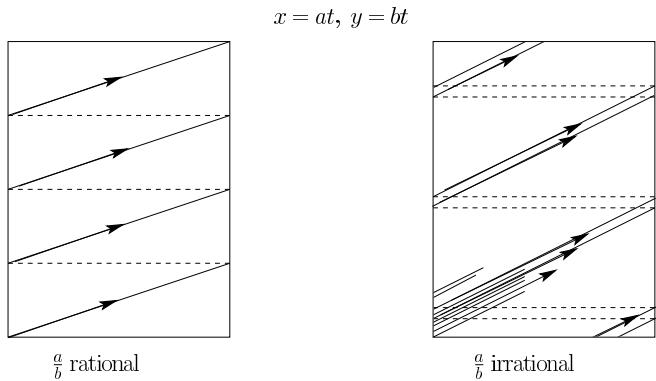
Figure 15.5 Submanifolds of the torus
at every point such that is defined by the ‘coordinate slice
It also follows that the set must be a closed subset of for this to occur. The proofs of these statements can be found in [11]. The above embedded submanifold is a regular embedding when is rational.
Problems
Show that if then the components are given by
where
If is a diffeomorphism, define a map by setting
and show that the components transform as
is a curve on and and is a differentiable map show that
Is the map given by an immersion, (ii) an embedded submanifold?
Show that the map defined by
is an immersion. Is it an embedded submanifold
Evaluate and . Find a vector field on for which is not a well-defined vector field.