We now give a geometrical interpretation of the curvature tensor, which will subsequently be used in the measurement of the gravitational field (see Section 18.8). Let where and are closed intervals of the real line, be a one-parameter family of curves on . We will assume that the restriction of the map to , where and are the open intervals and respectively, is an embedded twodimensional submanifold of . We think of each map defined by as being the curve represented by . and as the parameter along the curve. The one-parameter family of curves will be said to be from to if
for all
The tangent vectors to the curves of a one-parameter family constitute a vector field on the two-dimensional submanifold . If the curves are all covered by a single coordinate chart , then
The connection vector field defined by
is the tangent vector field to the curves connecting points having the same parameter value, . (see Fig. 18.1). The covariant derivative of the vector field along the curves is given by
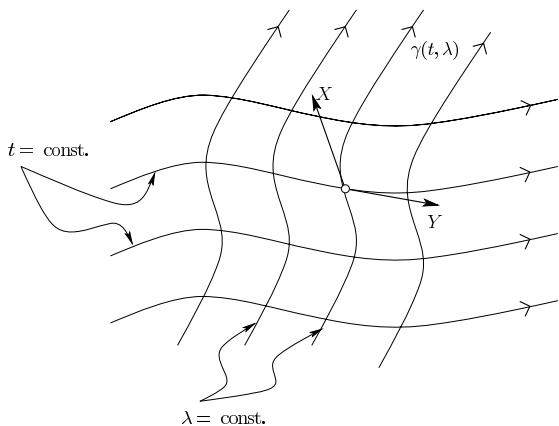
Figure 18.1 Tangent and connection vectors of a one-parameter family of geodesics
Hence
Alternatively, we can write
If is any vector field on then
From Eq. (18.44) and the Ricci identity Eq. (18.28)
Let be a pseudo-Riemannian manifold and a one-parameter family of geodesics, such that the geodesics . all have as an affine parameter,
the parametrization chosen to have the same normalization on all geodesics, or 0. It then follows that is constant along each geodesic, since
Thus, if the tangent and connection vector are initially orthogonal on a geodesic of the one-parameter family, , then they are orthogonal all along the geodesic.
In Eq. (18.46) set – this is possible since it is only necessary to have defined in terms of and (see Problem 18.14). With the help of Eq. (18.44) we have
known as the equation of geodesic deviation. For two geodesics, labelled by constants and , let be the tangent vector
For vanishingly small it is usual to think of as an ‘infinitesimal separation vector’. Since is constant along the geodesic we have
where . Thus measures the relative ‘acceleration’ between geodesics.
Problem
Equation (18.46) has strictly only been proved for a vector field . Show that it holds equally for a vector field whose components ) are only defined on the one-parameter family of curves .