The principle of equivalence
The Newtonian gravitational force on a particle of mass is where the scalar potential satisfies Poisson’s equation
Here is Newton’s gravitational constant and is the density of matter present. While it is in principle possible to generalize this theory by postulating a relativistically invariant equation such as
there are a number of problems with this theory, not least of which is that it does not accord with observations.
Key to the formulation of a correct theory is the principle of equivalence that, in its simplest version, states that all particles fall with equal acceleration in a gravitational field, a fact first attributed to Galileo in an improbable tale concerning the leaning tower of Pisa. While the derivation is by simple cancellation of from both sides of the Newtonian equation of motion
the masses appearing on the two sides of the equation could conceivably be different. On the left we really have inertial mass, , which measures the particle’s resistance to any force, while on the right the mass should be identified as gravitational mass, measuring the particle’s response to gravitational fields – its ‘gravitational charge’ so to speak. The principle of equivalence can be expressed as saying that the ratio of inertial to gravitational mass will be the same for all bodies irrespective of the material from which they are composed. This was tested to one part in for a vast variety of materials in 1890 by Eötvös using a torsion balance, and repeated in the 1960s to one part in by Dicke using a solar balancing mechanism (see C. M. Will’s article in [10]).
The principle of equivalence essentially says that it is impossible to distinguish inertia forces such as centrifugal or Coriolis forces from gravitational ones. A nice example of the equivalence of such forces is the Einstein elevator. An observer in an elevator at rest sees objects fall to the ground with acceleration . However if the elevator is set in free fall, objects around the observer will no longer appear to be subject to forces, much as if he were in an inertial frame in outer space. It has in effect been possible to transform away the gravitational field by going to a freely falling laboratory. Conversely as all bodies ‘fall’ to the floor in an accelerated rocket with the same acceleration, an observer will experience an ‘apparent’ gravitational field.
The effect of a non-inertial frame in special relativity should be essentially indistinguish able from the effects of gravity. The metric interval of Minkowski space (see Chapter 9) in a general coordinate system , where are inertial coordinates, becomes
where
Expressed in general coordinates, the (geodesic) equations of motion of an inertial particle, , are
where
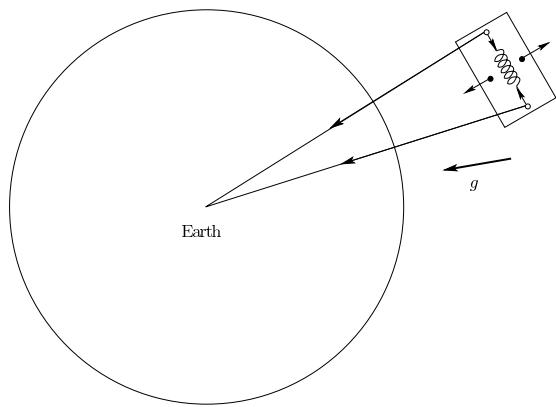
Figure 18.2 Tidal effects in a freely falling laboratory
The principle of equivalence is a purely local idea, and only applies to vanishingly smal laboratories. A real gravitational field such as that due to the Earth cannot be totally transformed away in general. For example, if the freely falling Einstein elevator has significan size compared to the scale on which there is variation in the Earth’s gravitational field, then particles at different positions in the lift will undergo different accelerations. Particles near the floor of the elevator will have larger accelerations than particles released from the ceiling, while particles released from the sides of the elevator will have a small horizonta acceleration relative to the central observer because the direction to the centre of the Earth is not everywhere parallel. These mutual accelerations or tidal forces can be measured in principle by connecting pairs of freely falling particles with springs (see Fig. 18.2).
Postulates of general relativity
The basic proposition of general relativity (Einstein, 1916) is the following: the world is a four-dimensional Minkowskian manifold (pseudo-Riemannian of index +2) called spacetime. Its points are called events. The world-line, or space-time history of a materia particle, is a parametrized curve whose tangent is everywhere timelike. The proper time, or time as measured by a clock carried by the particle between parameter values and , is given by
A test particle is a particle of very small mass compared to the major masses in its neighbourhood and ‘freely falling’ in the sense that it is subject to no external forces. The world-line of a test particle is assumed to be a timelike geodesic. The world-line of a photon of small energy is a null geodesic. Both satisfy equations
where the Christoffel symbols are given by Eq. (18.40) with Greek indices subsituted. The affine parameter is determined by
An introduction to the theory of general relativity, together with many of its developments, can be found in [9, 11–16].
The principle of equivalence has a natural place in this postulate, since all particles have the same geodesic motion independent of their mass. Also, at each event , geodesic norma coordinates may be found such that components of the metric tensor have the Minkowski values and the Christoffel symbols vanish, . In such coordinates the space-time appears locally to be Minkowski space, and gravitational forces have been locally transformed away since any geodesic at reduces to a ‘local rectilinear motion’ . When it is possible to find coordinates that transform the metric to constant values on an entire chart, the metric is locally flat and all gravitationa fields are ‘fictitious’ since they arise entirely from non-inertial effects. By Theorem 18.1 such coordinate transformations are possible if and onl if the curvature tensor vanishes. Hence it is natural to identify the ‘real’ gravitational field with the curvature tensor
The equations determining the gravitational field are Einstein’s field equations
where is the Einstein tensor defined above in Eqs. Eq. (18.61) and Eq. (18.62),
and is the energy–stress tensor of all the matter fields present. The constant is known as Einstein’s gravitational constant; we shall relate it to Newton’s gravitational constant directly. These equations have the property that for weak fields, , they reduce to the Poisson equation when appropriate identifications are made (see the discussion of the weak field approximation below), and by the contracted Bianchi identity Eq. (18.60) they guarantee a ‘covariant’ version of the conservation identities
Measurement of the curvature tensor
The equation of geodesic deviation Eq. (18.47) can be used to give a physical interpretation of the curvature tensor. Consider a one-parameter family of timelike geodesics with tangent vectors when expressed in a coordinate chart , where
Suppose the connection vector , where , is initially orthogonal to at ,
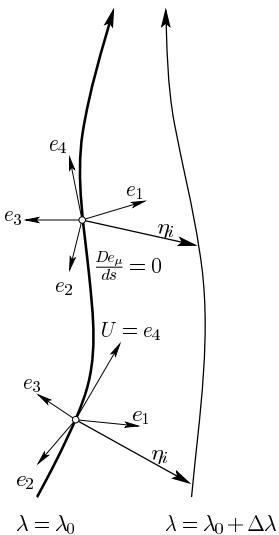
Figure 18.3 Physical measurement of curvature tensor
We then have for all , since is constant along each geodesic (see Section 18.5). Thus if are three mutually orthogonal spacelike vectors at on the central geodesic that are orthogonal to , and they are parallel propagated along this geodesic, , then they remain orthogonal to each other and along this geodesic,
In summary, if we set then the four vectors are an orthonormal tetrad of vectors along
The situation is depicted in Fig. 18.3. Let be any neighbouring geodesic from the family, then since we are assuming is orthogonal to , the equation of geodesic deviation in the form Eq. (18.48) can be written
Expanding in terms of the basis we have, adopting a cartesian tensor summation convention,
where , so that
Substituting Eq. (18.80) results in
which reads in any local coordinates at any point on such that
Thus measures the relative accelerations between neighbouring freely falling particles in the gravitational field. Essentially these are what are termed tidal forces in Newtonian physics, and could be measured by the strain on a spring connecting the two particles (see Fig. 18.2 and [17]).
The linearized approximation
Consider a one-parameter family of Minkowskian metrics having components such that reduces to flat Minkowski space, . Such a fam ily is known as a linearized approximation of general relativity. If we set
then for we have ‘weak gravitational fields’ in the sense that the metric is only slightly different from Minkowski space,
From it follows by differentiating with respect to at that
whence
In this equation and throughout the present discussion indices are raised and lowered with respect to the Minkowski metric, . For we evidently have
Assuming that partial derivatives with respect to and commute, it is straightforward to compute the linearization of the Christoffel symbols,
and
Thus, from the component expansion of the curvature tensor Eq. (18.25), we have
since
since . Thus
and for small values of the parameter the Riemann curvature tensor is
It is interesting to compare this equation with the expression in geodesic normal coordinates, Eq. (18.43).
The Newtonian tidal equation is derived by considering the motion oftwo neighbouring particles
Since we have
Compare with the equation of geodesic deviation Eq. (18.81) with replaced by , which is approximately correct for velocities
and we should have, by Eq. (18.84),
This equation can only hold in a general way if
and the Newtonian approximation implies that
Note that the Newtonian potentia has the dimensions of a velocity square – the weak field slow motion approximation ofgeneral relativity arises when this velocity is small compared to the velocity of light .
Multiplying Eq. (18.79) through by we find
and Einstein’s field equations can be written in the ‘Ricci tensor form
Hence
If we assume a perfect fluid, Example 9.4, for low velocities compared to we have
so that
and
Substituting in the Ricci form of Einstein’s equations we find
which is in agreement with the Newtonian equation Eq. (18.77) provided Einstein’s gravitational constant has the form
Show that the contracted Bianchi identity Eq. (18.60) implies that in geodesic coordinates at any point representing a local freely falling frame, the conservation identities (9.56) hold
Show that if we had assumed field equations of the form , there would have resulted the physically unsavoury result
Consider now the effect of a one-parameter family of coordinate transformations on a linearized approximation and set
The transformation of components of the metric tensor results in
and taking at gives
These may be thought ofas ‘gauge transformations’ for the weak fields , comparable with the gauge transformations (9.49), , which leave the electromagnetic field unchanged. In the present case, it is straightforward to verify that the transformations Eq. (18.88) leave the linearized Riemann tensor Eq. (18.84), or real gravitationalfield, invariant.
We define the quantities by
The transformation of under a gauge transformation is then
where indices are raised and lowered with the Minkowski metric, . Just as done for the Lorentz gauge (9.51), it is possible (after dropping primes) to find such that
Such a gauge is commonly known as a harmonic gauge. There are still available gauge freedoms subject to solutions of the wave equation
A computation of the linearized Ricci tensor using Eq. (18.84) give
in a harmonic gauge. The Einstein tensor is thus , and the linearized Einstein equation is
having solution in terms of retarded Green’s functions (12.23)
In vacuo, , Einstein’s field equations can be written , so that in the linearized approximation we have ; these solutions are known as gravitational waves (see Problem 18.20 for further details).
The Schwarzschild solution
The vacuum Einstein field equations, are a non-linear set of 10 second-order equations for 10 unknowns that can only be solved in a handful of special cases. The most important is that of spherical symmetry which, as we shall see in the next chapter, implies that the metric has the form in a set of coordinates
where and take the normal ranges ofpolar coordinates ( does not necessarily range from 0 to ), and and are functions of and . We will assume for simplicity that the solutions are static so that they are functions of the radial coordinate alone, . A remarkable theorem of Birkhoff assures us that all spherically symmetric vacuum solutions are in fact static for an appropriate choice of the coordinate ; a proof may be found in Synge [15].
We will perform calculations using Cartan’s formalism. Many books prefer to calculate Christoffel symbols and do all computations in the coordinate system of Eq. (18.90). Let be the orthonormal basis
such that
and let be the dual basis
We will write Cartan’s structural relations in terms of the ‘lowered’ connection forms since, by Eq. (18.73), we have . Thus Eq. (18.64) can be written
and setting successively , 4 we have, writing derivatives with respect to by a prime ,
From Eq. (18.93) it follows at once that , and substituting in Eq. (18.94) we see that since it is the sole coefficient of the 2-form basis element . Similarly, from and
Continuing in this way we find the following values for the connection 1-forms:
To obtain the curvature tensor it is now a simple matter of substituting these forms in the second Cartan structural equation Eq. (18.67), with indices lowered
For example
Substituting for using Eq. (18.92) we find
Similarly,
The components of the Riemann tensor in this basis are given by
The non-vanishing components are
The Ricci tensor components
are therefore
To solve Einstein’s vacuum equations , we see by adding Eq. (18.98) and Eq. (18.99) tha , whence
A rescaling of the time coordinate, , has the effect of making , which we now assume. By Eq. (18.99), reduces the second-order differential equation to
and the substitution results in
whence
If we substitute this into we have, by so that . The most general spherically symmetric solution of Einstein’s vacuum equations is therefore
known famously as the Schwarzschild solution. Converting the polar coordinates to equiv alent cartesian coordinates , , we have, as ,
and where
assuming the Newtonian approximation with potential is applicable in this limit. Since the potential of a Newtonian mass is given by , it is reasonable to make the identification
The constant has dimensions of length and , where the metric Eq. (18.101) exhibits singular behaviour, is commonly known as the Schwarzschild radius. For a solar mass, , its value is about 3 . However the Sun would need to collapse to approximately this size before strong corrections to Newtonian theory apply.
When paths ofparticles (timelike geodesics) and photons (null geodesics) are calculated in this metric, the following deviations from Newtonian theory are found for the sola system:
- There is a slowing of clocks at a lower gravitational potential. At the surface of the Earth this amounts to a redshift from a transmitter to a receiver at a height above it of
This amounts to a redshift of about and is measurable using the Mössbauer effect.
- The perihelion of a planet in orbit around the Sun precesses by an amount
For Mercury this comes out to 43 seconds of arc per century.
- A beam of light passing the Sun at a closest distance is deflected an amount
For a beam grazing the rim of the Sun the deflection is 1.75 seconds of arc.
The limi is of particular interest. Although it appears that the metric Eq. (18.101) is singular in this limit, this is really only a feature of the coordinates, not of the space-time as such. A clue that this may be the case is found by calculating the curvature components Eq. (18.97) for the Schwarzschild solution,
all of which approach finite values as
Verify these expressions for components of the Riemann tensor.
More specifically, let us make the coordinate transformation from to 2 , sometimes referred to as advanced time since it can be shown to be constant on inward directed null geodesics, while leaving the spatial coordinates , , unchanged. In these Eddington–Finkelstein coordinates the metric becomes
the metric shows no abnormality in these coordinates. Inward directed timelike geodesics in the region reach in finite -time (and also in finite proper time). However, after the geodesic particle crosses no light signals can be sent ou from it into (see Fig. 18.4). The surface 2 acts as a one-way membrane for light signals, called an event horizon. Observers with can never see any events inside , an effect commonly referred to as a black hole.
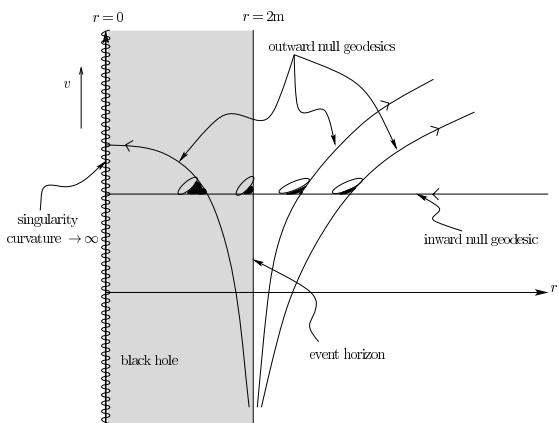
Figure 18.4 Schwarzschild solution in Eddington–Finkelstein coordinates
Problems
A linearized plane gravitational wave is a solution of the linearized Einstein equations of the form where . Show that the harmonic gauge condition Eq. (18.89) implies that, up to undefined constants,
Use the remaining gauge freedom to show that it is possible to transform to the form
Setting and , show that the equation of geodesic deviation has the form
and . Make a sketch of the distribution of neighbouring accelerations of freely falling parti cles about a geodesic observer in the two cases and ). These results are central to the observational search for gravity waves.
Show that every two-dimensional space-time metric (signature 0) can be expressed locally in conformal coordinates
Calculate the Riemann curvature tensor component , and write out the two-dimensional Einstein vacuum equations . What is their general solution?
(a) For a perfect fluid in general relativity,
show that the conservation identities imply
(b) For a pressure-free fluid show that the streamlines of the fluid (i.e. the curves satisfying are geodesics, and is a covariant 4-current,
(c) In the Newtonian approximation where
where and with , show that
and . Show in this approximation that the equation approximate to
(a) Compute the components of the Ricci tensor for a space-time that has a metric of the form
(b) Show that the space-time is a vacuum if and only if where is an arbitrary function and satisfies the two-dimensional Laplace equation
and show that it is possible to set by a coordinate transformation (c) Show that for
Show that a coordinate transformation can be found such that the Schwarzschild solution has the form
Evaluate the functions and explicitly.
Consider an oscillator at emitting a pulse of light (null geodesic) at If this is received by an observer at at , show that
By considering a signal emitted at , received at (assuming the radial positions and to be constant), show that and the gravitational redshift found by comparing proper times at emission and reception is given by
Show that for two clocks at different heights on the Earth’s surface, this reduces to
where and are the mass and radius of the Earth.
In the Schwarzschild solution show the only possible closed photon path is a circula orbit at , and show that it is unstable.
(a) A particle falls radially inwards from rest at infinity in a Schwarzschild solution. Show that it will arrive at in a finite proper time after crossing some fixed reference position , but that coordinate time
(b) On an infalling extended body compute the tidal force in a radial direction, by parallel propagating a tetrad (only the radial spacelike unit vector need be considered) and calculating
(c) Estimate the total tidal force on a person of height 1.8 , weighing 70 , falling head-first into a solar mass black hole , as he crosses