To begin with, we define a holomorphic (or analytic) map on . A complex-valued function is holomorphic if satisfies the Cauchy-Riemann relations for each ,
A map is called holomorphic if each function is holomorphic.
8.1.1 Definitions
is a complex manifold if the following axioms hold,
(i) is a topological space.
(ii) is provided with a family of pairs .
(iii) is a family of open sets which covers . The map is a homeomorphism from to an open subset of . [Hence, is even dimensional.]
(iv) Given and such that , the map from to is holomorphic.8
The number is called the complex dimension of and is denoted as . The real dimension is denoted either by or simply by . Let and be the (complex) coordinates of a point in the charts and , respectively. Axiom (iv) asserts that the function ( ) is holomorphic in , namely
These axioms ensure that calculus on complex manifolds can be carried out independently of the special coordinates chosen. For example, is the simplest complex manifold. A single chart covers the whole space and is the identity map.
Let and be atlases of . If the union of two atlases is again an atlas which satisfies the axioms of definition 8.1, they are said to define the same complex structure. A complex manifold may carry a number of complex structures (see example 8.2).
8.1.2 Examples
In exercise 5.1, it was shown that the stereographic coordinates of a point projected from the North Pole are
while those of a point projected from the South Pole are
[Note the orientation of in figure 5.5.] Let us define complex coordinates
is a holomorphic function of ,
Thus, is a complex manifold which is identified with the Riemann sphere .
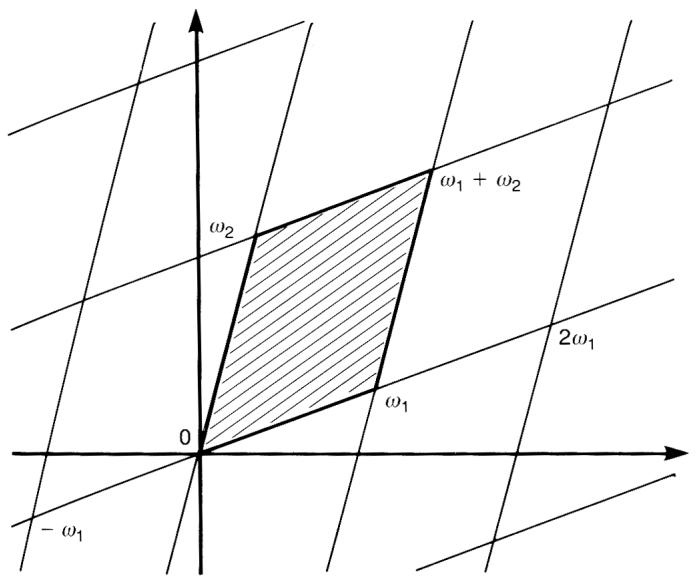
Take a complex plane and define a lattice where and are two non-vanishing complex numbers such
that ; see figure 8.1. Without loss of generality, we may take . The manifold is obtained by identifying the points such that for some . Since the opposite sides of the shaded area of figure 8.1 are identified, is homeomorphic to the torus . The complex structure of naturally induces that of . We say that the pair defines a complex structure on . There are many pairs which give the same complex structure on .
Figure 8.1. Two complex numbers and define a lattice in the complex plane. is homeomorphic to the torus (the shaded area).
When do pairs and define the same complex structure? We first note that two lattices and coincide if and only if there exists a matrix
such that
This statement is proved as follows.
Suppose
1 The group has been defined in (2.4). Two matrices and are identified in .
Since , we find . From
we also find . Thus, . Conversely, if , and are lattice points of and can be written as and where . Also and may be expressed as and where . Then we have
from which we find
Equating the determinants of both sides, we have . All the entries being integers, this is possible only when . Since
we must have , that is,
In fact, it is clear that
defines the same lattice as
and we have to identify those matrices of which differ only by their overall signature. Thus, two lattices agree if they are related by
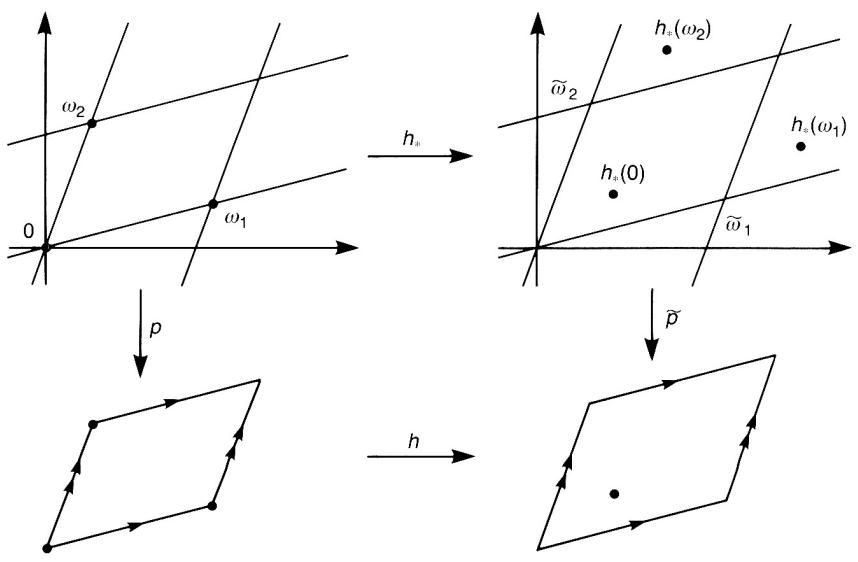
Assume that there exists a one-to-one holomorphic map of onto where , . Let and be the natural projections. For example, maps a point in to an equivalent point in . Choose the origin 0 and define to be a point such that (figure 8.2),
Figure 8.2. A holomorphic bijection and the natural projections , define a holomorphic bijection .
Then by analytic continuation from the origin, we obtain a one-to-one holomorphic map of onto itself satisfying
so that the diagram (8.3) commutes. It is known that a one-to-one holomorphic map of onto itself must be of the form , where and . We then have and . For to be well defined as a map of onto , we must have , see figure 8.2. By changing the roles of and , we have where is a complex number. Hence, we conclude that if , have the same complex structure, there must be a matrix and a complex number such that
Conversely, we verify that and related by (8.5) define the same complex structure. In fact,
define the same lattice (modulo translation) and we may take to be . and also define the same complex structure. We take, in this case, .
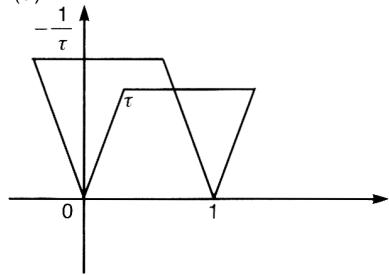
We have shown that the complex structure on is defined by a pair of complex numbers modulo a constant factor and . To get rid of the constant factor, we introduce the modular parameter , to specify the complex structure of . Without loss of generality, we take 1 and to be the generators of a lattice. Note, however, that not all of are independent modular parameters. As was shown previously, and define the same complex structure if
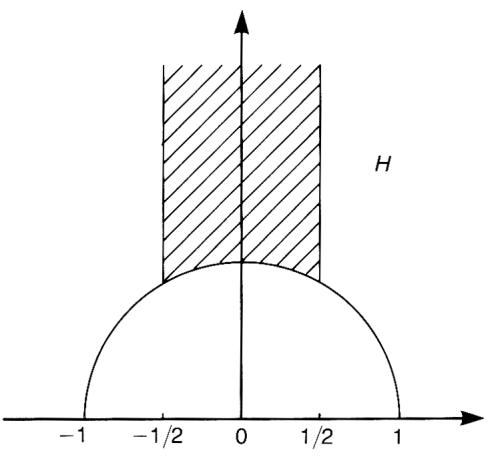
The quotient space is shown in figure 8.3, the derivation of which can be found in Koblitz (1984) p 100, and Gunning (1962) p 4.
Figure 8.3. The quotient space .
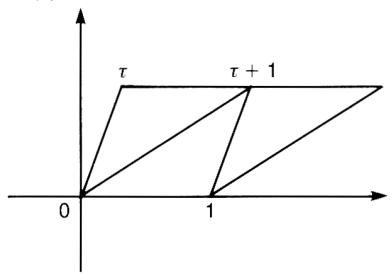
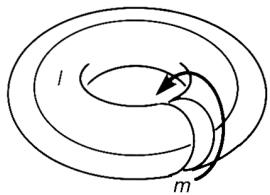
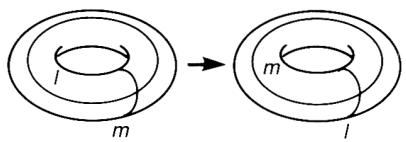
The change is called the modular transformation and is generated by and . The transformation generates a Dehn twist along the meridian as follows (figure 8.4(a)). (i) First, cut a torus along . (ii) Then take one of the lips of the cut and rotate it by with the other lip kept fixed. (iii) Then glue the lips together again. The other transformation corresponds to changing the roles of the longitude and the meridian (figure 8.4(b)).
(a)
(b)
Figure 8.4. (a) Dehn twists generate modular transformations. (b) changes the roles of and .
The complex projective space is defined similarly to ; see example 5.4. The tuple determines a complex line through the origin provided that . Define an equivalence relation
by if there exists a complex number such that . Then . The numbers are called the homogeneous coordinates, which is denoted by where is identified with . A chart is a subset of such that . In a chart , the inhomogeneous coordinates are defined by ( ). In , the coordinate transformation is
Accordingly, is a multiplication by , which is, of course, holomorphic.
The complex Grassmann manifolds are defined similarly to the real Grassmann manifolds; see example 5.5. is the set of complex -dimensional subspaces of . Note that .
Let be the set of matrices of rank ( ). Take and define an equivalence relation by if there exists such that . We identify with . Let be the collection of all the minors of . We define the chart to be a subset of such that . The coordinates on are given by the non-trivial entries of the matrix . See example 5.5 for details.
The common zeros of a set of homogeneous polynomials are a compact submanifold of called an algebraic variety. For example, let be a homogeneous polynomial of degree . If is a complex number, satisfies
This shows that the zeros of are defined on ; if then . For definiteness, consider
and define by
We define as in example 8.3. In , we have
where (note that ). Consider a holomorphic change of coordinates . Note that unless . Then is clearly a one-dimensional submanifold of . If , we have for which the Jacobian does not vanish unless . Then is a one-dimensional submanifold of . On , the coordinate change is a multiplication by and is, hence, holomorphic. In this way, we may define a one-dimensional compact submanifold of .
A complex manifold is a differentiable manifold. For example, is regarded as by the identification , . Similarly, any chart of a complex manifold has coordinates which may be understood as real coordinates . The analytic property of the coordinate transformation functions ensures that they are differentiable when the manifold is regarded as a -dimensional differentiable manifold.
来源与版本
正文:英文 · OCR 机器稿 · 待校对
核对状态:OCR 机器稿 · 待校对
来源版本:second-edition-local
来源 PDF SHA-256:fcd24c3371d092a8c699ccf5cf0765462924b6c48412804231076e8084b1940d
OCR 来源 SHA-256:0b6324f01172a3548cd34382e82fd8bfae574602b6b2cfaa357ba96bc2c35478
OCR 产物 SHA-256:e56ca3f232f2b6e0b2e63319ed2b8a62c5aaade6c92cf84d28ea83eec12efa4e