3.3.1 Oriented simplexes
We may assign orientations to an -simplex for . Instead of for an unoriented simplex, we will use to denote an oriented simplex. The symbol is used to denote both types of simplex. An oriented 1-simplex is a directed line segment traversed in the direction (figure 3.6(a)). Now
(a)
(b)
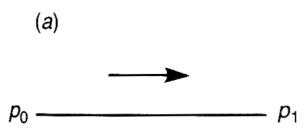
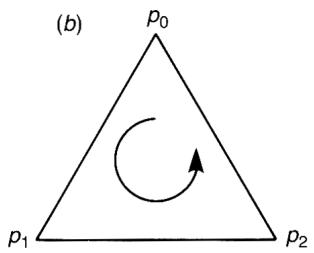
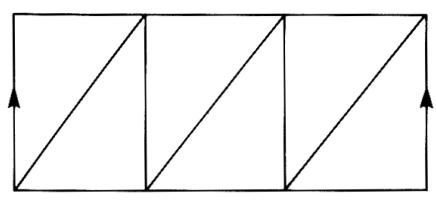
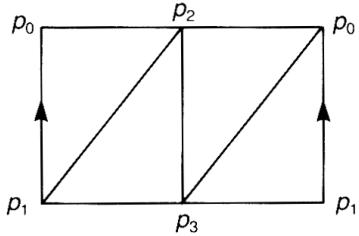
Figure 3.5. is a triangulation of a cylinder while is not.
Figure 3.6. An oriented 1-simplex and an oriented 2-simplex .
should be distinguished from . We require that
Here in front of should be understood in the sense of a finitely generated Abelian group. In fact, is regarded as the inverse of . Going from to followed by going from to means going nowhere, , hence .
Similarly, an oriented 2-simplex is a triangular region with a prescribed orientation along the edges (figure 3.6(b)). Observe that the orientation given by is the same as that given by or but opposite to , or . We require that
Let be a permutation of 0, 1, 2
These relations are summarized as
where ( ) if is an even (odd) permutation.
An oriented 3-simplex is an ordered sequence of four vertices of a tetrahedron. Let
be a permutation. We define
It is now easy to construct an oriented -simplex for any . The formal definition goes as follows. Take geometrically independent points in . Let be a sequence of points obtained by a permutation of the points . We define and to be equivalent if
is an even permutation. Clearly this is an equivalence relation, the equivalence class of which is called an oriented -simplex. There are two equivalence classes, one consists of even permutations of , the other of odd permutations. The equivalence class (oriented -simplex) which contains is denoted by , while the other is denoted by . In other words,
For , we formally define an oriented 0-simplex to be just a point .
3.3.2 Chain group, cycle group and boundary group
Let be an -dimensional simplicial complex. We regard the simplexes in as oriented simplexes and denote them by the same symbols as remarked before.
The -chain group of a simplicial complex is a free Abelian group generated by the oriented -simplexes of . If , is defined to be 0. An element of is called an -chain.
Let there be -simplexes in . We denote each of them by ( ). Then is expressed as
The integers are called the coefficients of . The group structure is given as follows. The addition of two -chains, and , is
The unit element is , while the inverse element of is . [Remark: An oppositely oriented -simplex is identified with .] Thus, is a free Abelian group of rank ,
Before we define the cycle group and the boundary group, we need to introduce the boundary operator. Let us denote the boundary of an -simplex by . should be understood as an operator acting on to produce its boundary. This point of view will be elaborated later. Let us look at the boundaries of lower-dimensional simplexes. Since a 0-simplex has no boundary, we define
For a 1-simplex , we define
The reader might wonder about the appearance of a minus sign in front of . This is again related to the orientation. The following examples will clarify this point. In figure 3.7(a), an oriented 1-simplex is divided into two, and . We agree that the boundary of is and so should be that of . If were defined to be , we would have . This is not desirable since is a fictitious boundary. If, instead, we take , we will have as expected. The next example is the triangle of figure 3.7(b). It is the sum of three oriented 1-simplexes,
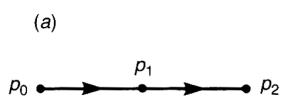
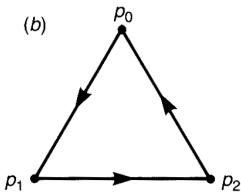
Figure 3.7. (a) An oriented 1-simplex with a fictitious boundary . (b) A simplicial complex without a boundary.
. We agree that it has no boundary. If we insisted on the rule , we would have
which contradicts our intuition. If, on the other hand, we take , we have
as expected. Hence, we put a plus sign if the first vertex is omitted and a minus sign if the second is omitted. We employ this fact to define the boundary of a general -simplex.
Let ( ) be an oriented -simplex. The boundary of is an -chain defined by
where the point under is omitted. For example,
We formally define for .
The operator acts linearly on an element of ,
The RHS of (3.21) is an element of . Accordingly, defines a map
is called the boundary operator. It is easy to see that the boundary operator is a homomorphism.
Let be an -dimensional simplicial complex. There exists a sequence of free Abelian groups and homomorphisms,
where is an inclusion map (0 is regarded as the unit element of ). This sequence is called the chain complex associated with and is denoted by . It is interesting to study the image and kernel of the homomorphisms .
If satisfies
is called an -cycle. The set of -cycles is a subgroup of and is called the -cycle group. Note that . [Remark: If , vanishes identically and , see (3.23).]
Let be an -dimensional simplicial complex and let . If there exists an element such that
then is called an -boundary. The set of -boundaries is a subgroup of and is called the -boundary group. Note that . [Remark: is defined to be 0.]
From lemma 3.1, it follows that and are subgroups of . We now prove an important relation between and , which is crucial in the definition of homology groups.
The composite map is a zero map; that is, for any .
Proof
Since is a linear operator on , it is sufficient to prove the identity for the generators of . If , since is a zero operator. Let us assume . Take . We find
which proves the lemma.
Let and be the -cycle group and the -boundary group of , then
Proof
This is obvious from lemma 3.3. Any element of is written as for some . Then we find , that is, . This implies .
What are the geometrical pictures of -cycles and -boundaries? With our definitions, picks up the boundary of an -chain. If is an -cycle, tells us that has no boundary. If is an -boundary, is the boundary of whose dimension is higher than by one. Our intuition tells us that a boundary has no boundary, hence . Those elements of that are not boundaries play the central role in this chapter.
3.3.3 Homology groups
So far we have defined three groups and associated with a simplicial complex . How are they related to topological properties of or to the topological space whose triangulation is ? Is it possible for to express any property which is conserved under homeomorphism? We all know that the edges of a triangle and those of a square are homeomorphic to each other. What about their chain groups? For example, the 1-chain group associated with a triangle is
while that associated with a square is
Clearly is not isomorphic to , hence cannot be a candidate of a topological invariant. The same is true for and . It turns out that the homology groups defined in the following provide the desired topological invariants.
Let be an -dimensional simplicial complex. The th homology group , , associated with is defined by
[Remarks: If necessary, we define for or . If we want to stress that the group structure is defined with integer coefficients, we
write . We may also define the homology groups with -coefficients, or those with -coefficients, .]
Since is a subgroup of , is well defined. The group is the set of equivalence classes of -cycles,
where each equivalence class is called a homology class. Two -cycles and are in the same equivalence class if and only if , in which case is said to be homologous to and denoted by or . Geometrically is a boundary of some space. By definition, any boundary is homologous to 0 since . We accept the following theorem without proof.
Homology groups are topological invariants. Let be homeomorphic to and let and be triangulations of and respectively. Then we have
In particular, if and are two triangulations of , then
Accordingly, it makes sense to talk of homology groups of a topological space which is not necessarily a polyhedron but which is triangulable. For an arbitrary triangulation , is defined to be
Theorem 3.4 tells us that this is independent of the choice of the triangulation .
Let . The 0-chain is . Clearly and and cannot be a boundary of anything). Thus
Let be a simplicial complex consisting of two 0-simplexes. Show that
Let . We have
Since is not a boundary of any simplex in , and
If , it satisfies
Thus, has to vanish and , hence
As for , we have and
Define a surjective (onto) homomorphism by
Then we find
Theorem 3.1 states that , or
Let , see figure 3.7(b). This is a triangulation of . Since there are no 2-simplexes in , we have and . Let where . We require that
This is satisfied only when . Thus, we find that
This shows that is isomorphic to and
Let us compute . We have and
Define a surjective homomorphism by
We verify that
From theorem 3.1 we find , or
is a triangulation of a circle , and (3.37) and (3.38) are the homology groups of .
Let be a simplicial complex whose polyhedron is a square. Verify that the homology groups are the same as those of example 3.8 above.
Let ; see figure 3.6(b). Since the structure of 0-simplexes and 1-simplexes is the same as that of example 3.8, we have
Let us compute . From the previous example, we have
Let . If , we have
This shows that , hence
Since there are no 3-simplexes in , we have . Then . Let . Since , must vanish. Hence, and we have
Let
be a simplicial complex whose polyhedron is the surface of a tetrahedron. Verify that
is a triangulation of the sphere and (3.42) gives the homology groups of .
3.3.4 Computation of
Examples 3.6-3.9 and exercises 3.2, 3.3 share the same zeroth homology group, . What is common to these simplicial complexes? We have the following answer.
Let be a connected simplicial complex. Then
Proof
Since is connected, for any pair of 0-simplexes and , there exists a sequence of 1-simplexes such that . Then it follows that is homologous to , namely . Thus, any 0-simplex in is homologous to say. Suppose
where is the number of 0-simplexes in . Then the homology class is generated by a single point,
It is clear that , namely , if .
Let ( ) be 1-simplexes in , being the number of 1-simplexes in , then
Note that ( ) always appears as a pair and in an element of . Thus, if
Now we have proved for a connected complex that if and only if .
Define a surjective homomorphism by
We then have . It follows from theorem 3.1 that .
3.3.5 More homology computations
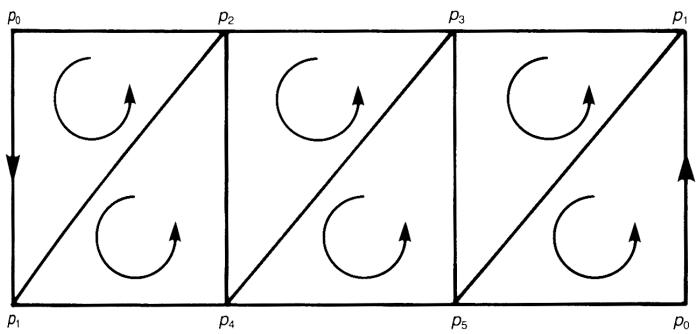
This and the next example deal with homology groups of nonorientable spaces. Figure 3.8 is a triangulation of the Möbius strip. Clearly . Let us take a cycle ,
Figure 3.8. A triangulation of the Möbius strip.
satisfies
Since each of , , , , and appears once and only once in , all the coefficients must vanish,
0. Thus, and
To find , we use our intuition rather than doing tedious computations. Let us find the loops which make complete circuits. One such loop is
Then all the other complete circuits are homologous to multiples of . For example, let us take
We find that since
If, however, we take
we find that since
We easily verify that all the closed circuits are homologous to , . is generated by just one element ,
Since is connected, it follows from theorem 3.5 that , being any 0-simplex of .
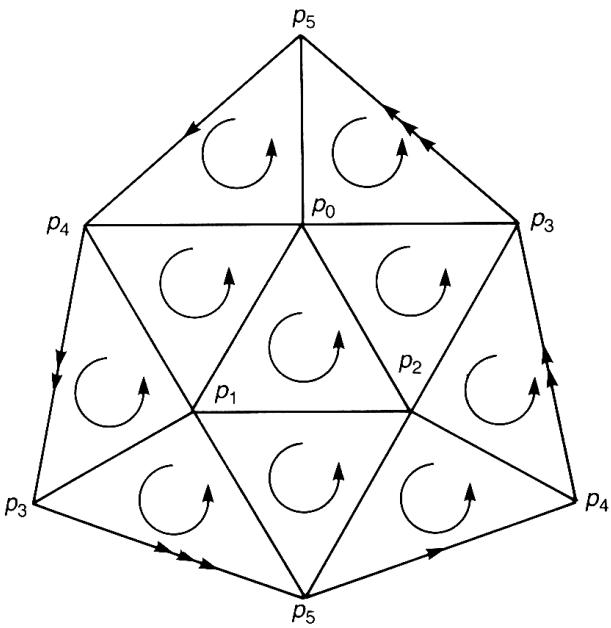
The projective plane has been defined in example 2.5(c) as the sphere whose antipodal points are identified. As a coset space, we may take the hemisphere (or the disc ) whose opposite points on the boundary are identified, see figure 2.5(b). Figure 3.9 is a triangulation of the projective plane. Clearly . Take a cycle ,
Figure 3.9. A triangulation of the projective plane.
The boundary of is
Let us look at the coefficient of each 1-simplex. For example, we have , hence . Similarly,
These ten conditions are satisfied if and only if , . This means that the cycle group is trivial and we have
Before we calculate , we examine from a slightly different viewpoint. Let us add all the 2-simplexes in with the same coefficient,
Observe that each 1-simplex of is a common face of exactly two 2-simplexes. As a consequence, the boundary of is
Thus, if , must vanish and we find as before. This observation remarkably simplifies the computation of . Note that any 1-cycle is homologous to a multiple of
cf example 3.10. Furthermore, equation (3.47) shows that an even multiple of is a boundary of a 2-chain. Thus, is a cycle and is homologous to 0. Hence, we find that
This example shows that a homology group is not necessarily free Abelian but may have the full structure of a finitely generated Abelian group. Since is connected, we have .
It is interesting to compare example 3.11 with the following examples. In these examples, we shall use the intuition developed in this section on boundaries and cycles to obtain results rather than giving straightforward but tedious computations.
Let us consider the torus . A formal derivation of the homology groups of is left as an exercise to the reader: see Fraleigh (1976), for example. This is an appropriate place to recall the intuitive meaning of the homology groups. The th homology group is generated by those boundaryless -chains that are not, by themselves, boundaries of some -chains. For example, the surface of the torus has no boundary but it is not a boundary of some 3-chain. Thus, is freely generated by one generator, the surface itself, . Let us look at next. Clearly the loops and in figure 3.10 have no boundaries but are not boundaries of some 2-chains. Take another loop . is homologous to since bounds the shaded area of figure 3.10.
Figure 3.10. is homologous to but is not. and generate .
Hence, is freely generated by and and . Since is connected, we have .
Now it is easy to extend our analysis to the torus of genus . Since has no boundary and there are no 3-simplexes, the surface itself freely generates . The first homology group is generated by those loops which are not boundaries of some area. Figure 3.11 shows the standard choice for the generators. We find
Figure 3.11. and generate
Since is connected, . Observe that is homologous to the edge of figure 2.12. The curves are called the canonical system of curves on .
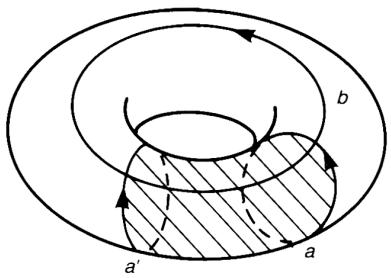
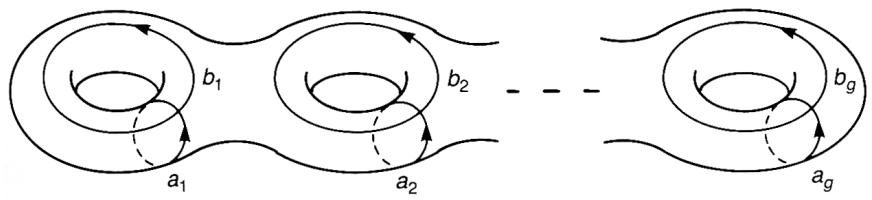
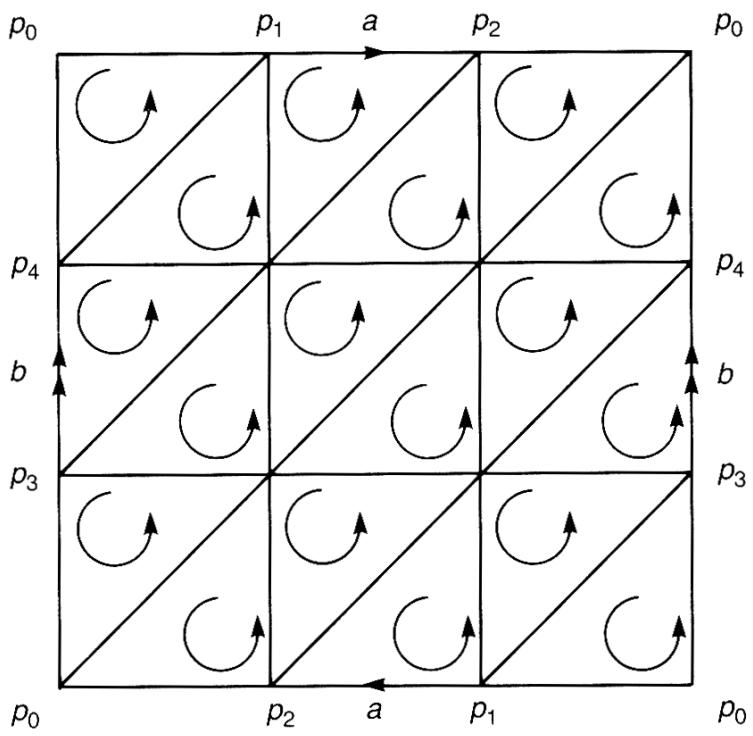
Figure 3.12 is a triangulation of the Klein bottle. Computations of the homology groups are much the same as those of the projective plane. Since , we have . Let . If is a combination of all the 2-simplexes of with the same coefficient, , the inner 1-simplexes cancel out to leave only the outer 1-simplexes
Figure 3.12. A triangulation of the Klein bottle.
where . For to be 0, the integer must vanish and we have
To compute we first note, from our experience with the torus, that every 1-cycle is homologous to for some . For a 2-chain to have a boundary consisting of and only, all the 2-simplexes in must be added with the same coefficient. As a result, for such a 2-chain , we have . This shows that . Thus, is generated by two cycles and such that , namely
We obtain since is connected.
来源与版本
正文:英文 · OCR 机器稿 · 待校对
核对状态:OCR 机器稿 · 待校对
来源版本:second-edition-local
来源 PDF SHA-256:fcd24c3371d092a8c699ccf5cf0765462924b6c48412804231076e8084b1940d
OCR 来源 SHA-256:0b6324f01172a3548cd34382e82fd8bfae574602b6b2cfaa357ba96bc2c35478
OCR 产物 SHA-256:f6146224f8bde5af518057b282919945a02e83fc786ed811ae464a8e9ca60375