The fundamental group classifies the homotopy classes of loops in a topological space . There are many ways to assign other groups to . For example, we may classify homotopy classes of the spheres in or homotopy classes of the tori in . It turns out that the homotopy classes of the sphere ( ) form a group similar to the fundamental group.
4.5.1 Definitions
Let denote the unit -cube
The boundary is the geometrical boundary of ,
We recall that in the fundamental group, the boundary of is mapped to the base point . Similarly, we assume here that we shall be concerned with continuous maps , which map the boundary to a point . Since the boundary is mapped to a single point , we have effectively obtained from ; cf figure 2.8. If denotes the cube whose boundary is shrunk to a point, we have . The map is called an -loop at . A straightforward generalization of definition 4.4 is as follows.
Let be a topological space and be -loops at . The map is homotopic to , denoted by , if there exists a continuous map such that
is called a homotopy between and .
Show that is an equivalence relation. The equivalence class to which belongs is called the homotopy class of and is denoted by .
Let us define the group operations. The product of -loops and is defined by
The product looks like figure 4.17(a) in . It is helpful to express it as figure 4.17(b). If we define by
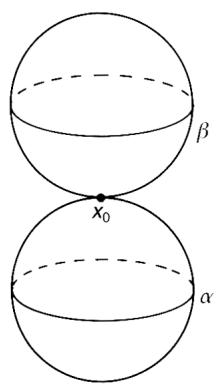
(a)
Figure 4.17. A product of -loops and .
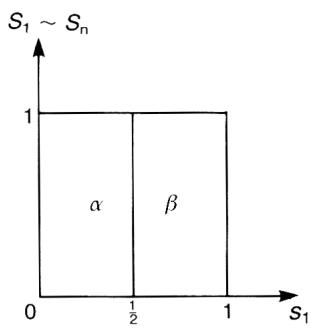
(b)
it satisfies
where is a constant -loop at , . Verify that both and are -loops at .
Let be a topological space. The set of homotopy classes of -loops ( ) at is denoted by and called the th homotopy group at . is called the higher homotopy group if .
The product just defined naturally induces a product of homotopy classes defined by
where and are -loops at . The following exercises verify that this product is well defined and satisfies the group axioms.
Show that the th homotopy group is a group. To prove this, the following facts may be verified; cf theorem 4.1.
(1)
(2) .
(3) , which defines the inverse .We have excluded so far. Let us classify maps from to . We note and . Let be such that and . We define if there exists a continuous map such that and . This shows that if and only if and are connected by a curve in , namely they are in the same (arccwise) connected component. Clearly this equivalence relation is independent of and we simply denote the zeroth homology group by . Note, however, that is not a group and denotes the number of (arccwise) connected components of .
来源与版本
正文:英文 · OCR 机器稿 · 待校对
核对状态:OCR 机器稿 · 待校对
来源版本:second-edition-local
来源 PDF SHA-256:fcd24c3371d092a8c699ccf5cf0765462924b6c48412804231076e8084b1940d
OCR 来源 SHA-256:0b6324f01172a3548cd34382e82fd8bfae574602b6b2cfaa357ba96bc2c35478
OCR 产物 SHA-256:d6454ba4f5b50ae31b568f9332c0fa0e3b41bcaa49a6ffe3f97760fb590637a8