The computation of fundamental groups in the previous section was, in a sense, ad hoc and we certainly need a more systematic way of computing the fundamental groups. Fortunately if a space is triangulable, we can compute the fundamental group of the polyhedron , and hence that of by a routine procedure. Let us start with some aspects of group theories.
4.4.1 Free groups and relations
The free groups that we define here are not necessarily Abelian and we employ multiplicative notation for the group operation. A subset of a group is called a free set of generators of if any element is uniquely written as
where is finite and . We assume no adjacent are equal; . If , is simply written as . If , the term should be dropped from . For example, is acceptable but is not. If each element is to be written uniquely, must be reduced to . If has a free set of generators, it is called a free group.
Conversely, given a set , we can construct a free group whose free set of generators is . Let us call each element of a letter. The product
is called a word, where and . If and the word is called a reduced word. It is always possible to reduce a word by finite steps. For example,
A word with no letters is called an empty word and denoted by 1. For example, it is obtained by reducing .
A product of words is defined by simply juxtaposing two words. Note that a juxtaposition of reduced words is not necessarily reduced but it is always possible to reduce it. For example, if and , the product is reduced as
Thus, the set of all reduced words form a well-defined free group called the free group generated by , denoted by . The multiplication is the juxtaposition of two words followed by reduction, the unit element is the empty word and the inverse of
is
Let . Show that the free group generated by is isomorphic to .
In general, an arbitrary group is specified by the generators and certain constraints that these must satisfy. If is the set of generators, the constraints are most commonly written as
and are called relations. For example, the cyclic group of order generated by (in multiplicative notation) satisfies a relation .
More formally, let be a group which is generated by . Any element is written as , where we do not require that the expression be unique ( is not necessarily free). For example, we have in . Let be the free group generated by . Then there is a natural homomorphism from onto defined by
Note that this is not an isomorphism since the LHS is not unique. is onto since generates both and . Although is not isomorphic to , is (see theorem 3.1),
In this sense, the set of generators and completely determine the group . [ is a normal subgroup. Lemma 3.1 claims that is a subgroup of . Let , that is, and . For any element , we have , hence .]
In this way, a group generated by is specified by the relations. The juxtaposition of generators and relations
is called the presentation of . For example, and .
Let be a free Abelian group generated by . Then we have . Since , we have a relation . The presentation of is .
4.4.2 Calculating fundamental groups of polyhedra
We shall be sketchy here to avoid getting into the technical details. We shall follow Armstrong (1983); the interested reader should consult this book or any textbook on algebraic topology. As noted in the previous chapter, a polyhedron is a nice approximation of a given topological space within a homeomorphism. Since fundamental groups are topological invariants, we have . We assume is an arcwise connected space and drop the base point. Accordingly, if we have a systematic way of computing , we can also find .
We first define the edge group of a simplicial complex, which corresponds to the fundamental group of a topological space, then introduce a convenient way of computing it. Let be a triangulation of a topological space . If we note that an element of the fundamental group of can be represented by loops in , we expect that similar loops must exist in as well. Since any loop in is made up of 1-simplexes, we look at the set of all 1-simplexes in , which can be endowed with a group structure called the edge group of .
An edge path in a simplicial complex is a sequence of vertices of , in which the consecutive pair is a 0- or 1-simplex of . [For technical reasons, we allow the possibility , in which case the relevant simplex is a 0-simplex .] If , the edge path is called an edge loop at . We classify these loops into equivalence classes according to some equivalence relation. We define two edge loops and to be equivalent if one is obtained from the other by repeating the following operations a finite number of times.
(1) If the vertices and span a 2-simplex in , the edge path may be replaced by and vice versa; see figure 4.10(a).
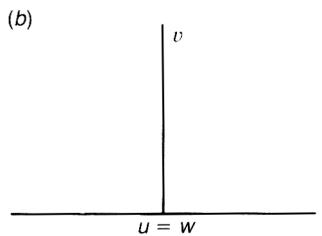
(2) As a special case, if in (1), the edge path corresponds to traversing along first then reversing backwards from to . This edge path may be replaced by a 0-simplex and vice versa, see figure 4.10(b).
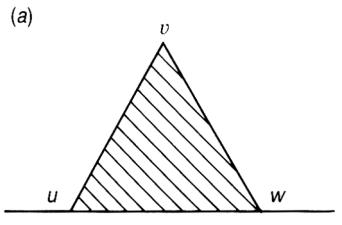
Figure 4.10. Possible deformations of the edge loops. In (a), is replaced by . In (b), is replaced by .
Let us denote the equivalence class of edge loops at , to which belongs, by . The set of equivalence classes forms a group under the product operation defined by
The unit element is an equivalence class while the inverse of is . This group is called the edge group of at and denoted by .
is isomorphic to .
The proof is found in Armstrong (1983), for example. This isomorphism is given by identifying an edge loop in with a loop in . To find , we need to read off the generators and relations. Let be a simplicial subcomplex of , such that
(a) contains all the vertices (0-simplexes) of ;
(b) the polyhedron is arcwise connected and simply connected.
Given an arcwise-connected simplicial complex , there always exists a subcomplex that satisfies these conditions. A one-dimensional simplicial complex that is arcwise connected and simply connected is called a tree. A tree is called the maximal tree of if it is not a proper subset of other trees.
A maximal tree contains all the vertices of and hence satisfies conditions (a) and (b) above.
Proof
Suppose does not contain some vertex . Since is arcwise connected, there is a 1-simplex in such that and . is a one-dimensional subcomplex of which is arcwise connected, simply connected and contains , which contradicts the assumption.
Suppose we have somehow obtained the subcomplex . Since is simply connected, the edge loops in do not contribute to . Thus, we can effectively ignore the simplexes in in our calculations. Let be the vertices of . Assign an ‘object’ for each ordered pair of vertices if is a 1-simplex of . Let be a group that is generated by all . What about the relations? We have the following.
(1) Since we ignore those simplexes in , we assign if .
(2) If is a 2-simplex of , there are no non-trivial loops around and we have the relation .
The generators and the set of relations completely determine the group .
is isomorphic to
In fact, we can be more efficient than is apparent. For example, should be set equal to 1 since corresponds to the vertex which is an element of . Moreover, from , we have . Therefore, we only need to introduce those generators for each pair of vertices such that and . Since there are no generators such that , we can ignore the first type of relation. If is a 2-simplex of such that , the corresponding relation is uniquely given by since we are only concerned with simplexes such that .
To summarize, the rules of the game are as follows.
(1) First, find a triangulation .
(2) Find the subcomplex that is arcwise connected, simply connected and contains all the vertices of .
(3) Assign a generator to each 1-simplex of , for which .
(4) Impose a relation if there is a 2-simplex such that . If two of the vertices and form a 1-simplex of , the corresponding generator should be set equal to 1.
(5) Now is isomorphic to which is a group generated by with the relations obtained in (4).Let us work out several examples.
From our construction, it should be clear that and involve only the 0-, 1- and 2-simplexes of . Accordingly, if denotes a 2-skeleton of , which is defined to be the set of all 0-, 1- and 2-simplexes in , we should have
This is quite useful in actual computations. For example, a 3-simplex and its boundary have the same 2-skeleton. A 3-simplex is a polyhedron of the solid ball , while its boundary is a polyhedron of the sphere . Since is contractible, . From (4.21) we find . In general, for , the -simplex and the boundary of have the same 2-skeleton. If we note that is contractible and the boundary of is a polyhedron of , we find the formula
Let be a simplicial complex of a circle . We take as the base point. A maximal tree may be . There is only one generator . Since there are no 2-simplexes in , the relation is empty. Hence,
in agreement with theorem 4.5.
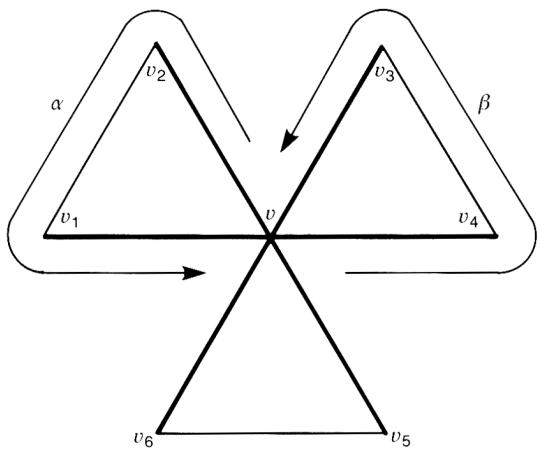
An -bouquet is defined by the one-point union of circles. For example, figure 4.11 is a triangulation of a 3-bouquet. Take the common point as the base point. The bold lines in figure 4.11 form a maximal tree . The generators of are , and . There are no relations and we find
Figure 4.11. A triangulation of a 3-bouquet. The bold lines denote the maximal tree .
Note that this is a free group but not free Abelian. The non-commutativity can be shown as follows. Consider loops and at encircling different holes. Obviously the product cannot be continuously deformed into , hence , or
In general, an -bouquet has generators and the fundamental group is isomorphic to the free group with generators with no relations.
Let be a two-dimensional disc. A triangulation of is given by a triangle with its interior included. Clearly itself may be and is empty. Thus, we find .
Figure 4.12 is a triangulation of the torus . The shaded area is chosen to be the subcomplex . [Verify that it contains all the vertices and is both arcwise and simply connected.] There are 11 generators with ten relations. Let us take and and write down the relations
Figure 4.12. A triangulation of the torus.
(a)
(b)
(c)
(d)
(e)
(f)(g)
(h) 1
(i)
(j) 1It follows from (e) and (f) that . We finally have
with a relation or
This shows that is generated by two commutative generators (note ), hence (cf example 4.4)
in agreement with (4.11).
We have the following intuitive picture. Consider loops and . The loop is identified with since and with . They generate since and are independent non-trivial loops. In terms of these, the relation is written as
where is a constant loop at , see figure 4.13.
Figure 4.13. The loops and satisfy the relation .
More generally, let be the torus with genus . As we have shown in problem 2.1, is expressed as a subset of with proper identifications at the boundary. The fundamental group of is generated by loops ( ). Similarly, to (4.28), we verify that
If we denote the generators corresponding to by and by , there is only one relation among them,
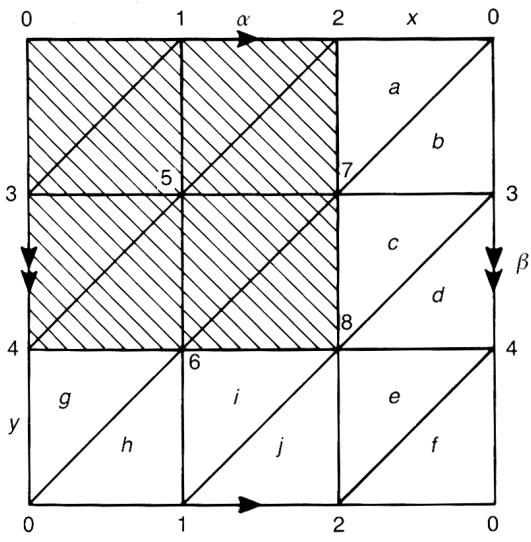
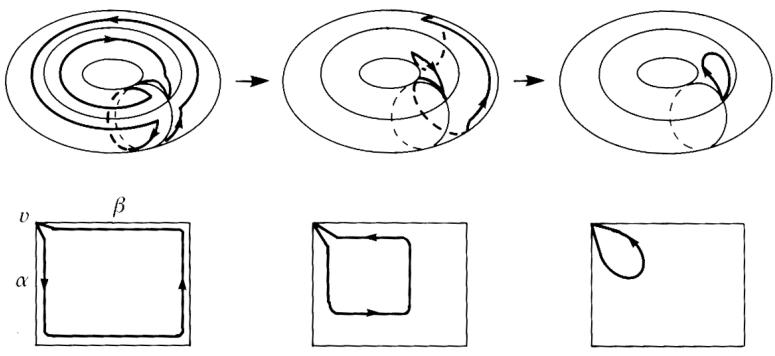
Figure 4.14 is a triangulation of the Klein bottle. The shaded area is the subcomplex . There are 11 generators and ten relations. Take and and write down the relations for 2-simplexes to show that
Figure 4.14. A triangulation of the Klein bottle.
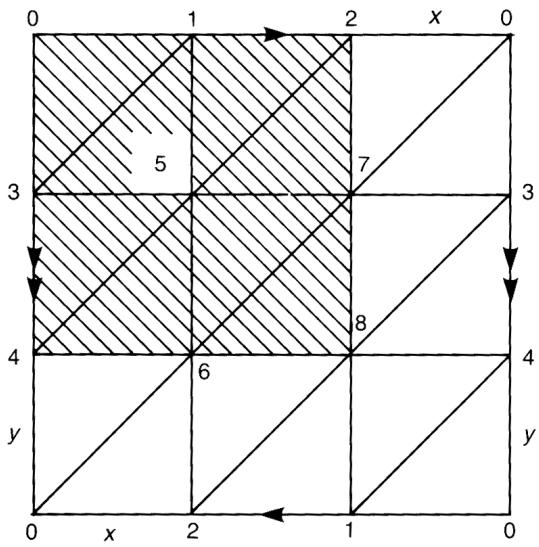
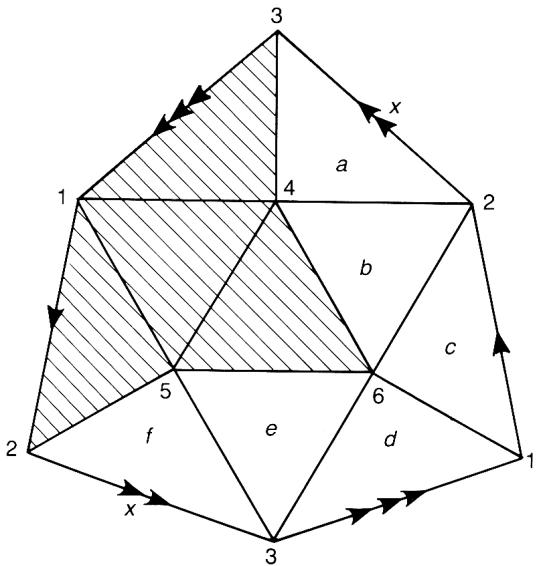
Figure 4.15 is a triangulation of the projective plane . The shaded area is the subcomplex . There are seven generators and six relations.
Figure 4.15. A triangulation of the projective plane.
Let us take and write down the relations
(a)
(b)
(c)
(d)
(e) 1
(f)Hence, we find that
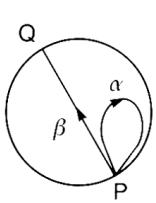
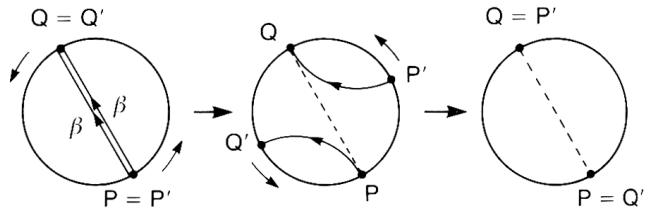
Intuitively, the appearance of a cyclic group is understood as follows. Figure 4.16(a) is a schematic picture of . Take loops and . It is easy to see that is continuously deformed to a point, and hence is a trivial element of . Since diametrically opposite points are identified in , is actually
(a)
(b)
Figure 4.16. (a) is a trivial loop while the loop cannot be shrunk to a point. (b) is continuously shrunk to a point.
a closed loop. Since it cannot be shrunk to a point, it is a non-trivial element of . What about the product? is a loop which traverses from to twice. It can be read off from figure 4.16(b) that is continuously shrunk to a point, and thus belongs to the trivial class. This shows that the generator , corresponding to the homotopy class of the loop , satisfies the relation , which verifies our result.
The same pictures can be used to show that
where is identified as with diametrically opposite points identified, . If we take the hemisphere of as the representative, can be expressed as a solid ball with diametrically opposite points on the surface identified. If the discs in figure 4.16 are interpreted as solid balls , the same pictures verify (4.33).
A triangulation of the Möbius strip is given by figure 3.8. Find the maximal tree and show that
[Note: Of course the Möbius strip is of the same homotopy type as , hence (4.34) is trivial. The reader is asked to obtain this result through routine procedures.]
4.4.3 Relations between and
The reader might have noticed that there is a certain similarity between the first homology group and the fundamental group . For example, the fundamental groups of many spaces (circle, disc, -spheres, torus and many more) are identical to the corresponding first homology group. In some cases, however, they are different: -bouquet) and -bouquet) , for
example. Note that -bouquet) is a free Abelian group while -bouquet) is a free group. The following theorem relates to .
Let be a connected simplicial complex. Then is isomorphic to , where is the commutator subgroup (see later) of .
Let be a group whose presentation is . The commutator subgroup of is a group generated by the elements of the form . Thus, is a group generated by with the set of relations and . The theorem states that if , then . For example, from -bouquet) , we find
which is isomorphic to -bouquet).
The proof of theorem 4.9 is found in Greenberg and Harper (1981) and also outlined in Croom (1978).
From , we have
Two relations are replaced by and to yield
where the factor is generated by and by .
Let be a connected topological space. Then is isomorphic to if and only if is commutative. In particular, if is generated by one generator, is always isomorphic to . [Use theorem 4.9.]
If and are of the same homotopy type, their first homology groups are identical: . [Use theorems 4.9 and 4.3.]
来源与版本
正文:英文 · OCR 机器稿 · 待校对
核对状态:OCR 机器稿 · 待校对
来源版本:second-edition-local
来源 PDF SHA-256:fcd24c3371d092a8c699ccf5cf0765462924b6c48412804231076e8084b1940d
OCR 来源 SHA-256:0b6324f01172a3548cd34382e82fd8bfae574602b6b2cfaa357ba96bc2c35478
OCR 产物 SHA-256:490166620107e20fc4836ecc0145c01a8f4c879c0aedb275b393f7ee3e50c31a