In general, there are no algorithms to compute higher homotopy groups . An ad hoc method is required for each topological space for . Here, we study several examples in which higher homotopy groups may be obtained by intuitive arguments. We also collect useful results in table 4.1.
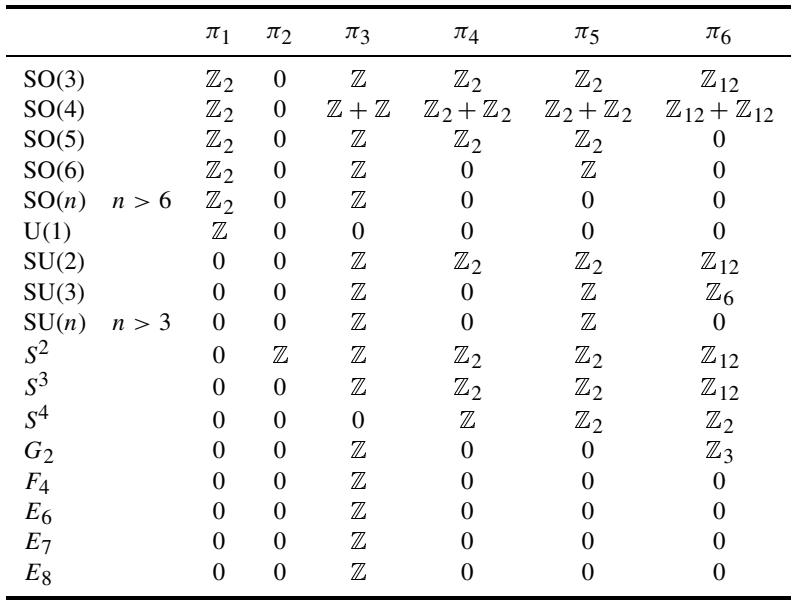
Table 4.1. Useful homotopy groups.
If we note that is the set of the homotopy classes of -loops in , we immediately find that
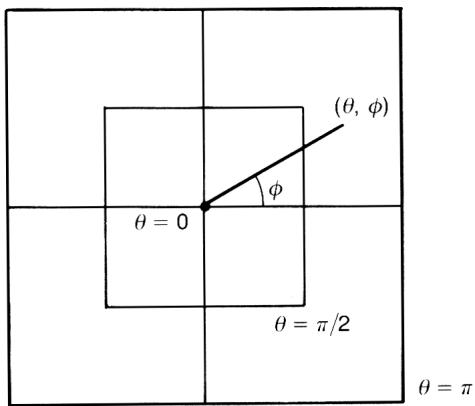
If maps onto a point , is the unit element . Since both and are orientable, we may assign orientations to them. If maps homeomorphically to in the same sense of orientation, then is assigned an element . If a homeomorphism maps onto in an orientation of opposite sense, corresponds to an element . For example, let . Since , the point in can be expressed by the polar coordinate , see figure 4.19. Similarly, can be expressed by the polar coordinate . Let be a 2-loop in . If and , the point sweeps once while the point scans once in the same orientation. This 2-loop belongs to the class . If is given by and , the point sweeps twice while scans once. This 2-loop belongs to the class . In general, the map , corresponds to the class of . A similar argument verifies (4.53) for general .
Figure 4.19. A point in may be expressed by polar coordinates .
Noting that is a universal covering space of for , we find
[Of course this happens to be true for , since .] For example, we have . Since is the universal covering group of , it follows from theorem 4.10 that (see also (4.48))
Shankar’s monopoles in superfluid correspond to non-trivial elements of these homotopy classes, see section 4.10. is also employed in the classification of instantons in example 9.8.
In summary, we have table 4.1. In this table, other useful homotopy groups are also listed. We comment on several interesting facts.
(a) Since is the universal covering group of SO(4), we have for
(b) There exists a map called the -homomorphism , see Whitehead (1978). In particular, if , the homomorphism is known to be an isomorphism and we have . For example, we find
(c) The Bott periodicity theorem states that
for . Similarly,
for . Similar periodicity holds for symplectic groups which we shall not give here.
Many more will be found in appendix A, table 6 of Ito (1987).
来源与版本
正文:英文 · OCR 机器稿 · 待校对
核对状态:OCR 机器稿 · 待校对
来源版本:second-edition-local
来源 PDF SHA-256:fcd24c3371d092a8c699ccf5cf0765462924b6c48412804231076e8084b1940d
OCR 来源 SHA-256:0b6324f01172a3548cd34382e82fd8bfae574602b6b2cfaa357ba96bc2c35478
OCR 产物 SHA-256:8a1134c9f2c9eaa024885ad6563d43abc4e62a156b5a7ec1b3ff016dde59b26d