There are several equivalent definitions of a connection on a principal bundle. Our approach is based on the separation of tangent space into ‘vertical’ and ‘horizontal’ subspaces. Although this approach seems to be abstract, it is advantageous compared with other approaches in that it clarifies the geometrical pictures involved and is defined independently of special local trivializations. Connections are also defined as -valued one-forms which satisfy certain axioms. These definitions are shown to be equivalent.
We briefly summarize the basic facts on Lie groups and Lie algebras, since we shall make extensive use of these (see section 5.6 for details). Let be a Lie group. The left action and the right action are defined by and for . induces a map . A left-invariant vector field satisfies . Left-invariant vector fields form a Lie algebra of , denoted by . Since is specified by its value at the unit element , and vice versa, there exists a vector space isomorphism . The Lie algebra is closed under the Lie bracket, where is the set of generators of . are called the structure constants. The adjoint action is defined by . The tangent map of is
called the adjoint map and is denoted by . If restricted to , maps onto itself; as , .
10.1.1 Definitions
Let be an element of a principal bundle and let be the fibre at . The vertical subspace is a subspace of which is tangent to at . [Warning: is the tangent space of and should not be confused with the tangent space of .] Let us see how is constructed. Take an element of . By the right action
a curve through is defined in . Since , this curve lies within . Define a vector by
where is an arbitrary smooth function. The vector is tangent to at , hence . In this way we define a vector at each point of and construct a vector field , called the fundamental vector field generated by . There is a vector space isomorphism given by . The horizontal subspace is a complement of in and is uniquely specified if a connection is defined in .
(a) Show that for
(b) Show that preserves the Lie algebra structure:
Let be a principal bundle. A connection on is a unique separation of the tangent space into the vertical subspace and the horizontal subspace such that
(i)
(ii) A smooth vector field on is separated into smooth vector fields and as .
(iii) for arbitrary and ; see figure 10.1.
Figure 10.1. The horizontal subspace is obtained from by the right action.
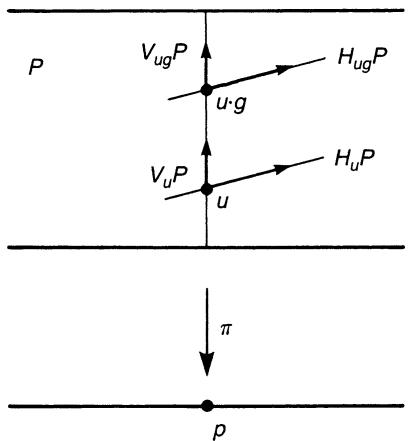
The condition (iii) states that horizontal subspaces and on the same fibre are related by a linear map induced by the right action. Accordingly, a subspace at generates all the horizontal subspaces on the same fibre. This condition ensures that if a point is parallel transported, so is its constant multiple , ; see later. At this point, the reader might feel rather
uneasy about our definition of a connection. At first sight, this definition seems to have nothing to do with the gauge potential or the field strength. We clarify these points after we introduce the connection one-form on . We again stress that our definition, which is based on the separation , is purely geometrical and is defined independently of any extra information. Although the connection becomes more tractable in the following, the geometrical picture and its intrinsic nature are generally obscured.
10.1.2 The connection one-form
In practical computations, we need to separate into and in a systematic way. This can be achieved by introducing a Lie-algebra-valued one-form called the connection one-form.
A connection one-form is a projection of onto the vertical component . The projection property is summarized by the following requirements,
(i) (10.3a)
(ii) (10.3b)that is, for
Define the horizontal subspace by the kernel of ,
To show that this definition is consistent with definition 10.1, we prove the following proposition.
Proof
Fix a point and define by (10.4). Take and construct . We find
since . Accordingly, . We note that is an invertible linear map. Hence, any vector is expressed as for some . This proves (10.5).
We have shown that the definition of the connection one-form is equivalent to that of the connection, since separates into in harmony with the axioms of definition 10.1. The connection one-form defined here is known as the Ehresmann connection in the literature.
10.1.3 The local connection form and gauge potential
Let be an open covering of and let be a local section defined on each . It is convenient to introduce a Lie-algebra-valued one-form on , by
Conversely, given a Lie-algebra-valued one-form , on , we can reconstruct a connection one-form whose pullback by is .
Given a -valued one-form on and a local section , there exists a connection one-form such that .
Proof
Let us define a -valued one-form on by
where is the exterior derivative on and is the canonical local trivialization defined by for . We first show that . For , we have
where we have noted that and at , see figure 10.2. We further note that and since along . Thus, we have obtained .
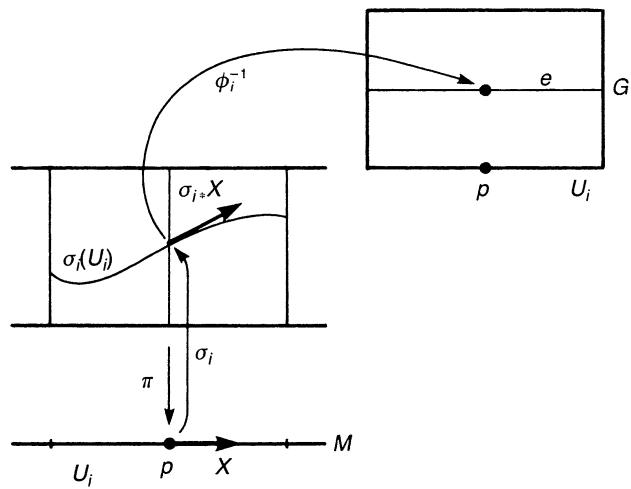
Figure 10.2. The canonical local trivialization defined by the local section over .
Next we show that satisfies the axioms of a connection one-form given in definition 10.2.
(i) Let . It follows from exercise 10.1(a) that . Now we have
(ii) Take and . We have
Since and (note that ), we have
where we have noted that
Here is a curve through , whose tangent vector at is .
Hence, the -valued one-form defined by (10.7) indeed satisfies and the axioms of a connection one-form.
For to be defined uniquely on , i.e. for the separation to be unique, we must have on . A unique one-form is then defined throughout by . To fulfil this condition, the local forms have to satisfy a peculiar transformation property similar to that of the Christoffel symbols. We first prove a technical lemma.
Let be a principal bundle and be a local section over such that . For ( ), and satisfy
where is the transition function.
Proof
Take a curve such that and . Since and are related by the transition function as (see (9.43)), we have
where stands for and we have assumed that is a matrix group for which . We note that
[Note that at .] This shows that the second term of represents the vector field at .
The compatibility condition is easily obtained by applying the connection one-form on (10.8). We find that
where the axioms of definition 10.2 have been used. Since this is true for any , this equation reduces to
This is the compatibility condition we have been seeking.
Conversely, given an open covering , the local sections and the local forms which satisfy (10.9), we may construct the -valued one-form over . Since a non-trivial principal bundle does not admit a global section, the pullback exists locally but not necessarily globally. In gauge theories, is identified with the gauge potential (Yang-Mills potential). As we have seen in the monopole case, the monopole field does not admit a single gauge potential and we require at least two to describe this U(1) bundle over .
Let be a principal bundle over and let be a chart of . Take local sections and over such that . Show that the corresponding local forms and are related as
In components, this becomes
which is simply the gauge transformation defined in section 1.8.
Let be a U(1) bundle over . Take overlapping charts and . Let be a local connection form on . The transition function is given by
and are related as
In components, we have the familiar expression
Our connection differs from the standard vector potential by the Lie algebra factor: .
Here we note again that is defined globally over the bundle . Although there are many connection one-forms on , they share the same global information about the bundle. In contrast, an individual local piece (gauge potential) is associated with the trivial bundle and cannot have any global information on . It is or, equivalently, the total of satisfying the compatibility condition (10.9), which carries the global information about the bundle.
10.1.4 Horizontal lift and parallel transport
Parallel transport of a vector has been defined in chapter 7 as transport without change. Parallel transport of an element of a principal bundle along a curve in is provided by the ‘horizontal lift’ of the curve.
Let be a bundle and let be a curve in . A curve is said to be a horizontal lift of if and the tangent vector to always belongs to .
Let be a tangent vector to . Then it satisfies by definition. This condition is an ordinary differential equation (ODE) and the fundamental theorem of ODEs guarantees the local existence and uniqueness of the horizontal lift.
Let be a curve in and let . Then there exists a unique horizontal lift in such that .
Let us construct such a curve . Let be a chart which contains and take a section over . If there exists a horizontal lift , it may be expressed as , where stands for . Without loss of generality, we may take a section such that , that is . Let be a tangent vector to at . Then is tangent to at . Since the tangent vector is horizontal, it satisfies . A slight modification of lemma 10.1 yields
By applying on this equation, we find
Multiplying on the left by , we have
The fundamental theorem of ODEs guarantees the existence and uniqueness of the solution of (10.13a).
Since , (10.13a) is expressed in a local form as
whose formal solution with is
where is a path-ordering operator along . The horizontal lift is expressed as .
Let be another horizontal lift of , such that . Then for all .
Proof
We first note that the horizontal subspace is right invariant, . Let be a horizontal lift of . Then is also a horizontal lift of since its tangent vector belongs to . From theorem 10.2 we find is the unique horizontal lift which starts at .
Let us consider the bundle where . Let be a local trivialization, where are the coordinates of while is that of the additive group . Let
be a connection one-form. It is easily verified that satisfies the axioms of the connection one-form. In fact, for , being an element of the Lie algebra of additive group, we have . Furthermore, , since is Abelian. Let be a curve . Let us work out a horizontal lift which starts at . Let
be tangent to . For to be horizontal, it must satisfy
The solution is easily found to be . We finally find the horizontal lift passing through ,
which is a helix over the unit circle.
Under the group action (right or left does not matter), translates to , . The shifted horizontal lift is
and do not commute in general and the exponential in (10.14) is not well defined as it is. Let and be -dependent matrices. Then the action of is
Generalization to products of more matrices should be obvious.
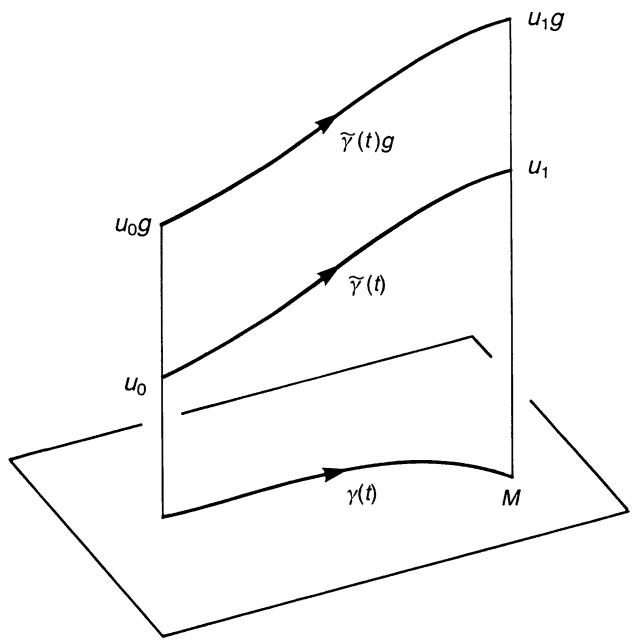
Let be a curve. Take a point . There is a unique horizontal lift of through , and hence a unique point , see figure 10.3. The point is called the parallel transport of along the curve . This defines a map such that . If the local form (10.14) is employed, we have
Figure 10.3. A curve in and its horizontal lifts and .
Corollary 10.1 ensures that commutes with the right action . First note that and . Observe that is a horizontal lift through and . From the uniqueness of the horizontal lift through , we have , that is . Since this is true for any , we have
Let be a horizontal lift of . Consider a map where . Show that
Consider two curves and such that . Define the product by
Let and Show that
Let us write , if are on the same horizontal lift. Show that is an equivalence relation.
来源与版本
正文:英文 · OCR 机器稿 · 待校对
核对状态:OCR 机器稿 · 待校对
来源版本:second-edition-local
来源 PDF SHA-256:fcd24c3371d092a8c699ccf5cf0765462924b6c48412804231076e8084b1940d
OCR 来源 SHA-256:0b6324f01172a3548cd34382e82fd8bfae574602b6b2cfaa357ba96bc2c35478
OCR 产物 SHA-256:e453db1e51f34092b1b64e4d6353e67bbf36091fea8b4a02407803bf7d05da77