9.4.1 Definitions
A principal bundle has a fibre which is identical to the structure group . A principal bundle is also denoted by and is often called a bundle over .
The transition function acts on the fibre on the left as before. In addition, we may also define the action of on on the right. Let be the local trivialization given by , where and . The right action of on is defined by , that is (figure 9.8),
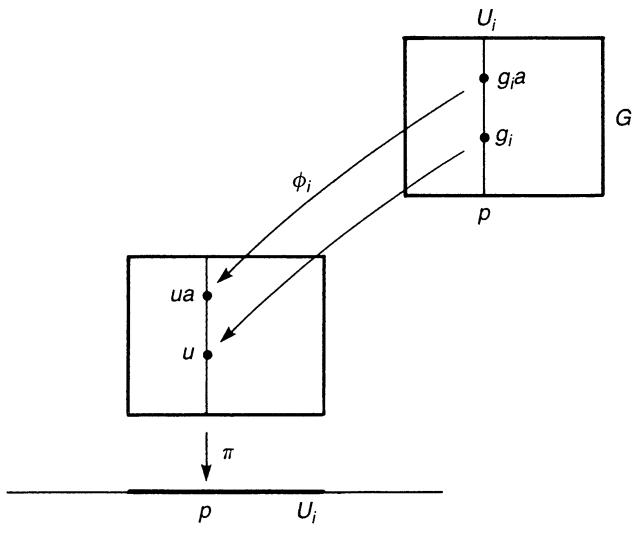
Figure 9.8. The right action of on .
for any and . Since the right action commutes with the left action, this definition is independent of the local trivializations. In fact, if ,
Thus, the right multiplication is defined without reference to the local trivializations. This is denoted by or . Note that . The right action of on is transitive since acts on transitively on the right and is diffeomorphic to . Thus, for any
there exists an element of such that . Then, if , we can construct the whole fibre as . The action is also free; if for some , must be the unit element of . In fact, if , we have . Since is bijective, we must have , that is, .
Given a section over , we define a preferred local trivialization as follows. For , , there is a unique element such that . Then we define by . In this local trivialization, the section is expressed as
This local trivialization is called the canonical local trivialization. By definition . If , two sections and are related by the transition function as follows
Let be a principal bundle with fibre and the base space . This principal bundle represents the topological setting of the magnetic monopole (section 1.9). Let be an open covering of , being the northern (southern) hemisphere. If we parametrize by the usual polar angles, we have
The intersection is a strip which is essentially the equator. Let and be the local trivializations such that
where . Take a transition function of the form where must be an integer so that may be uniquely defined on the equator. Since maps the equator to , this integer characterizes the homotopy group . The fibre coordinates and are related on the equator as
If , the transition function is the unit element of and we have a trivial bundle . If , the -bundle is twisted. It is remarkable that the topological structure of a fibre bundle is characterized by an integer. The integer characterizes how two local sections are pasted together at the equator. Accordingly, the integer corresponds to the element of the homotopy group .
Since is Abelian, the right action and the left action are equivalent. Under the right action , we have
The right action corresponds to the U(1)-gauge transformation.
If we identify all the infinite points of the Euclidean space , the one-point compactification is obtained. If a trivial bundle is defined over we shall have a new bundle over after compactification, which is not necessarily trivial. Let be an bundle over obtained from by one-point compactification. This principal bundle represents an instanton (section 1.10). Introduce an open covering of ,
where is a positive constant and is an infinitesimal positive number. The thin intersection is essentially . Let be the transition function defined at . Since maps to , it is classified by . The integer characterizing the bundle is called the instanton number. If is taken to be the unit element , we have a trivial bundle , which corresponds to the homotopy class 0. Non-trivial bundles are obtained as follows. We first note that (example 4.12). An element is written as
where . Separating and as and , we find . Thus SU(2) is regarded as the unit sphere and classifies maps from to SU(2) . The identity map is
where is the unit matrix and the are the Pauli matrices. Let us take a point . If denotes the radial distance of , the vector has unit length. We assign an element of to the point as
Let and be the local trivializations,
where and . On we have
While scans once, sweeps once, hence this bundle corresponds to the homotopy class 1 of . It is not difficult to see that the transition function corresponding to the homotopy class is given by
To continue our study of monopoles and instantons, we have to introduce connections (the gauge potentials) on the fibre bundle. We will come back to these topics in the next chapter.
Hopf has shown that is a U(1) bundle over . The unit three-sphere embedded in is expressed as
If we introduce and , this becomes
Let us parametrize as
The Hopf map is defined by
It is easily verified that maps to since
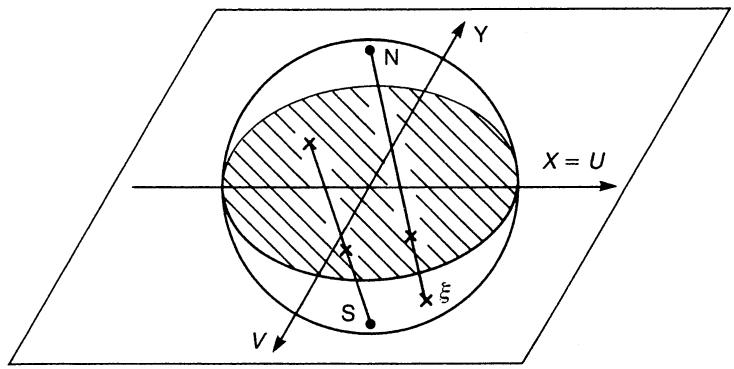
Let be the stereographic projection coordinates of a point in the southern hemisphere of from the North Pole. If we take a complex plane which contains the equator of , is within the circle of unit radius. We found in example 8.1 that (figure 9.9)
Figure 9.9. Stereographic coordinates of the sphere . is defined with respect to the projection from the North Pole while with respect to the projection from the South Pole.
Observe that is invariant under
where . Since , the point is also in . The stereographic coordinates of the northern hemisphere projected from the South Pole are given by
Note that on the equator .
The fibre bundle structure is given as follows. We first define the local trivializations, by
and by
Observe that these local trivializations are well defined on each chart. For example, on , hence both and are nonsingular. On the equator, , we have . Accordingly, the local trivializations on the equator are
and
The transition function on the equator is
If we circumnavigate the equator, traverses the unit circle in the complex plane once, hence the U(1) bundle is characterized by the homotopy class 1 of . Trautman (1977), Minami (1979) and Ryder (1980) have pointed out that a magnetic monopole of unit strength is described by the Hopf map .
The Hopf map can be understood from a slightly different point of view. We regard as a complex one-sphere
Define a map by
Under this map, points of of the form , are mapped to a single point of . This is the Hopf map obtained earlier. This is easily generalized to the case of the quaternion . The quaternion algebra is defined by the product table,
An arbitrary element of is written as
Clearly the unit quaternion represents . The quaternion one-sphere is given by
which represents . The Hopf map, in this case, takes the form
where is the quaternion projective space whose element is
Points of with are mapped under this map to a single point of and we have the Hopf map
The fibre is the unit quaternion . The transition function defined by the Hopf map belongs to the class 1 of . An instanton of unit strength is described in terms of this Hopf map.
Octonions define a Hopf map . This differs from other Hopf maps in that the fibre is not really a group. So far we have not found an application of this map in physics. 1
Let be a closed Lie subgroup of a Lie group . We show that is a principal bundle with fibre and base space . Define the right action of on by , , . The right action is differentiable since is a Lie group. Define the projection by the map . Clearly, are mapped to the same point hence . To define local trivializations, we need to define a map on each chart . Let be a local section over and . Define by . Since is a section at , it is expressed as for some and accordingly, . Then we define the local trivialization by
It is easy to see that ( ) hence is satisfied. Useful examples are (see example 5.18)
9.4.2 Associated bundles
Given a principal fibre bundle , we may construct an associated fibre bundle as follows. Let act on a manifold on the left. Define an action of on by
where and . Then the associated fibre bundle is an equivalence class in which two points and are identified.
Let us consider the case in which is a -dimensional vector space . Let be the -dimensional representation of . The associated vector bundle is defined by identifying the points and of , where and . For example, associated with is a vector bundle over with fibre . The fibre bundle structure of an associated vector bundle is given as follows. The projection is defined by . This projection is well defined since implies . The local trivialization is given by . The transition function of is given by where is that of .
Conversely a vector bundle naturally induces a principal bundle associated with it. Let be a vector bundle with (i.e. the fibre is or ). Then induces a principal bundle over by employing the same transition functions. The structure group is either or . Explicit construction of is carried out following the reconstruction process described in section 9.1.
Associated with a tangent bundle over an -dimensional manifold is a principal bundle called the frame bundle where is the set of frames at . We introduce coordinates on a chart . The bundle has a natural basis on . A frame at is expressed as
where is an element so that are linearly independent. We define the local trivialization by . The bundle structure of is defined as follows.
(i) If is a frame at , we define by .
(ii) The action of on the frame is given by , where is a new frame at , defined by
Conversely, given any frames and there exists an element of such that (9.68) is satisfied. Thus, acts on transitively.
(iii) Let and be overlapping charts with the coordinates and , respectively. For , we have
where . Since , we find the transition function to be
Accordingly, given , we have constructed a frame bundle with the same transition functions.
In general relativity, the right action corresponds to the local Lorentz transformation while the left action corresponds to the general coordinate transformation. It turns out that the frame bundle is the most natural framework in which to incorporate these transformations. If is normalized by introducing a metric, the matrix becomes the vierbein and the structure group reduces to ; see section 7.8.
A spinor field on is a section of a spin bundle which we now define. Since has no spinor representation, we need to introduce an orthonormal frame bundle whose structure group is . As we mentioned in example 4.12, is the universal covering group of . [To define a spin bundle, we have to check whether the bundle lifts to a bundle over . The obstruction to this lifting is discussed in section 11.6.]
To be specific, let us consider a spin bundle associated with the four-dimensional Lorentz frame bundle , where is a four-dimensional Lorentz manifold. We are interested in a frame with a definite spacetime orientation as well as a time orientation. The structure group is then reduced to
The universal covering group of is , see example . The homomorphism is a map with The Weyl spinor is a section of the fibre bundle . The Dirac spinor is a section of
A section of is a representation of and a section of is a representation, see Ramond (1989) for example. A Dirac spinor belongs to .
The general structure of the spin bundle will be worked out in section 11.6.
9.4.3 Triviality of bundles
A fibre bundle is trivial if it is expressed as a direct product of the base space and the fibre. The following theorem gives the condition under which a fibre bundle is trivial.
A principal bundle is trivial if and only if it admits a global section.
Proof
Let be a principal bundle over and let be a global section. This section may be used to show that there exists a homeomorphism between and . If is an element of , the product belongs to the fibre at . Since the right action is transitive and free, any element is uniquely written as for some and . Define a map by
It is easily verified that is indeed a homeomorphism and we have shown that is a trivial bundle .
Conversely, suppose . Let be a trivialization. Take a fixed element . Then defined by is a global section.
Is there a corresponding theorem for vector bundles? We know that any vector bundle admits a global null section. Thus, we cannot simply replace by in theorem 9.2. Let us consider the associated principal bundle of . By definition, and share the same set of transition functions. Since the twisting of a bundle is described purely by the transition functions, we obtain the following corollary.
A vector bundle is trivial if and only if its associated principal bundle admits a global section.
9.1 Let be the real line bundle over (i.e. is either the cylinder or the Möbius strip). Show that the Whitney sum is a trivial bundle. Sketch to confirm the result.
9.2 Let be the volume element of normalized as . Let be a smooth map and consider the pullback .
(a) Show that is closed and written as , where is an -form on .
(b) Show that the Hopf invariant
is independent of the choice of
(c) Show that if is homotopic to , then .
(d) Show that if is odd. [Hint: Use .]
(e) Compute the Hopf invariant of the map defined in example 9.9.
Endnotes
来源与版本
正文:英文 · OCR 机器稿 · 待校对
核对状态:OCR 机器稿 · 待校对
来源版本:second-edition-local
来源 PDF SHA-256:fcd24c3371d092a8c699ccf5cf0765462924b6c48412804231076e8084b1940d
OCR 来源 SHA-256:0b6324f01172a3548cd34382e82fd8bfae574602b6b2cfaa357ba96bc2c35478
OCR 产物 SHA-256:2674add18853aa5dad5747cf618769b3a479c92afaaeb33117fe74676a8206b1
Footnotes
-
Octonions are also known as Cayley numbers. The set of octonions is a vector space over but not a field. The product is neither commutative nor associative. See John C Baez, The Octonions math.RA/0105155 for a recent review. ↩