13.4.1 The Becchi-Rouet-Stora operator and the Faddeev-Popov ghost
Let be the effective action of the Weyl fermion in the complex representation of the gauge group . In the previous section, we observed that the change of under an infinitesimal gauge transformation is given by
Following Stora (1984) and Zumino (1985) we introduce the BRS operator and the Faddeev-Popov ghost . Let be the set of maps from to . In addition to the ordinary exterior derivative , we introduce another exterior derivative on which we call the Becchi-Rouet-Stora (BRS) operator. In general, is defined on an infinite-dimensional space but we may also consider the restriction of to a finite-dimensional compact subspace of , such as , parametrized by . Then may be written as . We require that and be anti-derivatives,
If we define , is clearly nilpotent,
Under the action of transforms as
Note that is independent of while depends on through . Define the Faddeev-Popov (FP) ghost by
The actions of on and are found to be
It is easy to verify that is nilpotent on and and, hence, on any polynomial of and as it should be; see exercise 13.1. Define the field strength of by
We also define
where (13.65b) follows since (note that ). It is found from theorem 10.1 that is an Ehresmann connection on the principal bundle and its associated curvature two-form.
The existence of a non-Abelian anomaly implies that does not vanish under the action of the BRS operator ( roughly corresponds to ; see (13.39) and (13.63a)),
Since is independent of , acts through only. Before we write down the Wess-Zumino consistency condition for the non-Abelian anomaly, we stop here and consider the physical meaning of the BRS operator and the FP ghost.
Verify from (13.63) that the actions of on and are nilpotent,
13.4.2 The BRS operator, FP ghost and moduli space
To find the physical meaning of and , we need to examine the topology of the gauge fields (Atiyah and Jones 1978, Singer 1985, Sumitani 1985). Let be the space of all gauge potential configurations on . For definiteness, we take but the generalization to arbitrary is obvious. The topology of is trivial since, for any gauge potential configurations and , the combination ( ) is again a gauge potential on . Note, however, that does not describe the physical configuration space of the gauge theory. We have to identify those field configurations which are connected by -gauge transformations. Let be the space of all gauge transformations on ( in our previous notation). Then the physical configuration space must be identified with , called the moduli space of the gauge theory. We have seen in section 10.5 that the gauge field configuration on is classified by the transition function , being the equator of . In the present case, is classified by the transition function on the equator and, hence,
Thus, each connected component of is labelled by the instanton number . This component is denoted by .
We note that the space has a natural projection and can be made into a fibre bundle whose fibre is , see figure 13.1. Let be a representative of the class and let
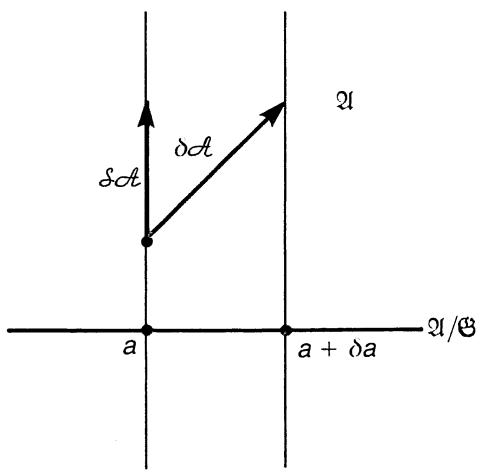
Figure 13.1. The BRS operator is the restriction of along the fibre.
be an element of in . We denote the exterior derivative operator in by , which is a functional variation and should not be confused with the usual derivative ; see Leinaas and Olaussen (1982). If is applied on (13.69), we find that
where . The first term of (13.70) represents the derivative of along while the second represents that along the fibre; see figure 13.1. The BRS transformation is obtained by restricting the variation along the fibre,
where the FP ghost is . We also find that
which reproduces (13.63a).
13.4.3 The Wess-Zumino conditions
Exercise 13.1 shows that is nilpotent on any polynomial of and ,
The nilpotency is required by the interpretation of as an exterior derivative operator. In particular, we should have
This condition is called the Wess-Zumino consistency condition (WZ condition) and can be used to determine the non-Abelian anomaly (Wess and Zumino 1971, Stora 1984, Zumino 1985, Zumino et al 1984). If the anomaly is mathematically well defined, should satisfy the WZ condition. This condition is so strong that once the first term of is given, the anomaly is completely pinned down.
13.4.4 Descent equations and solutions of WZ conditions
Stora (1984) and Zumino (1985) constructed the solution of WZ conditions as follows. The Abelian anomaly in -dimensional space is given by
where , as before. Let be the Chern-Simons form of ,
Since the algebraic structure of the triplet is exactly the same as that of , we also have
where we have noted that and . If we expand in powers of , we have
where is sth order in and .
We now note that since . In terms of the Chern-Simons forms, this can be expressed as
Substituting (13.77) into (13.78), we have
If we collect terms of the same order in , we have the ‘descent equations’

Note here that increases the degree of by one, see (13.63). Let us look at the -form . If we put
satisfies the WZ condition,
where we have assumed that has no boundary and use has been made of (13.80b). This shows that once is obtained, the anomaly is easily found.
defined here is given by
[Note: In the proof, we tentatively drop the normalization factor to simplify the expressions. This factor will be recovered at the very end.]
Proof
We start with (11.105),
where
If we substitute into and collect terms of first order in , we have:
where str is the symmetrized trace defined by (11.8). Now we use
to change the final line of the previous equation to
Integrating by parts, we find that
If we recover the normalization, we finally have
For and , we have
These results are also verified by direct computations. Up to the normalization factor, (13.83b) yields the non-Abelian anomaly in four-dimensional space; see (13.56).
Sumitani (1984) pointed out that the approach to the non-Abelian anomalies here is ad hoc and does not clarify the following points:
(1) The WZ condition (13.73) does not fix the normalization of the anomaly and, moreover, the uniqueness of the solution is far from trivial.
(2) It is not clear why we should start from the Abelian anomaly in -dimensional space.
To answer these questions we need to develop a more elaborate index theorem called the family index theorem; see Atiyah and Singer (1984), Singer (1985) and Sumitani (1984, 1985). In the next section, we outline the physicists’ approach to this problem, closely following the work of Alvarez-Gaume and Ginsparg (1984).
Endnotes
Unplaced source note
We drop the representation index to simplify the expression.
Unplaced source note
The set should not be confused with , the set of -forms on . The distinction should be clear from the context.
来源与版本
正文:英文 · OCR 机器稿 · 待校对
核对状态:OCR 机器稿 · 待校对
来源版本:second-edition-local
来源 PDF SHA-256:fcd24c3371d092a8c699ccf5cf0765462924b6c48412804231076e8084b1940d
OCR 来源 SHA-256:0b6324f01172a3548cd34382e82fd8bfae574602b6b2cfaa357ba96bc2c35478
OCR 产物 SHA-256:6ca255111c6a389e46c2ee7b954c6d580d621b83a84ec8a08085039d838ac853