As an illustration of the formalism developed in the previous section, we compute the one-loop vacuum-to-vacuum amplitude of the closed orientable bosonic string theory. Since and , we have
To evaluate (14.121) we need to take several steps.
14.3.1 Moduli spaces, CKV, Beltrami and quadratic differentials
In example 8.2, we have shown that the complex structure, namely the conformal structure, of the torus is specified by a complex parameter ( ). Figure 8.3 shows the moduli space
where is the upper half-plane.
Take the torus specified by the Teichmüller parameter ( ). As a representative, we take a torus in figure 14.8. The metric in naturally induces a flat metric (as guaranteed by the uniformization theorem)
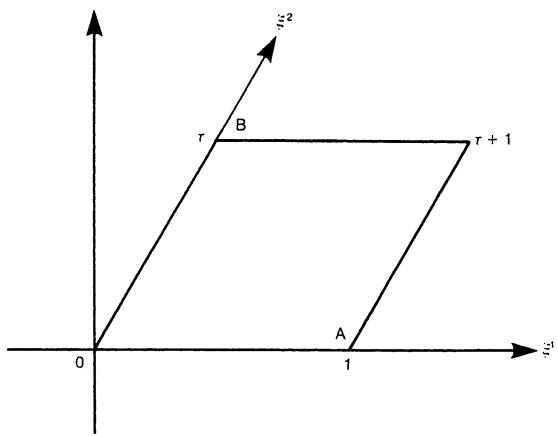
Figure 14.8. The parallelogram whose complex structure is parametrized by .
The CKV are globally defined holomorphic vectors. We take as the normalized basis of the CKV. The condition yields , that is (we have dropped the phase). The vector generates translations in the complex plane,
We must note, however, that the translation is defined modulo the lattice; and yield the identical translation. This forces to lie within the parallelogram of figure 14.8. Since
is found to be
Our next task is to evaluate the Weil-Petersson measure. On the torus there is one quadratic differential . Since is a globally defined holomorphic differential, it must be of the form,
To find the Beltrami differential, we evaluate the change of the metric under a small variation of . For this purpose, it is convenient to introduce the -coordinate system in figure 14.8. The point A corresponds to and B to . Accordingly, we have . Under a small change of the Teichmüller parameter, we have, up to a conformal factor,
Comparing this with (14.110), we find that
Here is the complex conjugate of in (14.110). Of course, this is a reparametrization of the Teichmüller space and does not affect the results. If the reader feels awkward with this, s/he may choose as the Teichmüller parameter. From (14.125) and (14.126), we have, up to irrelevant constants,
Finally, we have obtained
14.3.2 The evaluation of determinants
We first consider . Since we take a flat metric, the Laplacian takes quite a simple form,
where is the Laplacian defined by (14.87b). Since
the amplitude (14.121) reduces to
where we have used (14.124) and (14.127). We have factorized the integrand so that the modular invariance is manifest, see exercise 14.7.
Let us compute the spectrum of . It is convenient to express the Laplacian in -coordinates. From
we readily find that
where etc. The eigenfunction satisfying the periodic boundary condition on the torus is
Substituting this into (14.131), we find the eigenvalue
The determinant is expressed as an infinite product:
the product being taken for all integers
Clearly is ill defined and needs to be regularized. Let us introduce the Eisenstein series (Siegel 1980, Lang 1987) defined by
the summation being taken for all integers . This series converges for and can be analytically continued to the complex -plane. The series has a simple pole at where we have a Laurent expansion,
This expression is known as the Kronecker first limit formula and is essential for our purposes. In (14.136), is Euler’s constant and is the Dedekind -function
Neglecting constant factors, we have
To evaluate the exponent, we note the functional equation,
Taking the limit in (14.139), we have
From (14.136), we also have
Equating the coefficients of and , we find that
Substituting (14.140) into (14.138), we obtain
Finally, it follows from (14.129) and (14.141) that
A neat form of is obtained if we define the discriminant
Up to an irrelevant constant, the one-loop amplitude is
is known as the cusp form of weight 12, implying
and , where the are the Fourier coefficients,
Higher genus amplitudes are given by the cusp forms of other weights, see Belavin and Knizhnik (1986), Moore (1986), Gilbert (1986) and Morozov (1987).
Show that
where the branch is chosen so that if . Use this result to show that and are independently invariant under and .
来源与版本
正文:英文 · OCR 机器稿 · 待校对
核对状态:OCR 机器稿 · 待校对
来源版本:second-edition-local
来源 PDF SHA-256:fcd24c3371d092a8c699ccf5cf0765462924b6c48412804231076e8084b1940d
OCR 来源 SHA-256:0b6324f01172a3548cd34382e82fd8bfae574602b6b2cfaa357ba96bc2c35478
OCR 产物 SHA-256:80c8307dd3a239c34e4c82520360bf22f1f516619afc529f3125fba9a1b299a5