12.6 Propagators in frequency-momentum space
The propagator defined by equation 12.4 will take a wavefunction at time 0 and give the wavefunction at any other time t, positive or negative. We will find it useful to define a version of the propagator that takes into account causality, only giving a non-zero result for
Definition (Retarded propagator)
The retarded propagator is given by
This can also be written
where is the step-function
We will use an integral representation of given by
To derive this, note that as a distribution, has a Fourier transform given by
since the calculation
makes sense for replaced by lim (or, for real boundary values of complex, taking values in the upper half-plane). Fourier inversion then gives equation 12.10.
Digression. The integral 12.10 can also be computed using methods of complex analysis in the variable . Cauchy’s integral formula says that the integral about a closed curve of a meromorphic function with simple poles is given 2i times the sum of the residues at the poles. For , since falls of exponentially if has a non-zero positive imaginary part, the integral along the real axis will be the same as for the semi-circle closed in the upper half-plane (with the radius of the semi-circle taken to infinity). encloses no poles so the integral is 0.
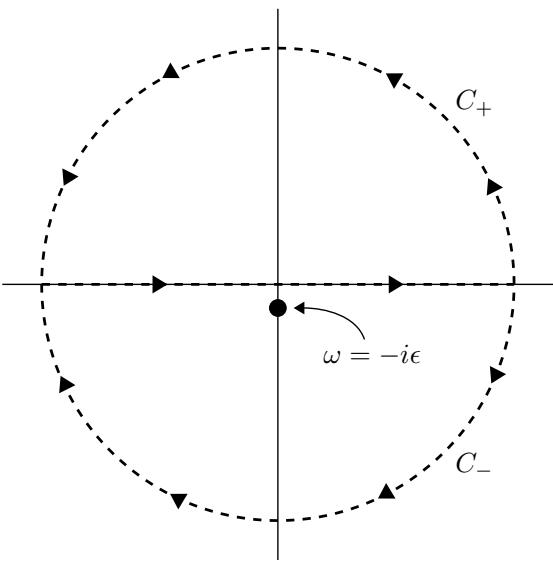
Figure 12.2: Evaluating via contour integration.
For , one instead closes the path using in the lower half-plane, and finds that the integral can be evaluated in terms of the residue the pole at (with the minus sign coming from orientation of the curve), giving
By similar arguments one can show that has (as a distribution) Fourier transform
and the integral representation
Taking times the sum of the Fourier transforms for and gives the distribution
as one expects since the delta-function is the Fourier transform of
Returning to the propagator, as in section 11.5 one can Fourier transform with respect to time, and thus get a propagator that depends on the frequency . The Fourier transform of equation 12.6 with respect to time is
Using equations 12.5 and 12.10 the retarded progagator in position space is given by
Shifting the integration variable by
one finds
but this is the Fourier transform
where
Digression. By the same argument as the one above for the integral representation of , but with pole now at
the integral in equation 12.12 can be evaluated by the Cauchy integral formula, recovering formula 12.9 for
来源与版本
正文:英文 · OCR 机器稿 · 待校对
核对状态:OCR 机器稿 · 待校对
原书 PDF · 印刷页 143、144、145、146、147、148、149、150、151、152、153、154、155
来源版本:2025-10-20
来源 PDF SHA-256:5a1941b2443b54d5db3d055f1e5ba390429b7a728475258017aaac87ee85a837
OCR 来源 SHA-256:55676446aee34cc17959b0de1d053a7951848ea85a0d86e471e07a39d2998f8c
OCR 产物 SHA-256:55676446aee34cc17959b0de1d053a7951848ea85a0d86e471e07a39d2998f8c