12.5 The propagator in position space
Concept links · terms present in this machine draft; source roles are unverified: eigenvalue
Free particle states with the simplest physical interpretation are momentum eigenstates. They describe a single quantum particle with a fixed momentum , and this momentum is a conserved quantity that will not change. In the momentum space representation (see section 11.5) such a time-dependent state will be given by
In the position space representation such a state will be given by
a wave with (restoring temporarily factors of ℏ and using wavelength and angular frequency
As for any quantum system, time evolution of a free particle from time 0 to time is given by a unitary operator . In the momentum space representation this is just the multiplication operator
In the position space representation it is given by an integral kernel called the “propagator”:
Definition (Position space propagator)
The position space propagator is the kernel of the time evolution operator acting on position space wavefunctions. It determines the time evolution of wavefunctions for all times t
where is the initial value of the wavefunction at time .
In the Dirac notation one has
and the propagator can be written as
can be computed for the free particle case by Fourier transform of the momentum space multiplication operator:
so
Note that (as expected due to translation invariance of the Hamiltonian operator) this only depends on the diference . Equation 12.5 can be rewritten as an inverse Fourier transform with respect to this diference
where
To make sense of the integral 12.5, the product it can be replaced by a complex variable . The integral becomes well-defined when (“imaginary time”) is positive, and then defines a holomorphic function in . Doing the integral by the same method as in equation 11.6, one finds
For real and positive, this is the kernel function for solutions to the partial diferential equation
known as the “heat equation”. This equation models the way temperature difuses in a medium, it also models the way probability of a given position difuses in a random walk. Note that here it is that gives the probability density, something quite diferent from the way probability occurs in measurement theory for the free particle quantum system. There it is that gives the probability density for the particle to have position observable eigenvalue q.
Taking as initial condition
the heat equation will have as solution at later times
This is physically reasonable: at times , an initial source of heat localized at a point difuses as a Gaussian about with increasing width. For one gets something that grows exponentially at ±∞, and so is not in or even .
In real time t as opposed to imaginary time , interpreted as the limit lim ), equation 12.7 becomes
Unlike the case of imaginary time, this expression needs to be interpreted as a distribution, and as such equation 12.4 makes sense for . One can show that, for with amplitude peaked around a position and with amplitude of its Fourier transform peaked around a momentum , at later times will become less localized, but with a maximum amplitude at
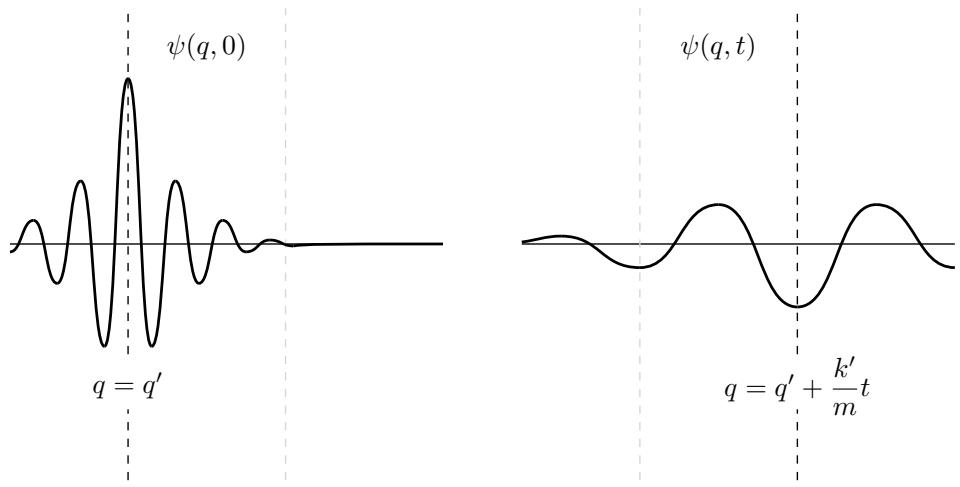
Figure 12.1: Time evolution of an initially localized wavefunction.
This is what one expects physically, since is the velocity corresponding to momentum for a classical particle.
Note that the choice of square root of in 12.9 is determined by the condition that one get an analytic continuation from the imaginary time version for so one should take in 12.9
We have seen that an initial momentum eigenstate
evolves in time by multiplication by a phase factor. An initial position eigenstate
evolves to
Near this function has a rather peculiar behavior. It starts out localized at at , but at any later time , no matter how small, the wavefunction will have constant amplitude extending out to infinity in position space. Here one sees clearly the necessity of interpreting such a wavefunction as a distribution.
For a physical interpretation of this calculation, note that while a momentum eigenstate is a good approximation to a stable state one can create and then study, an approximate position eigenstate is quite diferent. Its creation requires an interaction with an apparatus that exchanges a very large momentum (involving a very short wavelength to resolve the position). By the Heisenberg uncertainty principle, a precisely known position corresponds to a completely unknown momentum, which may be arbitrarily large. Such arbitrarily large momenta imply arbitrarily large velocities, reaching arbitrarily far away in arbitrarily short time periods. In later chapters we will see how relativistic quantum theories provide a more physically realistic description of what happens when one attempts to localize a quantum particle, with quite diferent phenomena (including possible particle production) coming into play.
来源与版本
正文:英文 · OCR 机器稿 · 待校对
核对状态:OCR 机器稿 · 待校对
原书 PDF · 印刷页 143、144、145、146、147、148、149、150、151、152、153、154、155
来源版本:2025-10-20
来源 PDF SHA-256:5a1941b2443b54d5db3d055f1e5ba390429b7a728475258017aaac87ee85a837
OCR 来源 SHA-256:55676446aee34cc17959b0de1d053a7951848ea85a0d86e471e07a39d2998f8c
OCR 产物 SHA-256:55676446aee34cc17959b0de1d053a7951848ea85a0d86e471e07a39d2998f8c