33.1 The supersymmetric oscillator
Concept links · terms present in this machine draft; source roles are unverified: adjoint operator · eigenvalue
In the previous chapters we discussed in detail
• The bosonic harmonic oscillator in degrees of freedom, with state space generated by applying d creation operators an arbitrary number of times to a lowest energy state . The Hamiltonian is
where is the number operator for the j’th degree of freedom, with eigenvalues
• The fermionic oscillator in degrees of freedom, with state space generated by applying d creation operators to a lowest energy state
|0 . The Hamiltonian is
where is the number operator for the th degree of freedom, with eigenvalues 1.
Putting these two systems together we get a new quantum system with state space
and Hamiltonian
Notice that the lowest energy state |0⟩ for the combined system has energy due to cancellation between the bosonic and fermionic degrees of freedom.
For now, taking for simplicity the case of one degree of freedom, the Hamiltonian is
with eigenvectors satisfying
While there is a unique lowest energy state of zero energy, all non-zero energy states come in pairs, with two states
both having energy nℏ.
This kind of degeneracy of energy eigenvalues usually indicates the existence of some new symmetry operators commuting with the Hamiltonian operator. We are looking for operators that will take to ⟩ and vice-versa, and the obvious choice is the two operators
which are not self adjoint, but are each other’s adjoints
The pattern of energy eigenstates looks like this
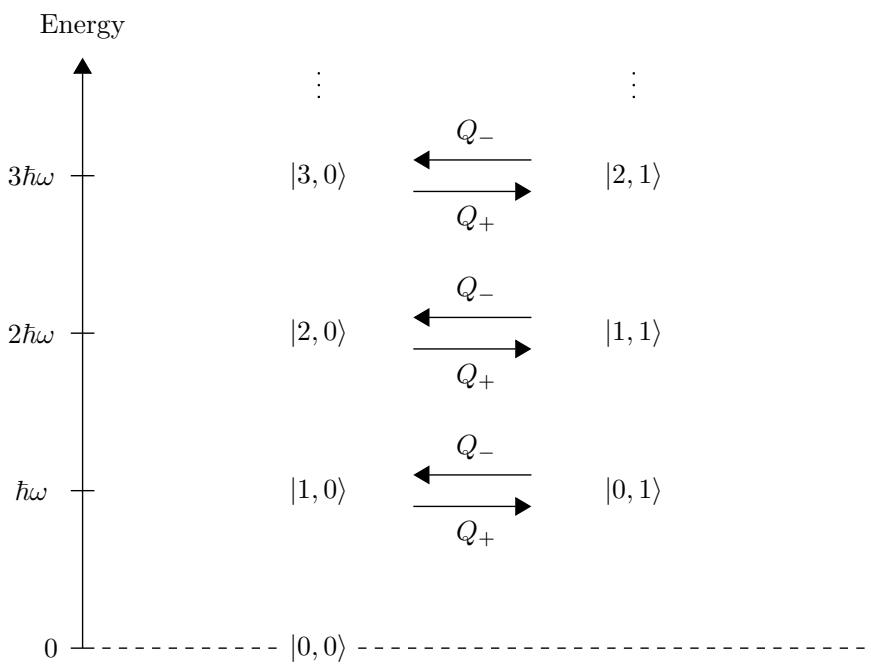
Figure 33.1: Energy eigenstates in the supersymmetric oscillator.
Computing anticommutators using the CCR and CAR for the bosonic and fermionic operators (and the fact that the bosonic operators commute with the fermionic ones since they act on diferent factors of the tensor product), one finds that
and
One could instead work with self-adjoint combinations
which satisfy
The Hamiltonian is a square of the self-adjoint operator , and this fact alone tells us that the energy eigenvalues will be non-negative. It also tells us that energy eigenstates of non-zero energy will come in pairs
with the same energy. To find states of zero energy (there will just be one, |0, 0⟩), instead of trying to solve the equation for |0⟩, one can look for
solutions to
The simplification here is much like what happens with the usual bosonic harmonic oscillator, where the lowest energy state in various representations can be found by looking for solutions to
There is an example of a physical quantum mechanical system that has exactly the behavior of this supersymmetric oscillator. A charged particle confined to a plane, coupled to a magnetic field perpendicular to the plane, can be described by a Hamiltonian that can be put in the bosonic oscillator form (to show this, we need to know how to couple quantum systems to electromagnetic fields, which we will come to in chapter 45). The equally spaced energy levels are known as “Landau levels”. If the particle has spin , there will be an additional term in the Hamiltonian coupling the spin and the magnetic field, exactly the one we have seen in our study of the two-state system. This additional term is precisely the Hamiltonian of a fermionic oscillator. For the case of gyromagnetic ratio , the coeficients match up so that we have exactly the supersymmetric oscillator described above, with exactly the pattern of energy levels seen there.
来源与版本
正文:英文 · OCR 机器稿 · 待校对
核对状态:OCR 机器稿 · 待校对
原书 PDF · 印刷页 351、352、353、354、355、356、357
来源版本:2025-10-20
来源 PDF SHA-256:5a1941b2443b54d5db3d055f1e5ba390429b7a728475258017aaac87ee85a837
OCR 来源 SHA-256:4bffdfd7f61d0f27874e4d55387956022c3478d2484e219ae76652492608b208
OCR 产物 SHA-256:4bffdfd7f61d0f27874e4d55387956022c3478d2484e219ae76652492608b208