In Newtonian mechanics an inertial frame is a one-to-one correspondence between physical events and points of , each event being assigned coordinates such that the motion of any free particle is represented by a rectilinear path . This is Newton’s first law of motion. Coordinate transformations
between inertial frames are called Galilean transformations, shown in Example 2.29 to have the form
where is a real constant, and are constant vectors, and is a orthogonal matrix,
If there is no rotation, in Eq. (9.1), then a rectilinear motion is transformed to
where and
This is known as the law of transformation of velocities and its inverse form,
is called the Newtonian law of addition of velocities.
In 1888 the famous Michelson–Morley experiment, using light beams oppositely directed at different points of the Earth’s orbit, failed to detect any motion of the Earth relative to an ‘aether’ postulated to be an absolute rest frame for the propagation of electromagnetic waves. The apparent interpretation that the speed of light be constant under transformations between inertial frames in relative motion is clearly at odds with Newton’s law of additior of velocities. Eventually the resolution of this problem came in the form of Einstein’s principle of relativity (1905). This is essentially an extension of Galileo’s and Newton’s ideas on invariance of mechanics, made to include electromagnetic fields (of which ligh is a particular manifestation). The geometrical interpretation due to Hermann Minkowski (1908) is the version we will discuss in this chapter.
Poincaré and Lorentz transformations
In classical mechanics we assume that events form a Galilean space-time, as described in Example 2.29. In relativity the structure is somewhat different. Instead of separate spatial and temporal intervals there is a single interval defined between pairs of events, written
where is the velocity of light . This singles out events connected by a light signal as satisfying . Setting , the interval reads
where
Throughout this chapter, Greek indices , , etc. will range from 1 to 4 while indices . range from 1 to 3. The set with this interval structure is called Minkowski space-time, or simply Minkowski space. The geometrical version of the principle of relativity says that the set of events forms a Minkowski space-time. The definition of Minkowski space as given here is not altogether satisfactory. We will give a more precise definition directly, in terms of an affine space.
The restricted class of coordinate systems for which the space-time interval has the form Eq. (9.2) will be called inertial frames. We will make the assumption, as in Newtonian mechanics, that free particles have rectilinear paths with respect to inertial frames in Minkowski space-time. As shown in Example 2.30, transformations preserving Eq. (9.2) are of the form
where the coefficients satisfy
Equation (9.3) is known as a Poincaré transformation, while the linear transformations that arise on setting are called Lorentz transformations.
We define the light cone at an event to be the set of points connected to by light signals,
where , etc. Events on can be thought of either as a receiver of light signals from or as a transmitter of signals that arrive at . Poincaré transformations clearly preserve the light cone at any event .
As for Eq. (5.9), the matrix version of Eq. (9.4) is (see also Example 2.30)
where and . Taking determinants, we have . It is further possible to subdivide Lorentz transformations into those having and those having (see Problem 9.2). Those Lorentz tansformations for which both and are called proper Lorentz transformations. They are analogous to rotations about the origin in Euclidean space. All other Lorentz transformations are called improper.
Affine geometry
There is an important distinction to be made between Minkowski space and a Minkowskian vector space as defined in Section 5.1. Most significantly, Minkowski space is not a vector space since events do not combine linearly in any natural sense. For example, consider two events and , having coordinates and with respect to some inertial frame. If the linear combination is defined in the obvious way as being the event having coordinates , then under a Poincaré transformation Eq. (9.3)
In particular, the origin of Minkowski space has no invariant meaning since it is transformed to a non-zero point under a general Poincaré transformation. The difference of any pair of points, , does however always undergo a linear transformation
and can be made to form a genuine vector space. Loosely speaking, a structure in which differences of points are defined and form a vector space is termed an affine space.
More precisely, we define an affine space to be a pair (, ) consisting of a set and a vector space , such that acts freely and transitively on as an abelian group of transformations. The operation of on is written , and is required to satisfy
for all . There is then no ambiguity in writing expressions such as . Recall from Section 2.6 that afree action means that if then , while the action is transitive if for any pair of points there exists a vector such that . The vector in this equation is necessarily unique, for if then , and since the action is free it follows tha
Let be a fixed point of . For any point be the unique vector such that . This establishes a one-to-one correspondence between the underlying set of an affine space and the vector space acting on it. If is any basis for then the real functions where are said to be coordinates on determined by the basis and the origin
As anticipated above, in an affine space it is always possible to define the difference of any pair of points . Given a fixed point let and be the unique vectors in such that and , and define the difference of two points of to be the vector . This definition is independent of the choice of fixed point , for if is a second fixed point such that then
and
Minkowski space and 4-tensors
Minkowski space can now be defined as an affine space where is a four dimensional Minkowskian vector space having metric tensor , acting freely and transitively on the set . is an orthonormal basis of such that
we say an inertial frame is a choice of fixed point , called the origin, together with the coordinates on defined by
The interval between any two events and in is defined by
This is independent of the choice offixed point or orthonormal frame , since it depends only on the vector difference between and and the metric tensor . In an inertial frame the interval may be expressed in terms of coordinates
Under a Lorentz transformation and a change of origin we have for an arbitrary point
where is given by the Poincaré transformation
It is a simple matter to verify that the coordinate expression Eq. (9.6) for is invariant with respect to Poincaré transformations Eq. (9.7).
Elements of will be termed 4-vectors. With respect to a Poincaré transformation Eq. (9.7) the components transform as
where satisfy Eq. (9.4). The inverse transformations are
Elements of , defined in Chapter 7, are termed 4-tensors of type . Since we restrict attention to orthonormal bases of , the components of a 4-tensor are only required to transform as a tensor with respect to the Lorentz transformations,
4-tensors of type (0, 1) are called 4-covectors, and 4-tensors of type (0, 0) will be termed 4-scalars or simply scalars. The important thing about 4-tensors, as for general tensors, is that if a 4-tensor equation can be shown to hold in one particular frame it holds in all frames. This is an immediate consequence of the homogeneous transformation law of components.
By Eq. (9.4) is a covariant 4-tensor of rank 2 since its components transform as
where . The inverse metric , defined by
has identical components to and is a contravariant tensor of rank 2,
We will use and to raise and lower indices of 4-tensors; for example,
Given two 4-vectors , define their inner product to be the scalar
We say the vectors are orthogonal if . The magnitude ofa 4-vector is defined to be . A non-zero 4-vector is called
spacelike if
timelike if
null if
The set of all null 4-vectors is called the null cone. This is a subset of the vector space of 4-vectors. The concept of a light cone at , defined in Section 2.30, is the set of points of that are connected to by a null vector, Figure 9.1 shows how the null cone separates 4-vectors into the various classes. Timelike or null vectors falling within or on the upper half of the null cone are called future-pointing, while those in the lower half are past-pointing.
Spacelike vectors, however, lie outside the null cone and form a continuously connected region of , making it impossible to define invariantly the concept of a future-pointing or past-pointing spacelike vector – see Problem 9.2.
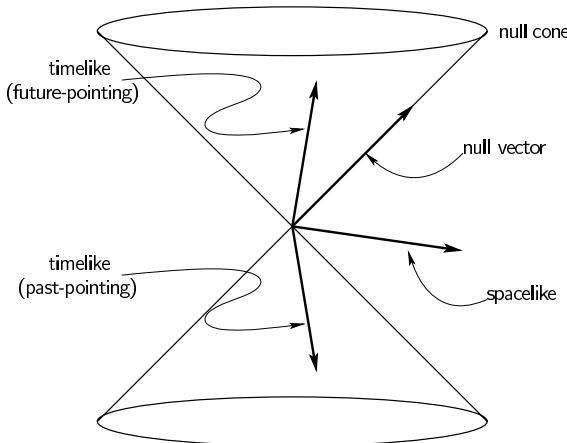
Figure 9.1 The null cone in Minkowski space
Problems
Show that
is a Lorentz transformation for all values of and . Find those 4-vectors whose components are unchanged by all Lorentz transformations of this form.
Show that for any Lorentz transformation one must have either
(a) Show that those transformations having have the property that they preserve the concept of ‘before’ and ‘after’ for timelike separated events by demonstrating that they preserve the sign of
(b) What is the effect of a Lorentz transformation having ?
(c) Is there any meaning, independent of the inertial frame, to the concepts of ‘before’ and ‘after for spacelike separated events?
Show that (i) if is a timelike 4-vector it is always possible to find a Lorentz transformation such that will have components and (ii) if is a null vector then it is always possible to find a Lorentz transformation such that has components .
Let and be 4-vectors. Show the following:
(a) If and is timelike, then is spacelike.
(b) If and and are both null vectors, then they are proportional to each other.
(c) and are both timelike future-pointing then and is timelike.
(d) Find other statements similar to the previous assertions when and are taken to be various combinations of null, future-pointing null, timelike future-pointing, spacelike, etc.
If the 4-component of a 4-vector equation is shown to hold in all inertia frames, show that all components are equal in all frames,