World-lines and proper time
Let be any closed interval of the real line . A continuous map is called a parametrized curve in Minkowski space . In an inertial frame generated by a basis of such a curve may be written as four real functions . We frequently write these functions as in place of ), and generally assume them to be differentiable.
If the parametrized curve passes through the event having coordinates , so that for some , define the tangent 4-vector to the curve at to be the 4-vector given by
This definition is independent of the choice of orthonormal basis on , for if is a second o.n. basis related by a Lorentz transformation , then
The parametrized curve is called timelike, spacelike or null at if its tangent 4- vector at is timelike, spacelike or null, respectively. The path of a material particle wil be assumed to be timelike at all events through which it passes, and is frequently referred to as the particle’s world-line (see Fig. 9.2). This assumption amounts to the requirement that the particle’s velocity is always less than , for
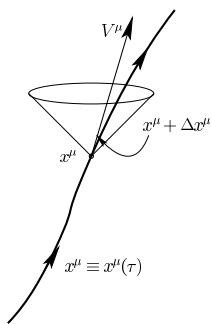
Figure 9.2 World-line of a material particle
on setting . Hence
For two neighbouring events on the world-line, and , set
where
In the limit
Hence
Since the velocity of the particle is everywhere less than the relativistic law of transformation of velocities Eq. (9.19) can be used to find a combination of rotation and boost, Eq. (9.8) and Eq. (9.14), which transforms the particle’s velocity to zero at any given point on the particle’s path. Any such inertial frame in which the particle is momentarily at res is known as an instantaneous rest frame or i.r.f. at . The i.r.f. will of course vary from point to point on a world-line, unless the velocity is constant along it. Since in an i.r.f. we have from Eq. (9.22) that . Thus measures the time interva registered on an inertial clock instantaneously comoving with the particle. It is generally interpreted as the time measured on a clock carried by the particle from to
The factor in Eq. (9.22) represents the time dilatation effect of Eq. (9.16) on such a clock due to its motion relative to the external inertial frame. The total time measured on a clock carried by the particle from event to event is given by
and is called the proper time from to . If we fix the event and let vary along the curve then proper time can be used as a parameter along the curve,
The tangent 4-vector calculated with respect to this special parameter is called the 4-velocity of the particle,
Unlike coordinate time , proper time is a true scalar parameter independent of inertial frame; hence the components of 4-velocity transform as a contravariant 4-vector
From Eq. (9.24) the magnitude of the 4-velocity always has constant magnitude
The 4-acceleration of a particle is defined to be the contravariant 4-vecto with components
Expressing these components in terms of the coordinate time parameter gives
The 4-vectors and are orthogonal to each other since
and expanding the left-hand side gives , so that
Show that in an i.r.f. the components of 4-velocity and 4-acceleration are given by
and verify that the 4-vectors and are orthogonal to each other.
Relativistic particle dynamics
We assume each particle has a constant scalar attached to it, called its rest mass. This may be thought ofas the Newtonian mass in an instantaneous rest frame of the particle, satisfying Newton’s second law for any imposed force in that frame. The 4-momentum of the particle is defined to be the 4-vector having components where is the 4-velocity of the particle,
where
For the momentum reduces to the Newtonian formula and the energy can be written as . The energy contribution , which arises even when the particle is at rest, is called the particle’s rest-energy.
Show the following identities:
The relations Eq. (9.32) make sense even in the limit provided the particle has zero rest mass, . Such particles will be termed photons, and satisfy the relations
Here is called the direction of propagation of the photon. The 4-momentum ofa photon has the form
and is clearly a null vector,
In analogy with Newton’s law , it is sometimes useful to define a 4-force having components
By Eq. (9.28) the 4-force is always orthogonal to the 4-velocity. Defining 3-force in the usual way by
and using we obtain
Problems
Using the fact that the 4-velocity transforms as a 4-vector, show from the transformation equation for that the transformation of under boosts is
From the remaining transformation equations for derive the law of transformation of velocities Eq. (9.19).
Let be a frame with velocity relative to in the -direction.
(a) Show that for a particle having velocity , acceleration in the -direction relative to , its acceleration in is
(b) A rocketeer leaves Earth at with constant acceleration at every moment relative to hi instantaneous rest frame. Show that his motion relative to the Earth is given by
(c) In terms of his own proper time show that
(d) If he proceeds for 10 years of his life, decelerates with for another 10 years to come to rest, and returns in the same way, taking 40 years in all, how much will people on Earth have aged on his return? How far, in light years, will he have gone from Earth?
A particle is in hyperbolic motion along a world-line whose equation is given by
Show that
and that the proper time starting from along the path is given by
Evaluate the particle’s 4-velocity and 4-acceleration . Show that has constant magnitude.
For a system of particles it is generally assumed that the conservation of total 4- momentum holds in any localized interaction,
Use Problem 9.4 to show that the law ofconservation of4-momentum holds for a given system provided the law of energy conservation holds in all inertial frames. Also show that the law of conservation of momentum in all frames is sufficient to guarantee conservation of 4-momentum.
A particle has momentum , energy in a frame .
(a) If is an inertial frame having velocity relative to , use the transformation law of the momentum 4-vecto to show that
where and are the components of respectively perpendicular and parallel to .
(b) If the particle is a photon, use these transformations to derive the aberration formula
where is the angle between and .