3.4.1 Connectedness and homology groups
Let and . From example 3.6 and exercise 3.1, we have and . More generally, we have the following theorem.
Let be a disjoint union of connected components, where . Then
Proof
We first note that an -chain group is consistently separated into a direct sum of -chain subgroups. Let
where is the number of linearly independent -simplexes in . It is always possible to rearrange so that those -simplexes in come first, those in next and so on. Then is separated into a direct sum of subgroups,
This separation is also carried out for and as
We now define the homology groups of each component by
This is well defined since . Finally, we have
(a) Let be a disjoint union of connected components, . Then it follows that
(b) If , is connected. [Together with theorem 3.5 we conclude that if and only if is connected.]
3.4.2 Structure of homology groups
and are free Abelian groups since they are subgroups of a free Abelian group . It does not mean that is also free Abelian. In fact, according to theorem 3.2, the most general form of is
It is clear from our experience that the number of generators of counts the number of -dimensional holes in . The first factors form a free Abelian group of rank and the next factors are called the torsion subgroup of . For example, the projective plane has and the Klein bottle has . In a sense, the torsion subgroup detects the ‘twisting’ in the polyhedron . We now clarify why the homology groups with -coefficients are preferable to those with - or -coefficients. Since has no non-trivial subgroups, the torsion subgroup can never be recognized. Similarly, if -coefficients are employed, we cannot see the torsion subgroup either, since for any . [For any , there exists a number such that .] If is given by (3.54), is
3.4.3 Betti numbers and the Euler-Poincaré theorem
Let be a simplicial complex. The th Betti number is defined by
In other words, is the rank of the free Abelian part of .
For example, the Betti numbers of the torus are (see example 3.12)
and those of the sphere are (exercise 3.3)
The following theorem relates the Euler characteristic to the Betti numbers.
Theorem 3.7 · The Euler-Poincaré theorem
Let be an -dimensional simplicial complex and let be the number of -simplexes in . Then
[Remark: The first equality defines the Euler characteristic of a general polyhedron . Note that this is the generalization of the Euler characteristic defined for surfaces in section 2.4.]
Proof
Consider the boundary homomorphism,
where is defined to be . Since both and are vector spaces, theorem 2.1 can be applied to yield
where is defined to be trivial. We also have
From these relations, we obtain
Since the Betti numbers are topological invariants, is also conserved under a homeomorphism. In particular, if and are two triangulations of , we have . Thus, it makes sense to define the Euler characteristic of by for any triangulation of .
3.1 The most general orientable two-dimensional surface is a 2-sphere with handles and holes. Compute the homology groups and the Euler characteristic of this surface. 3.2 Consider a sphere with a hole and identify the edges of the hole as shown in figure 3.13. The surface we obtained was simply the projective plane . More generally, consider a sphere with such ‘crosscaps’ and compute the homology groups and the Euler characteristic of this surface.
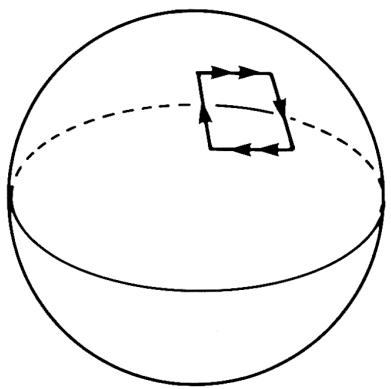
Figure 3.13. A hole in , whose edges are identified as shown. We may consider with such holes.
来源与版本
正文:英文 · OCR 机器稿 · 待校对
核对状态:OCR 机器稿 · 待校对
来源版本:second-edition-local
来源 PDF SHA-256:fcd24c3371d092a8c699ccf5cf0765462924b6c48412804231076e8084b1940d
OCR 来源 SHA-256:0b6324f01172a3548cd34382e82fd8bfae574602b6b2cfaa357ba96bc2c35478
OCR 产物 SHA-256:07a59e7ddaceb706bda6729f8d3e68a95579f5854256ec02daf93c0be81a12fa