4.10 Textures in superfluid
4.10.1 Superfluid
Here comes the last and most interesting example. Before 1972 the only example of the BCS superfluid was the conventional superconductor (apart from indirect observations of superfluid neutrons in neutron stars). Figure 4.29 is the phase diagram of superfluid without an external magnetic field. From NMR and other observations, it turns out that the superfluid is in the spin-triplet p-wave state. Instead of the field operators (see (4.65b)), we define the order parameter in terms of the creation and annihilation operators. The most general form of the triplet superfluid order parameter is
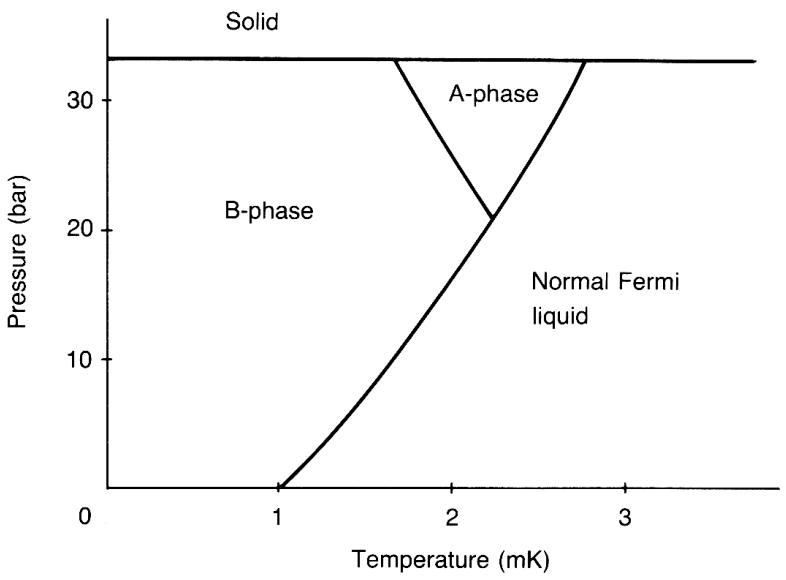
Figure 4.29. The phase diagram of superfluid .
where and are spin indices. The Cooper pair forms in the p-wave state hence is proportional to
The bulk energy has several minima. The absolute minimum depends on the pressure and the temperature. We are particularly interested in the A phase in figure 4.29.
The A-phase order parameter takes the form
where is a unit vector along which the spin projection of the Cooper pair vanishes and is a pair of orthonormal unit vectors. The vector takes its value in . If we define , the triad forms an orthonormal frame at each point of the medium. Since any orthonormal frame can be obtained from a standard orthonormal frame by an application of a three-dimensional rotation matrix, we conclude that the order parameter of is . The vector introduced here is the axis of the angular momentum of the Cooper pair.
For simplicity, we neglect the variation of the -vector. [In fact, is locked
along due to the dipole force.] The order parameter assumes the form
where and form an orthonormal frame at each point of the medium. Let us take a standard orthonormal frame . The frame is obtained by applying an element to the standard frame,
Since depends on the coordinate , the configuration defines a map as . The map is called the texture of a superfluid . The relevant homotopy groups for classifying defects in superfluid -A are .
If a container is filled with , the boundary poses certain conditions on the texture. The vector is understood as the direction of the angular momentum of the Cooper pair. The pair should rotate in the plane parallel to the boundary wall, thus should be perpendicular to the wall. [Remark: If the wall is diffuse, the orbital motion of Cooper pairs is disturbed and there is a depression in the amplitude of the order parameter in the vicinity of the wall. We assume, for simplicity, that the wall is specularly smooth so that Cooper pairs may execute orbital motion with no disturbance.] There are several kinds of free energy and the texture is determined by solving the Euler-Lagrange equation derived from the total free energy under given boundary conditions.
Reviews on superfluid are found in Anderson and Brinkman (1975), Leggett (1975) and Mermin (1978).
4.10.2 Line defects and non-singular vortices in
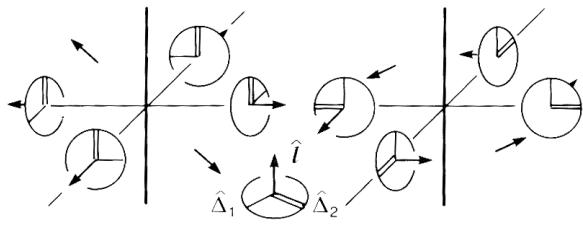
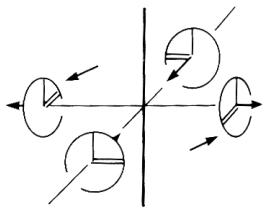
The fundamental group of is . Textures which belong to class 0 can be continuously deformed into the uniform configuration. Configurations in class 1 are called disgyrations and have been analysed by Maki and Tsuneto (1977) and Buchholtz and Fetter (1977). Figure 4.30 describes these disgyrations in their lowest free energy configurations.
(a)
(c)
Figure 4.30. Disgyrations in .
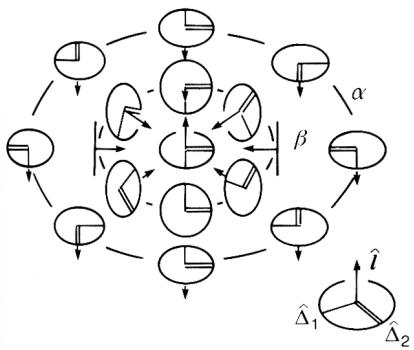
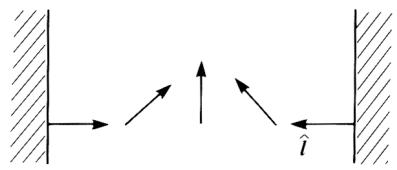
A remarkable property of is the addition ; the coalescence of two disgyrations produces a trivial texture. By merging two disgyrations, we may construct a texture that looks like a vortex of double vorticity (homotopy class ‘2’) without a singular core; see figure 4.31(a). It is easy to verify that the image of the loop traverses twice while that of the smaller loop may be shrunk to a point. This texture is called the Anderson-Toulouse vortex (Anderson and Toulouse 1977). Mermin and Ho (1976) pointed out that if the medium is in a cylinder, the boundary imposes the condition (boundary) and the vortex is cut at the surface, see figure 4.31(b) (the Mermin-Ho vortex).
(a)
Figure 4.31. The Anderson-Toulouse vortex and the Mermin-Ho vortex . In the boundary forces to be perpendicular to the wall.
(b)
Since , there are no point defects in He-A. However, introduces a new type of pointlike structure called the Shankar monopole, which we will study next.
4.10.3 Shankar monopole in
Shankar (1977) pointed out that there exists a pointlike singularity-free object in . Consider an infinite medium of . We assume the medium is asymptotically uniform, that is, approaches a standard orthonormal frame as . Since all the points far from the origin are mapped to a single point, we have compactified to . Then the texture is classified according to . Let us specify an element of SO(3) by a ‘vector’ in as before (example 4.12). Shankar (1977) proposed a texture,
where is a monotonically decreasing function such that
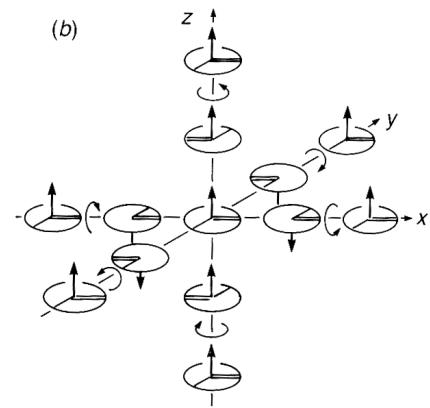
We formally extend the radius of to and define the rotation angle modulo . This texture is called the Shankar monopole, see figure 4.32(a). At first sight it appears that there is a singularity at the origin. Note, however, that the length of is there and it is equivalent to the unit element of SO(3). Figure 4.32(b) describes the triad field. Since as , irrespective of the direction, the space is compactified to . As we scan the whole space, sweeps SO(3) twice and this texture corresponds to class 1 of .
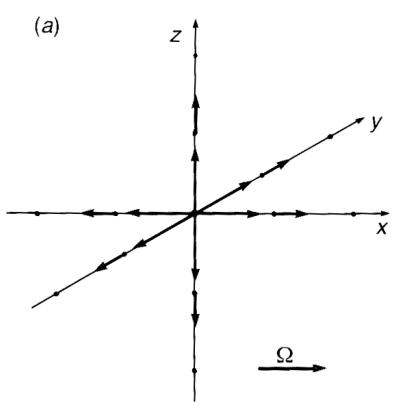
Figure 4.32. The Shankar monopole: (a) shows the ‘vectors’ and (b) shows the triad . Note that as the triad approaches the same configuration.
Sketch the Shankar monopole which belongs to the class of . [You cannot simply reverse the arrows in figure 4.32.]
Consider classical Heisenberg spins defined in , see section 4.8. Suppose spins take the asymptotic value
for the total energy to be finite, see figure 4.20. Show that the extended objects in this system are classified by . Sketch examples of spin configurations for the classes and .
4.1 Show that the -sphere is a deformation retract of punctured Euclidean space . Find a retraction.
4.2 Let be the two-dimensional closed disc and be its boundary. Let be a smooth map. Suppose has no fixed points, namely for any . Consider a semi-line starting at through (this semi-line is always well defined if ). The line crosses the boundary at some point . Then define by . Use and to show that such an does not exist and hence, that must have fixed points. [Hint: Show that if such an existed, and would be of the same homotopy type.] This is the two-dimensional version of the Brouwer fixed-point theorem.
4.3 Construct a map which belongs to the elements 0 and 1 of . See also example 9.9.
Endnotes
Unplaced source note
The name ‘texture’ is, in fact, borrowed from the order-parameter configuration in liquid crystals, see section 4.9.
来源与版本
正文:英文 · OCR 机器稿 · 待校对
核对状态:OCR 机器稿 · 待校对
来源版本:second-edition-local
来源 PDF SHA-256:fcd24c3371d092a8c699ccf5cf0765462924b6c48412804231076e8084b1940d
OCR 来源 SHA-256:0b6324f01172a3548cd34382e82fd8bfae574602b6b2cfaa357ba96bc2c35478
OCR 产物 SHA-256:a65b27e99a4063ef2def7d622b1a51a1acc0ab129ede247fc6f518f22ed09b78