One of the main tools in the study of de Rham cohomology groups is Stokes’ theorem with which most physicists are familiar from electromagnetism. Gauss’ theorem and Stokes’ theorem are treated in a unified manner here.
6.1.1 Preliminary consideration
Let us define an integration of an -form over an -simplex in a Euclidean space. To do this, we need first to define the standard -simplex in where
see figure 6.1. If is a coordinate of , is given by
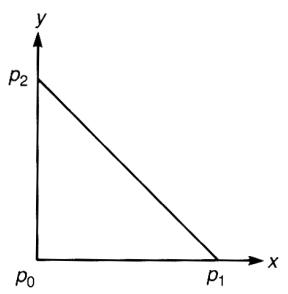
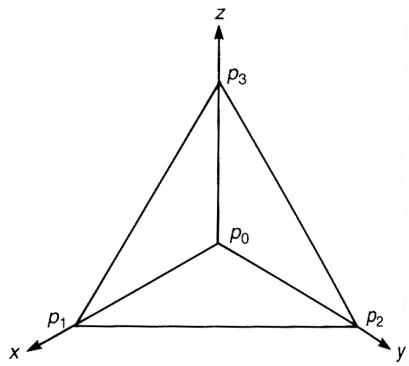
Figure 6.1. The standard 2-simplex and the standard 3-simplex .
An -form (the volume element) in is written as
We define the integration of over by
where the RHS is the usual -fold integration. For example, if and , we have
Next we define an -chain, an -cycle and an -boundary in an -dimensional manifold . Let be an -simplex in and let be a smooth map. [To avoid the subtlety associated with the differentiability of at the boundary of , may be defined over an open subset of , which contains .] Here we assume is not required to have an inverse. For example, may be a point in . We denote the image of in by and call it a (singular) -simplex in . These simplexes are called singular since they do not provide a triangulation of and, moreover, geometrical independence of points makes no sense in a manifold (see section 3.2). If is the set of -simplexes in , we define an -chain in by a formal sum of with -coefficients
In the following, we are concerned with -coefficients only and we omit the explicit quotation of . The -chains in form the chain group . Under , the boundary is also mapped to a subset of . Clearly, is a set of -simplexes in and is called the boundary of
. corresponds to the geometrical boundary of with an induced orientation defined in section 3.3. We have a map
The result of section 3.3 tells us that is nilpotent; .
Cycles and boundaries are defined in exactly the same way as in section 3.3 (note, however, that is replaced by ). If is an -cycle, while if is an -boundary, there exists an -chain such that . The boundary group is the set of -boundaries and the cycle group is the set of -cycles. There are infinitely many singular simplexes which make up and . It follows from that ; cf theorem 3.3. The singular homology group is defined by
With mild topological assumptions, the singular homology group is isomorphic to the corresponding simplicial homology group with -coefficients and we employ the same symbol to denote both of them.
Now we are ready to define an integration of an -form over an -chain in . We first define an integration of on an -simplex of by
where is a smooth map such that . Since is an -form in , the RHS is the usual -fold integral. For a general -chain , we define
6.1.2 Stokes’ theorem
Theorem 6.1 · Stokes' theorem
Let and . Then
Proof
Since is a linear combination of -simplexes, it suffices to prove (6.8) for an -simplex in . Let be a map such that . Then
where (5.75) has been used. We also have
Note that is an -form in . Thus, to prove Stokes’ theorem
it suffices to prove an alternative formula
for an -form in . The most general form of is
Since an integration is distributive, it suffices to prove (6.9b) for . We note that
By direct computation, we find, from (6.2), that
For the boundary of , we have
Note that vanishes when one of is constant. Then it follows that
since on . In fact, most of the faces of do not contribute to the RHS of (6.9b) and we are left with
Since is the standard -simplex ( , ), on which , the second term is
The first term is
where the integral domain has been projected along to the -plane, preserving the orientation. Collecting these results, we have proved (6.9b). [The reader is advised to verify this proof for using figure 6.1.]
Let and . Show that Stokes’ theorem is written as
where and is the boundary of a surface . Similarly, for , show that
where and is the boundary of a volume .
来源与版本
正文:英文 · OCR 机器稿 · 待校对
核对状态:OCR 机器稿 · 待校对
来源版本:second-edition-local
来源 PDF SHA-256:fcd24c3371d092a8c699ccf5cf0765462924b6c48412804231076e8084b1940d
OCR 来源 SHA-256:0b6324f01172a3548cd34382e82fd8bfae574602b6b2cfaa357ba96bc2c35478
OCR 产物 SHA-256:a054cb6e8f2e8ad71c73b88f8b0d5e1caec498beb3f475752400f881ea62a159